Twenty-two cities matter more than the rest. They hold the thrones, the banks, the temples and the wonders, and every adventure passes through at least one of them. Switch on Grand cities on the map to see where they stand.
A city's size is its permanent population. Capitals can be small: Hajhia's queen rules from a tent city, and the Successor-Caliph's court moves with the seasons.
Orcosian Theocracy · capital · 29,000 · port, citadel, walls, plaza
The holy city of the Lion of Light sits on a hill above the river. It is the seat of the Lion-Pontiff and, this year, the most courted city in the world, because every side in the war wants Orcosia's armies, or at least its neutrality.
Districts
Lion Hill, the temple-palace and the Sun Treasury mint where sun-reals are struck. The Glassworks, where white sand from the coast becomes the finest lenses in the world. The River Steps, docks still half-flooded since spring. The Copyists' Quarter, where scribes copy rubbings of Elder inscriptions brought from as far as Qabahrah.
Landmarks
The Lion Gate, whose bronze lions are said to roar when a liar passes. The Sun Treasury. The road north to the Ucillamope Library.
Peoples
Astellian above all. Bretborn scholars, and Hoarfolk kiln-masters in the Glassworks.
Factions
The Sun Temple and its three inner parties. The Orcosian Readers of the Order of the Unread Script. Envoys from Balsozhia, Hajhia, Merland and, secretly, Asraha.
Trouble
One of the Pontiff's confessors is a Successor's Eye. The Pontiff is about to hear the confession of a Hajhian envoy.
Life & lore
Feasts
Lionsday (21 Rocadones) is the city's own: the Lion-Pontiff blesses the sun from Lion Hill, and penitents queue on the hill steps to shout their secrets before noon. Floodwake (1 Ondaria) sends candle-boats off the River Steps. Orcos also keeps Kiln Morning (9 Reaping), when the Glassworks open their furnaces to the public and every child is given a burning-glass.
Daily life
Breakfast is honey-bread and watered wine, bought at the Lion Gate from sellers who shout their prices so nobody can call them secret. Clerks wear white linen with a yellow sun-thread at the cuff. The Glassworks smell of wood-smoke and hot sand, the Copyists' Quarter of ink and vinegar. On the River Steps, still knee-deep since spring, people sell eel fried in honey-vinegar from boats.
Customs
Weddings are held at noon in the open, "in the Lion's eye"; a marriage made indoors after dark is not lawful in Orcos. Bread is handed to a guest in the doorway, never inside. The dead are carried to the River Steps at dusk for Tunarejo, with a sun-real on the tongue for the rich and a honey-cake for everyone else. Whispering in the street is rude.
Folklore
Everyone knows the Lion Gate roars at liars; envoys this year enter by the River Steps instead. Copyists say a rubbing copied by lamplight copies itself wrong. A lens that cracks in the kiln means someone in the house is lying. The proverb painted over the Sun Treasury door reads Ponozos nu jiasarear cafias soa: "a lie does not live in the light."
History
The Grey Sweat (344–349) killed one in five; the plague-pits lie under the Copyists' Quarter, which is why rents there are cheap. In the Honey Years (470s) the lens-grinder Rago of Pasba ground the first reading-lens in the Glassworks, and the Ucillamope Library bought every one he made. The Sun Treasury mint was moved inside Lion Hill in 512, after the Ilbarescian schism.
People
Sabuela of Lierno keeps the Burning-Glass in the Glassworks, where kiln-men drink; she hears every envoy's servant and sells nothing she cannot deny. Saski Hondur, a Hoarfolk kiln-master, wants Orcosian lenses kept out of Merlish cannon-sights. Father Vechejo the Bright, of the Golden Pride, hears confessions on Lion Hill and pays in thin dinars. Rozuna of Nieciera sells "Elder" rubbings in the Copyists' Quarter; half are forged, and she fences stolen ones too.
This year
Every inn is full of envoys, and a private room costs ten times its usual 2 shillings. The Sun Temple says the Comet of Thaw was the Lion's eye turning south. Copyists have been questioned over the Ucillamope theft in Mieles. In Rocadones two Glassborn Strays walked through the Lion Gate, and the bronze lions made no sound at all, which has upset the city more than any comet.
The war
Orcos is "still deciding", so it is full of foreigners paying in four currencies. Hajhian refugees camp below Lion Hill, and grain from the south costs four times its peacetime price. The Sunlancers drill daily on the hill, and boys follow them hoping to be taken. Golden Pride priests spend Balsozhian dinars that the Treasury changers will only take at 0.7.
Market & law
The sun-real (1.1 crowns) is struck on Lion Hill, and refusing one is an insult to Rocadones. A reading-lens costs 3 sun-reals, a burning-glass 4 shillings, a copied rubbing 2 shillings. The Sun Treasury keeps gold for a tithe of a tenth. Crimes are punished by confession and penance at noon, with fines to the Treasury; necromancers are burned at noon "so the Lion sees".
Healing
The Sun Temple heals for 5 shillings a wound, and its priests are among the best on the continent. Glassworkers suffer kiln-eye, a slow clouding of the sight, which the temple treats with honey drops and Ucillamope physicians (2 shillings) treat with rest in a dark room. Any healing said to "borrow from the dead" is treated as necromancy and sent to the noon fire.
Adventure seed. Rozuna of Nieciera is offering a rubbing she swears is the one stolen from the Ucillamope Library. Three envoys want it, and the Lion Gate has started roaring again.
Orcosian Theocracy · 36,000 · port, citadel, walls, temple · largest city on the Flokburgh Continent
The City of a Thousand Bells is richer and louder than the capital, and resents being ruled by priests. Every guild hangs a bell, and every bell rings at a different hour.
Districts
The Bell Market, the busiest market in the west. The Tanneries, downwind and unloved. The Old Walls, built on Elder foundations with inscriptions in the stonework. Ondaria's Steps, the flood-goddess's temple at the waterfront.
Peoples
Astellian, Tallian caravan families, a Kettlekin balloon yard, and Rhunari bodyguards hired from the south.
Factions
The Bell Guild, a council of merchants who want a charter of freedom from the Pontiff. Ilbarescian agents stirring them on.
Trouble
The Bell Guild has asked Merland for a loan to raise its own militia. Calloway & Daughters is considering it.
Life & lore
Feasts
Floodwake (1 Ondaria) is bigger here than anywhere: the priestesses of Ondaria's Steps launch a thousand candle-boats and the guilds race barges for the flood-goddess's ribbon. On the Ringing (19 Uxbridmanch), the anniversary of the Great Fire, every bell in the city sounds at once, the only time in the year they agree. The Kettlekin balloon yard keeps Kettlemoot (12 Haymonth) noisily.
Daily life
The Bell Market sells chickpea fritters wrapped in vine leaves (1 penny) and Tallian camel-milk cheese. Workmen wear leather caps stamped with their guild's bell. Houses in the newer quarters are brick, built after 772; the Old Walls quarter is stone. Something is always ringing, and the Tanneries, downwind, smell of lime and dog dung whichever way the wind blows.
Customs
Apprentices are bound by tying a thread from their master's bell-rope round the wrist. A married couple ring their guild's bell together, and a wrong note is a bad omen. At a funeral the bell is struck once for each year of the dead person's life, at a penny a stroke. It is unlucky to stand under a bell when it is rung for someone else.
Folklore
The Saddlers' bell is said to have rung by itself the night before the Great Fire, and nobody will hang a new rope on it. Touching the Elder inscriptions in the Old Walls is thought to bring luck in trade, so the lowest glyphs are worn smooth. People say "every bell rings at a different hour" of a council that cannot agree.
History
The Great Fire of 772 began in the Tanneries and burned a third of the city in two days. The guilds, not the Pontiff, paid for the rebuilding, and each hung a new bell to prove it. The Bell Guild was founded the next year from the men who had paid, and it has been asking for its charter of freedom ever since.
People
Livaral of Vovien, Master of the Bell Guild, wants a charter and a militia and will pay adventurers to carry letters to Shifton. Nardesa Long-Camel runs the biggest Tallian caravan yard and owes a song to half the city. Mother Ayuela of Pelón keeps Ondaria's Steps and hates the Bell Guild's ledgers. Dibbit Ropeburner, a Kettlekin in the balloon yard, fences anything small enough to fly out.
This year
Calloway & Daughters is weighing the Bell Guild's loan, and Merlish clerks have been seen measuring the Old Walls. Ilbarescian agents are paying apprentices to ring bells at the wrong hours, which annoys everyone and proves nothing. The Mantena flood sent hundreds of river families downstream, and they sleep on Ondaria's Steps.
The war
Bustogollo grows rich on the war it is not fighting: Merlish, Balsozhian and Hajhian buyers bid against each other for leather, rope and saddles in the Bell Market. Rhunari bodyguards cost twice what they did in spring. Grain prices in the south are four times their peacetime level, and the Bell Guild blames the Pontiff for it.
Market & law
Prices are posted in sun-reals and Merlish pennies. A good saddle costs 2 sun-reals, a guild bell-cast 300. Every guild pays a bell-tax to Lion Hill, and the Bell Guild says that is the whole quarrel. Ringing a bell out of its hour is fined 5 shillings, and selling short weight earns a noon penance in the Bell Market.
Healing
Tanners suffer lime-hand, cracked and bleeding skin, treated with goose fat sold on Ondaria's Steps. The priestesses there specialise in the half-drowned and charge 3 shillings, less than the Sun Temple. Marsh ague comes up the river in Ondaria; willow-bark costs a penny a twist and Utturi bark 1 shilling a dose.
Adventure seed. The Saddlers' bell rang by itself last night. Nardesa Long-Camel says it means fire, and someone has been buying lamp-oil by the barrel in the Tanneries.
Republic of Merland · capital · 18,300 · port, citadel, walls, plaza
Not the biggest city in Merland, but the one that counts. The Moot sits here, and so does the money. A letter of credit written in Shifton is honoured in every port of both continents.
Districts
The Towers, the Counting-Towers of the great banks, one of the wonders of the world. Moot Square, where the Fifty meet and a crowd always waits for news. The Ropewalks, the shipyards. Lantern Row, where the Quiet Hands keep their dens behind honest shopfronts.
Landmarks
The Moot Hall. Shifton Mast, the sky-dock tower at the end of the Kamiechia sky-lane.
Peoples
Angshire. Kettlekin sky-crews at the Mast. Hoarfolk factors of the Powder Moot, who are suddenly unwelcome.
Factions
The war party and the peace party of the Moot. Calloway & Daughters. The Quiet Hands. An embassy from Kushi that everyone watches.
Trouble
The Moot is debating whether to seize the Powder Moot's warehouses in revenge for the cannon sold to Balsozhia.
Life & lore
Feasts
Gatefair (1–3 Haymonth) is happening now: the city's boundary stones are walked and beaten, the gates are hung with ribbon and tolls are waived for three days. Forgefire (1 Uxbridmanch) is when the Moot's contracts are renewed in Moot Square. Shifton also keeps Vane Day (12 Isgard), when the Counting-Towers' brass scales are oiled and the city bets on which will turn first.
Daily life
Clerks eat hot pease-pudding and a herring on bread from barrows in Moot Square (2 pennies) and read the Shifton Weathervane standing up. Respectable people wear dark wool and a brass ledger-pin. The Ropewalks smell of tar and hemp; Lantern Row of lamp-oil and pies. Bankers cross between the Towers by the fifth-storey bridges and are seldom seen in the street.
Customs
A Shifton marriage is a written contract, signed at the Anvil and witnessed by two burgesses' clerks; love is an optional clause. Children are given a penny struck in their birth year to keep for life. The dead are buried with their account books closed, and an unpaid debt is read aloud at the grave. Haggling over an agreed price is a grave rudeness.
Folklore
When the brass scale on a Counting-Tower tips without wind, sell everything. The Roof-Runners' song Seven Towers and a Ladder is banned in the Moot and sung in every tavern. Merchants say "a struck coin and an unstruck tale": trust what is weighed. Knocking twice, pausing, then once on any door is said to bring the Quiet Hands, or bad luck.
History
The Counting-Towers were built between 640 and 702, and Calloway & Daughters, founded by Josiah Calloway in 701, was the first house to fill a vault. The Shifton Standard was declared here in 712. In 744 Kettlekin built the press that printed the first broadsheet, the Shifton Weathervane. The Towers robbery has no date anyone agrees on.
People
Martha Penhallow keeps the Scale and Feather on Moot Square, where burgesses' clerks drink and trade rumours by the pint. Father Aldous Wren, a Bellows priest of the Anvil, arranges loans to both sides of the war. Silas Coombe runs a pawnshop on Lantern Row and fences for the Quiet Hands at a third of value. Gravdal Thurn, factor of the Powder Moot, is packing quietly.
This year
The Moot is debating whether to seize the Powder Moot's warehouses, and Hoarfolk in the street are jostled. The Kushi embassy has hired the whole top floor of the Scale and Feather. Broadsheet astrologers are still selling Comet of Thaw horoscopes at 1 penny. A Tower scale tipped on a still night in Rocadones, and the Weathervane printed it.
The war
Broadsheets print casualty lists every Smithsday, and crowds wait in Moot Square for them. The war tax is now one part in fifteen. Calloway & Daughters lends heavily to Queen Dorottya, so half the city's savings ride on Hajhia. Hajhian refugees sell steppe groats on the quays at a loss, and the Ledger House has never been fuller.
Market & law
Everything here is priced in crowns and pennies. A letter of credit costs 1% to write and needs its countersign. Debtors go to the Ledger House; thieves are branded with a T on a second offence; forging a letter of credit or the crown is a hanging matter. A sky-passage from Shifton Mast to Kamiechia costs 9 crowns.
Healing
The Thetletown Church's hospital by the Ropewalks treats sailors and rope-workers for nothing on Smithsdays. Ucillamope-trained physicians charge 2 shillings and keep shops in Moot Square. Pox comes in by sea every few years, and Tsuruma physicians from the Kushi embassy now offer variolation at 1 crown a child.
Adventure seed. Silas Coombe will buy a forged countersign for any Calloway letter. Someone has offered him the countersign for the Queen of Hajhia's account.
Republic of Merland · 27,700 · citadel, walls · largest Merlish city
The workshop of the Republic: coal smoke, foundry noise and hiring halls. Shifton lends the money, and Macham makes the things it is spent on.
Districts
The Scales, where the Guild of the Scales weighs coin and sets the Shifton Standard. The Hiring Halls, where mercenary captains sign anyone who can hold a sword, at 2 shillings a day. The Foundry Ward, which casts Merlish cannon under a Hoarfolk licence. The Coal Gate, where carts arrive from the Mavehambe mines.
Peoples
Angshire. Hoarfolk founders. Kettlekin mechanics. Rhunari in the hiring halls.
Factions
The Guild of the Scales. The Foundry masters, who would love the Hoarfolk licence to lapse. The Kettlekin Workshop Moot.
Trouble
A Kettlekin foreman has built a cannon that does not need the Hoarfolk design, and both the Powder Moot and the Quiet Hands want it.
Life & lore
Feasts
Forgefire (1 Uxbridmanch) is Macham's great day: every furnace in the Foundry Ward is relit from the Anvil's flame, apprentices are bound in the Hiring Halls and the Guild of the Scales weighs the year's first crown. Kettlemoot (12 Haymonth) is loud in the Kettlekin workshops. Coal Gate Night (30 Hofjor) honours miners killed at Mavehambe with lamps on every cart.
Daily life
Foundrymen eat mutton pasties with a knot of crust to hold in a black hand (1 penny), and drink small beer by the quart. Coal smoke hangs over the Foundry Ward, and laundry is never white. Workers wear leather aprons and clogs; Kettlekin wear goggles pushed up on their foreheads. Hammers start at the sixth bell and stop only on Smithsday.
Customs
Founders marry on a casting day, and the couple pour a ladle together; a cracked casting means the match is bad. An apprentice's first wage is spent on a round for the whole shop. The dead are buried with a coin from the Scales in each hand. Nobody in the Foundry Ward whistles indoors, because the Kettlekin say it is a prayer.
Folklore
Miners at the Coal Gate say the Rust-Man walks the carts at night and leaves orange handprints, and they count the cart-nails every morning. Foundrymen tell of the Bell That Would Not Pour, a gun cast in 760 that cracked three times until a Hoarfolk founder spat in the mould. The Scales' motto: "every crown weeps in the end."
History
The Guild of the Scales was chartered in 712 to set the Shifton Standard, and Macham, not Shifton, has weighed every crown since. The Hoarfolk licence to cast cannon was signed in 748 for ninety-nine years less a day, and every founder can tell you when it lapses. The Kettle-Fort was begun in 831 and has sat in its shed since.
People
Joan Tolley keeps the Ladle and Tongs by the Foundry Ward gate and lends rooms to anyone the mercenary captains have signed. Master Weigher Hugh Allard of the Guild of the Scales wants the Paper Men silenced. Teggap Gearbiter, the Kettlekin foreman with the new cannon, has gone into hiding. Ned Rafe fences scrap brass and stolen drawings at the Coal Gate.
This year
Teggap Gearbiter's cannon, which does not need the Hoarfolk design, has vanished with its maker, and both the Powder Moot and the Quiet Hands are asking after it. The Moot argues every month about finishing the Kettle-Fort. Orange handprints have been found on two cannon in the Foundry Ward.
The war
The Hiring Halls sign anyone who can hold a sword at 2 shillings a day, and Rhunari queue with farm boys. Wages in the Foundry Ward have doubled. Rust-saboteurs salted three barrels this spring, so every gun is now guarded. Women have taken half the jobs at the Coal Gate, and the carters' guild is still arguing about it.
Market & law
Macham sells cannon at 1,500 crowns to licensed buyers, hand-gonnes at 6 crowns, and coal at 4 pennies a hundredweight. Short-weighting a coin before the Scales means a hanging if it is counterfeit and a fine of ten times the weight if it is clipped. Selling cannon to an unlicensed buyer is treason.
Healing
Coal miners and founders get grey lung, which has no cure; the Guild pays a retired miner 2 pennies a day. Burns are dressed with lime-water and linseed oil at the Thetletown Church's foundry hospital. Barber-surgeons in the Hiring Halls set bones for 6 pennies and pull teeth for 2.
Adventure seed. Joan Tolley has a lodger who never leaves his room, works by night, and pays in Kettlekin cogs. His window smells of thunder-salt.
Principality of Ortonzania · capital · 23,800 · port, citadel, walls, temple, plaza
Prince Godric's capital, with the strongest fleet on the Flokburgh Continent in its harbour. The city's name is shared by a necropolis in the Qabahran desert, a fact Shifracters find either thrilling or obscene.
Districts
The Prince's Rock, the citadel. The Admiralty Yards. The Anvil Temple of the Thetletown Church. The Quiet Quarter of Soumi traders, who worship the Silent War.
Peoples
Angshire, Soumi, and a small community of Bretborn exiles nobody discusses.
Factions
The Prince's court. The Admiralty. The Ashworth Circle, rumoured to meet under the Prince's Rock.
Trouble
The Prince is outfitting a ship for Qabahrah under sealed orders.
Life & lore
Feasts
The Long Silence (20 Thaw) empties the Quiet Quarter's streets and half the city's; Soumi traders settle disputes by staring contests on the Admiralty steps at sunset. Gatefair (1–3 Haymonth) belongs to the Angshire quarters, and the Gatemules hold their own procession. On Launching Day (1 Mieles) a new hull leaves the Admiralty Yards and the Prince breaks a honeycomb on her bow.
Daily life
Sailors eat salt cod stew with honey-bread and drink cider from Midmanch. The Quiet Quarter is hushed, with shop signs painted instead of called. The Admiralty Yards smell of tar, oak and pitch. Officers wear blue coats with brass anchors; Soumi wear grey and speak last. Gulls and caulking hammers are the city's two sounds.
Customs
Angshire couples marry at the Anvil Temple; Soumi couples marry by sitting silent together for a whole day. Sailors lost at sea are given an empty grave with an oar on it. Since spring, families sit up with the dead for three nights before burial and nail the coffin shut. It is unlucky to say "Winedihul" aboard a ship.
Folklore
Children sing Down the Midmanch Road to count skipping-rope turns: "One for the rider, two for his crown, three for the dead men walking to town." Sailors say the Prince's Rock is hollow to the sea. The Soumi saying painted over the Quiet Quarter gate reads Sululo jashe on puhai: "the silent man is strong."
History
Shifract's harbour was dredged in 655 with some of the first Hoarfolk powder sold outside a hold. The Anvil Temple was rebuilt in stone after the Merlish burned it in the war of 459–463. The Quiet Quarter was granted to Soumi traders in 671, after the failed Valsiarian Rebellion, as part of the peace.
People
Bess Marlow keeps the Anchor and Comb by the Admiralty Yards and finds crews for captains who ask no questions. Brother Oswin Thatch, of the Rust-Watch, preaches at the Anvil Temple and keeps a list of names. Saanu Mertala, a Soumi silver-trader, holds the Quiet Quarter's purse. Kit Halloran smuggles for the Gatemules and fences in the harbour.
This year
The Prince is outfitting a ship under sealed orders, and its crew is being signed for double pay and no destination. Fresh graves in the Litta churchyard have been found empty, and the Hollow Legion has been seen on the Midmanch road. The Bretborn exiles have closed their doors since the Rust-Watch began asking questions.
The war
Mercenary captains recruit in Shifract at 2 shillings a day, and the Admiralty has impressed fishing boats as scouts. The fleet guards the northern sea against Ritata and Kushi. Ship's biscuit is rationed for civilians, and the Soumi refuse to fight, which the Angshire quarters resent loudly and the Soumi ignore quietly.
Market & law
Crowns are the coin; elephant marks pass in the Quiet Quarter. A ship's passage to Shifton costs 1 shilling a day. Smuggling past customs is fined at the cargo's value, and the Gatemules pay it as a cost of business. Grave-robbing is now a hanging matter. Soumi traders forbid interest and lend by profit-sharing.
Healing
The Anvil Temple heals for 5 shillings a wound. Sailors catch pox in the harbour taverns and scurvy on long patrols, treated with sauerkraut and Kushi lime-pickle. Since spring, a bite from a walking corpse is cauterised at once. Bretborn exiles are said to heal with marrow-salt in the Quiet Quarter at night.
Adventure seed. Bess Marlow is signing crew for the Prince's sealed ship. One of her recruits came back from Litta last month, and he does not breathe when he sleeps.
Protectorate of Kovavikia · capital · 33,200 · citadel, walls, temple, plaza · largest city in the north
The fur capital of the taiga, conquered by Raugaria only last year. The Theocracy's banners fly from the citadel; the Kjelheim faith still burns in the old temple.
Districts
The Rib Temple, built around a white bone as long as a ship, which Kjelheimers say is a rib of the Worm. The Fur Market. The Garrison. The Sledge Gate, from which roads close for four months a year.
Peoples
Norse. Woolly Rhunari traders from the steppe. Hoarfolk come down from the Hoarspine to trade.
Factions
Jarl-Protector Ulfar's puppet court. The Raugarian garrison. Kjelheim priests feeding the insurrection.
Trouble
The Rib Temple's bone has begun to grow frost on the hottest days.
Life & lore
Feasts
Wormwake Eve (6 Rostovund) is the city's great night: Kjelheimers pour mead into cracks at the Rib Temple "so the Father sleeps", while the garrison tries to stop them. The Shedding (10 Hofjor) is kept by the Raugarian garrison alone. On Sledge Night (1 Isgard) the Sledge Gate is closed with a feast, and roads stay shut until Thaw.
Daily life
Gogur eats smoked elk, rye porridge and cloudberry jam, washed down with birch beer. Houses are log-built and sunk half underground for warmth. In the Fur Market, sable and wolverine pelts hang in rows, and the air smells of tallow and pine-tar. Everyone wears felt boots and a fur hat; the garrison's grey uniforms are mocked by children.
Customs
Kjelheim couples marry before the Rib Temple's bone, touching it together. Children are named on their first winter's night. The dead are buried in winter only in the frozen ground near the Sledge Gate; summer dead are smoked and kept until it freezes. It is taboo to dig deeper than a man's height without a priest's leave.
Folklore
Kjelheimers say the white bone in the Rib Temple is a rib of the Worm and grows when it dreams. A frost on the bone in summer means the Worm turns over. Mothers warn: "Dig too deep and the Father bites." The Fur Market's proverb, in Fjallic, is Som fåk bigryrelin pistbe renin burdpø: "snow hides the road, but the wolf finds it."
History
The Rib Temple was built around the bone in about 300 by Kjelheim priests who found it in a riverbank. The Long Winter of 525 killed a third of Kovavikia, and Gogur's walls were built to keep wolves, not soldiers, out. The Fur Market was licensed by Kovavikia's old jarls in 610.
People
Kerska Vordottir keeps the Wolverine's Head by the Fur Market and serves birch beer to garrison officers she would gladly poison. Fennik Dalsson, the Rib Temple's old priest, hides Kjelheim rebels under the floor. Saski Kumdis, a Hoarfolk fur-trader, wants the Hoarspine roads open. Grem Tolvsson, a fur-buyer, fences garrison stores.
This year
The Rib Temple's bone grows frost on the hottest days, and the Raugarian priests want it guarded. A wolverine migration is moving through the forests near Hofjor, and trappers say they have never seen so many. Someone keeps cutting the Worm's rune into the bone at night, and the garrison has not caught them.
The war
Gogur was conquered only last year, and Raugaria's banners fly over a city that hates them. The garrison takes young men for the war in Hajhia; the Kjelheim insurrection takes the rest. Fur prices are down because the Hoarspine passes are shut. Jarl-Protector Ulfar's puppet court is laughed at in every tavern.
Market & law
Payment is in hacksilver: an ounce is worth a crown. A sable pelt costs 3 crowns, a wolverine 2, a fur cloak 2. Theft from the Fur Market is punished by turning out into the taiga in winter. Raugarian priests mistrust stamped coin, but they take it. Smuggling over the glacier costs 5 crowns a head.
Healing
Winter-black (frostbite) is treated with elk-fat and snow-rub by herb-wives, though the Norse know it is wrong; amputations are done in the Garrison by Raugarian surgeons. Kjelheim priests at the Rib Temple heal free for anyone who will pour an offering. Temple healing from the Raugarian priests costs 5 shillings a wound.
Adventure seed. Fennik Dalsson will pay in hacksilver to have the Rib Temple watched one night. He thinks the rune-cutters are his own priests.
Raugarian Theocracy · capital · 7,300 · port, citadel, walls
A small holy city of hunters at the head of a rain-dark inlet, ruled by priests who believe walls are a sin, though they have built some anyway.
Districts
The Cathedral Close around the Antler Cathedral, one of the wonders of the world. The Kennels of the Hunt. The Longship Harbour. The Penner's Gate, where once a year every prisoner in the Theocracy is set loose to be hunted or to escape.
Peoples
Norse, and Mistwood Bretborn who come to trade maps and rifles.
Factions
The High Huntress's loyalists, the zealots of the Wild Hunt, and the old Kjelheim families.
Trouble
The insurgents have promised to free this year's prisoners themselves.
Life & lore
Feasts
The Shedding (10 Hofjor) is the city's holiest day: antlers are gathered in the Cathedral Close, and the year's holy hunts are drawn by lot. The Loosing (30 Ondaria) opens the Penner's Gate, and every prisoner in the Theocracy runs into the forest with a day's start. On Longship Night (21 Rocadones) the harbour boats are lit and raced.
Daily life
Fagervik eats venison, rye bread and smoked herring, and drinks lingonberry ale. Hunters wear green-dyed leather and carry longbows even to market. Rain falls through the Antler Cathedral's roof and dribbles into the Close. The Kennels of the Hunt howl at dawn. Houses are timber, with doors that are never locked, because locks are the Penner's tools.
Customs
Couples marry in the Antler Cathedral, standing in the rain together. A child's first hunt, at twelve, is their coming of age. The dead are laid out in the forest for the wild beasts, then their bones are gathered and buried. Locking a door is a sin, and caging a songbird is a crime.
Folklore
When a living stag walks into the cathedral nave, a new High Huntress will be chosen. Children sing The Penner's Key, about a gaoler who locked himself in his own cell. The proverb carved over the Kennels reads Renin er flytbrøn trulo banutåld: "the wolf in a house is a dog." A white hound born in the Kennels is a sign of war.
History
The Antler Cathedral was built between 680 and 760 over a shrine raised in 402. The walls, built in 744 after the Raiders' Winter, were blessed as "fences against wolves", not walls. The Penner's Gate was cut in 600, when the first Loosing was held.
People
Krarha Hvinsdottir keeps the Running Hart near the harbour and boards Mistwood Bretborn who come to trade maps. Huntsman-Priest Resto Pekråmsson of the Wild Hunt leads the Kennels and wants war on Orcosia. Tir ith Veth, a Mistwood Bretborn, sells rifles to anyone the Theocracy has not caught. Hvenust Tosusson buys stolen silver at the Longship Harbour.
This year
The insurgents have promised to free this year's prisoners themselves before the Loosing. The Antler Cathedral has a stag's track in its nave, and nobody saw the stag. The longship crews of Kogenda ignore Fagervik's orders, so the harbour is half empty.
The war
Raugaria has sent its longbow regiments east, and Fagervik's hunters have gone with them. The Kjelheim insurrection makes the forest roads unsafe. Wetland villages say the Huntress takes their sons and the rebels feed their daughters. Thunder-salt is too dear for hunters, who prefer bows anyway.
Market & law
Payment is in hacksilver, weighed on the Close's scales; an ounce is a crown. A longbow costs 1 crown, a Mistwood sparklock 800 crowns, when one is sold at all, a map of the Bliksberg 2 crowns. There are no prisons: the guilty wait for the Loosing in the Kennel pens. Hunting in the Bliksberg without leave is death. Slavery is the worst crime.
Healing
Hunter-priests heal with moss poultices and blood-letting, and charge 5 shillings a wound at the cathedral. Marsh ague comes up from the wetlands; willow-bark is free at the cathedral door. Hunters gored by elk are treated by the Kennel surgeons, who also treat the hounds and charge the same.
Adventure seed. Krarha Hvinsdottir is hiding a Mistwood Bretborn who claims to know which prisoners the insurgents plan to free first, and why one of them matters.
Balsozhian Empire · capital · 14,800 · port, citadel, walls, plaza
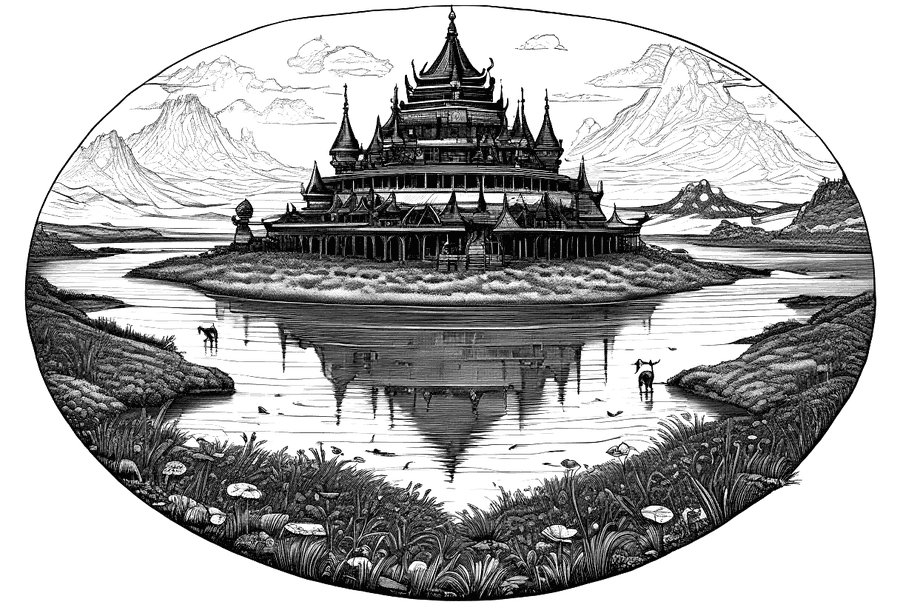
The lake capital of the horse-lords. For most of the year it is a modest city around a palace on an island. At midsummer a hundred thousand riders camp around it, and it becomes the largest city in the world for a month.
Districts
The Lake Palace, one of the wonders of the world. The Tent Ring, the clan camping-grounds. The Dinar Mint, where the coin is being thinned to pay for the war. The North Harbour, ice-bound in winter, from which ships sail to Ritata.
Peoples
Vengrian. Grey Wall Rhunari in imperial pay. Hoarfolk gunners of the Open Forge. Tsuruma envoys from Ritata.
Factions
The horse-lords, who despise guns. The Emperor's new gunners. The Mint-masters, who know exactly how poor the empire is.
Trouble
The Hoarfolk cannon have arrived and need an escort south. The horse-lords refuse to guard them.
Life & lore
Feasts
The Midsummer Gathering is ending now: for all of Rocadones a hundred thousand riders camped in the Tent Ring, and the last clans are breaking camp in early Haymonth. Breakice (1 Thaw) launches the Emperor's barge from the North Harbour. The Sitting of Snow (15 Longnight) fills the Tent Ring with clan campfires and horse-ancestor stories.
Daily life
Balsozhans eat mutton, millet and mare's-milk curd, and drink fermented mare's milk. The Tent Ring smells of horse dung and smoke for a month a year, and of nothing for the rest. Riders wear felt coats and fox-fur hats. The Lake Palace causeway is wide enough for forty riders abreast and is never empty.
Customs
Oaths are sworn outdoors, under the Severe Virgin's sky, and a promise made indoors means nothing. Couples marry on horseback. The dead are buried with their horse's bridle, and a horse is killed only in mercy. A guest is sacred: harming one is the worst sin. Swearing in a house is taboo.
Folklore
Every beam in the Hall of Ten Thousand Horses has a horse carved on it for a warrior who died, and people say the horses neigh on the night before a battle. Children learn Tólócs ígyer muka csodor: "a broken oath is a dead horse." A white mare foaled in the Tent Ring is a sign of a new emperor.
History
The Lake Palace was built between 590 and 655 after the Hajhian Campaign. The Dinar Mint was founded in 640, and its coin was worth 1.2 crowns until this year. The North Harbour froze solid in the Year of Two Winters (817) and three ships were crushed.
People
Tétta Mász keeps the Grey Mare on the causeway, the only inn the horse-lords drink at, and listens to both sides. Laszolt Kász, a clerk at the Dinar Mint, knows exactly how thin the dinar is and is selling the secret. Zekila Böglenc, a shaman, rides in trance for the Emperor's war council. Nér Kory fences army horses at the Tent Ring.
This year
The Hoarfolk cannon have arrived and need an escort south, and the horse-lords refuse to guard them. Bread riots broke out in Rocadones over the thinned dinar. The Emperor has ordered a new beam carved for every rider lost this year, and the carvers are running out of oak.
The war
Press-gangs work the river towns, and young men hide in the reed-beds. The Emperor thins the dinar to pay for the war, and bread costs three times what it did. Hoarfolk gunners of the Open Forge drink in the North Harbour, and the horse-lords spit at them. Tetmik Spiders now raid army supply trains.
Market & law
The horse-dinar is worth 0.7 crowns, and changers weigh every one. A riding horse costs 17 dinars, a mare's milk skin 1 penny. Horse-thieves are dragged behind their stolen horse. Oath-breakers are "given to the wind" and may be killed by anyone. A weeping dinar is called a "wind-coin".
Healing
Shamans heal by riding in trance to the Severe Virgin's tent, and charge in horses. The Thetletown Church's hospital in the Lake Palace treats officers for 5 shillings a wound. Riders get saddle-sores and broken collarbones; bone-setters in the Tent Ring set them for a skin of mare's milk. Wounded riders are sent to the Satorbapios Springs.
Adventure seed. Laszolt Kász will sell the true weight of the dinar to the highest bidder. The Torkburgh Lanterns want it, and so do the Emperor's own spies.
Principality of Valsiaria · capital · 19,800 · port, citadel, walls, plaza
A quiet city by Soumi custom. On holy days the whole city is silent from dawn to dusk, and a shout can earn a fine. This year the silence is broken nightly by Manttamite street-preachers.
Districts
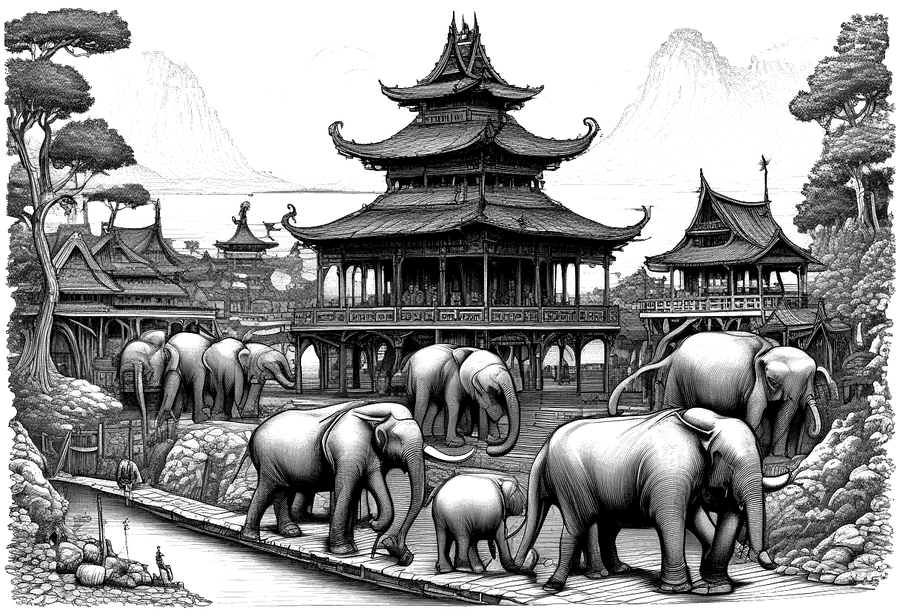
The Royal Stables, home to two hundred war elephants. The Quiet Temples. The Market of Marks, where Saski silver is coined. The Harbour, where Kushi ships unload.
Peoples
Soumi. Kettlekin from the nearby coast. Hoarfolk of Saski Hold.
Factions
Princess Emese's peace salon. The Manttamite crusade. The Silent Church.
Trouble
The Princess has received a letter from her brother, the Emperor. She has not opened it.
Life & lore
Feasts
The Long Silence (20 Thaw) is kept here more strictly than anywhere: the whole city is silent from dawn to dusk, and the Quiet Temples settle the year's disputes by staring contests at sunset. The Silent Days (10th, 20th and 30th of each month) close the Market of Marks. On Tusk Morning (1 Reaping) the Royal Stables' two hundred elephants walk to the Harbour to bathe.
Daily life
Valsiarians eat river fish baked in clay, barley flatbread and forest honey, and drink birch-sap wine. Clothes are undyed grey linen or wool; colour is thought loud. Houses are timber with mossed roofs. The city's sounds are elephants, rain and the Manttamite drums after dark. The Market of Marks smells of hot silver from the coining-house.
Customs
Courtship is silent: a suitor sits outside the family's door for three evenings, and is accepted when the father sits beside him. Weddings are a day of shared silence. The dead are wrapped in grey and buried at the forest's edge without speeches. Speaking first to an elder is a grave rudeness, and so is a raised voice anywhere.
Folklore
It is said the first Prince of Valsiaria won his throne by out-staring a war elephant. A dropped coin in the Market of Marks is left on the ground until a Silent Day, when the poor may take it. The Quiet Temples' saying is Paruulull sunanut on vuusu: "loud words are small." Children are told that Manttamites have no tongues, only drums.
History
The Market of Marks first struck elephant marks from Saski silver in 590, during the conquest of Igyoszavas. The Royal Stables were built in 612, when Prince Aarno I had the first wild herd driven in from the southern forests and the druids cursed him for it. In 702 a fire in the Quiet Temples burned for a day, and nobody raised the alarm until sunset.
People
Puy Vijonen keeps the Grey Lamp near the Harbour and lets rooms to Kushi sailors who pay in strings of cash. Sister Hiiva Puolanen of the Silent Church judges staring contests and has never lost. Jypyn Loniluunen, a Reconciler preacher, wants the two churches reunited and needs protection. Vuhiiny Pumahanen fences ivory for the Tulpio Tigers in the Harbour.
This year
Manttamite street-preachers break the silence every night, and the city watch fines them 2 elephant marks a shout. The Princess has received a letter from her brother, the Emperor, and has not opened it; the whole city is betting on what it says. Grey-green lichen has been seen on a beggar at the Harbour.
The war
Valsiaria refuses to fight, and Manttamite crusaders march through it with banners and drums. Princess Emese's peace salon meets at the palace, and envoys from both alliances queue outside. Grain is dear because the Dearth has reached the southern vassals. Balsozhian recruiters are fined for speaking in the Market of Marks.
Market & law
The elephant mark (0.15 crowns) is coined here. A war elephant costs 400 crowns, a silver ring 2 marks. Lending at interest is forbidden: merchants share profits instead. Disputes go to a staring contest before a silent judge; fines are paid in silence. Exile is the worst sentence. Killing an elephant is a capital crime.
Healing
The Quiet Temples heal for 5 shillings a wound, in silence. Marsh ague comes up from Kaporesia with the ships; Utturi bark costs 1 shilling a dose in the Harbour. The Bloom has reached the city's edge, and the temple burns the first spots with a hot iron. Druids in the forest heal with honey and blood at the roots of trees.
Adventure seed. Sister Hiiva Puolanen has been challenged to a staring contest by a Manttamite preacher. If she loses, the Loud say, the Silent Church must open its doors to them.
Kingdom of Hajhia · capital · 4,500 permanent · port, citadel, walls, plaza
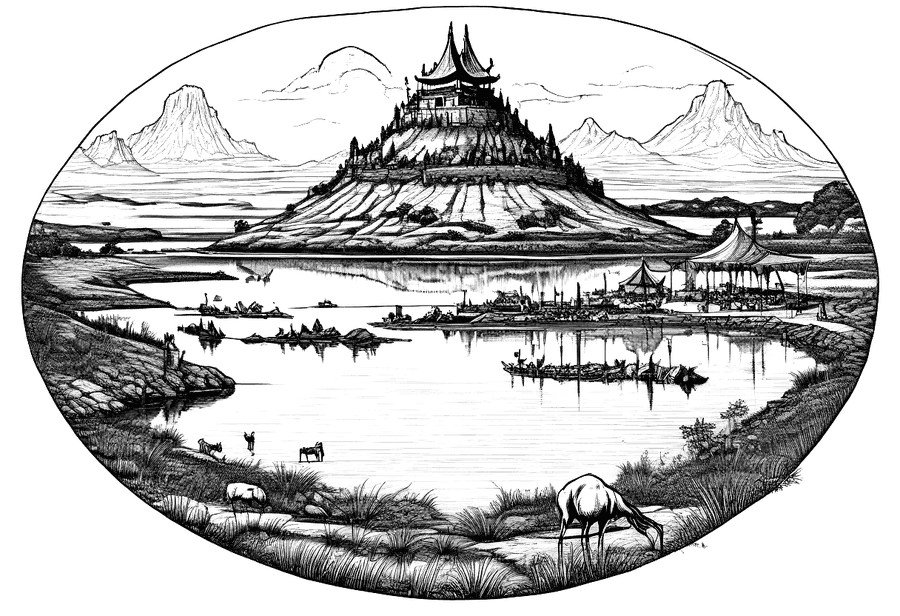
A small stone core beside a lake, surrounded by a tent city that can hold a nation. This year the tents are full of refugees from the north, and the Queen sleeps in none of them.
Districts
The Stone Ring, the citadel and the royal treasury. The Tent Sea, now a refugee camp of a hundred thousand. The Lake Shore, where Tallian caravans water their camels.
Peoples
Vengrian. Tallian. Woolly Rhunari of the clans sworn to the Queen.
Factions
The Queen's riders. The old nobility, some of whom think Zsolt's claim is better. Merlish envoys with Calloway gold.
Trouble
The walls of the Stone Ring were built against horse-archers, not cannon.
Life & lore
Feasts
The Sitting of Snow (15 Longnight) fills the Tent Sea with clan fires, oaths renewed under the open sky and horse-ancestor stories for three nights. Hornday (20 Tunarejo) is kept by the woolly Rhunari on the Lake Shore. Queen's Ride (1 Mieles), the anniversary of Dorottya's crowning in 833, is kept this year with a parade of the Queen's Wings.
Daily life
Erencszasz eats mutton stew, millet cakes and sheep's cheese, and drinks fermented mare's milk. The Tent Sea is felt tents in rows, mud between them and smoke over all. Riders wear sheepskin coats; refugees wear whatever they fled in. The Lake Shore smells of camels, and the Stone Ring of sweat and fresh earth.
Customs
Oaths are made outdoors, under the Severe Virgin's sky. Weddings are on horseback, and the bride's family rides away with her saddle. The dead are buried on the steppe with their horse's bridle and the grave is ridden over until the grass hides it. Harming a guest is the worst sin, and every refugee is a guest.
Folklore
The Queen has sworn not to sleep under a roof until the invaders are gone, and children say her tent moves every night so the Emperor's dreams cannot find it. The proverb chalked on the Stone Ring's gate is Hitin zügest gipegy zhaza bösz baj: "the grass forgets the fire, but the earth remembers." Seeing an eagle over the lake means victory.
History
The Stone Ring was built in 584, during the Hajhian Campaign, against horse-archers. It held in 590 against a Balsozhian siege of eleven weeks. The Tallian caravans first camped on the Lake Shore in about 400, and the city's market still keeps their law: whoever tells the best story pays nothing at the water-trough.
People
Gala Zory keeps the Iron Bridle in the Stone Ring, the only inn with a roof the Queen's riders will enter, and feeds refugees from the back door. Bobado Long-Road, a Tallian caravan-master on the Lake Shore, buys and sells everything. Simos Jozh, an old noble, thinks Zsolt's claim is better and talks to strangers. Lence Penc fences stolen horses for the Montaso Sharks.
This year
The Tent Sea holds a hundred thousand refugees from the north. Camp flux broke out in Rocadones, and the Thetletown Church has sent field hospitals. The Hoarfolk cannon are coming down the Witfordge, and the garrison is throwing up earth banks in front of the Stone Ring day and night.
The war
The walls of the Stone Ring were built against horse-archers, not cannon. Merlish envoys pay in Calloway gold for everything. Bread costs three times its peacetime price. Steppe groats are worth less every week. Woolly Rhunari sworn to the Queen camp on the Lake Shore, and two Grey Wall companies wait in Balsozhian pay to the north.
Market & law
The steppe groat (0.08 crowns) is the coin; a crown buys twelve. A riding horse costs 300 groats this year, double the peacetime price, a sheepskin coat 30. Oath-breakers are given to the wind. Horse-thieves are dragged. Merlish crowns are taken at the Stone Ring at full value, and the Montaso Sharks ransom stolen horses back for half their price.
Healing
Camp flux is killing children in the Tent Sea; the Thetletown Church's field hospitals boil everything and are trusted more than the shamans. Shamans ride in trance for the sick and charge a sheep. Tallian drovers sell camel's-milk remedies that do nothing. Bone-setters set riders' collarbones for a groat.
Adventure seed. Gala Zory has found a Balsozhian letter in a refugee's boot. It names the gate of the Stone Ring that will be opened from inside.
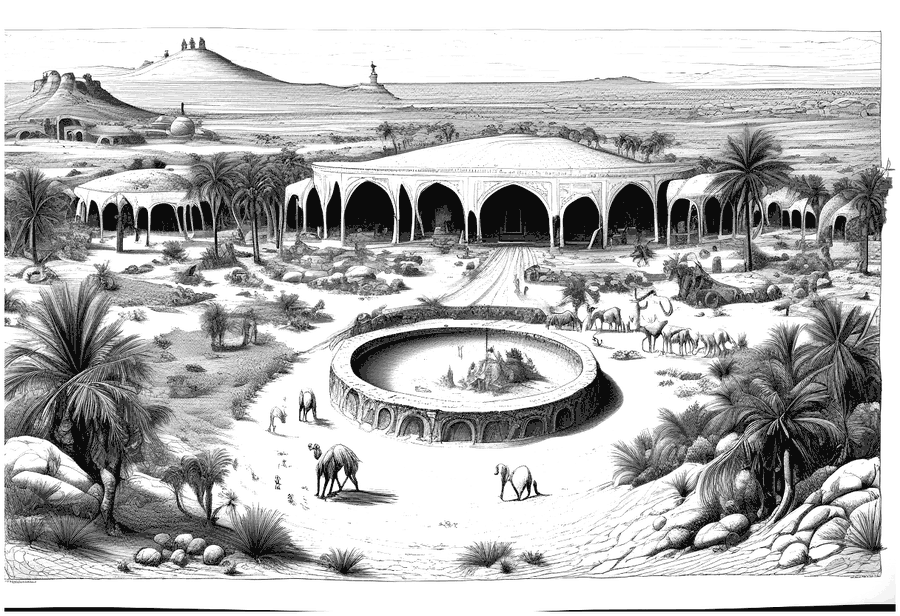
The Successor-Caliph's court moves across the desert with the seasons, but it always returns to Qaqah, because Qaqah has the Well. The city is small, white and holy, and every caravan road on the continent ends here.
Districts
The Well of the Successors, one of the wonders of the world. The Court of Shade, the palace of awnings. The Scriptorium of the Successor's Scribes. The Caravan Gate.
Peoples
Qashari. Leopard Bretborn envoys. Glassborn Strays, who are tolerated and watched.
A Glassborn Stray has walked into the Scriptorium and begun to chime at the inscriptions.
Life & lore
Feasts
Wellwater, at the first rain in Longnight, opens the water-year: every well is blessed and the Successor-Caliph descends the nine hundred and ninety steps of the Well. The Unspoken Night falls this month, at the dark of the Lamp in Haymonth: no name is spoken from dusk to dawn, and travellers are given water without question. Caravan Day (30 Reaping) honours the caravans that never came home.
Daily life
Qaqah eats dates, flatbread and goat's-milk yoghurt, and drinks sweet mint tea and water from the Well. Houses are white-washed mud-brick with roof terraces where people sleep in summer. The Court of Shade is a palace of awnings. Men and women wear veils and kohl against the glare. The Caravan Gate smells of camels and spice.
Customs
Guest-right is law: a traveller who asks may stay three days, and refusing them is a capital crime. Weddings are held at the Well's edge, and the couple pour a drop of water into it together. The dead are buried in the desert before sunset with a skin of water. It is taboo to speak the names of the Hidden Ones aloud.
Folklore
People say the Well's pool reflects the sky as it was on the day Bretbury burned. A Glassborn's chime means the Hidden Ones are listening. Children learn Nakh dashoojesh dahar lar sanaf: "do not refuse water to a stranger." A caravan that arrives at the Caravan Gate at noon is lucky; one at midnight is carrying a ghost.
History
The First Wells Compact was sworn at Qaqah in 41, and guest-right became law. The Scriptorium was founded in 560 to copy the inscribed stones. The Court of Shade was raised in 702, after the old palace fell down in a sandstorm and the Caliph decided he preferred awnings.
People
Nubaalah al-Lareeti keeps the House of Three Days by the Caravan Gate, where every guest gets three nights free and the fourth costs a mithqal. Scribe Lanikh al-Yukanahi of the Scriptorium wants the Stray destroyed before it reads anything aloud. Takif al-Waheeqi, a well-priest, blesses caravans for a drop of water. Haseeshah al-Kuradhahi fences Elder rubbings at the Caravan Gate.
This year
A Glassborn Stray has walked into the Scriptorium and begun to chime at the inscriptions. The Successor's Eyes have surrounded it and are arguing about what to do. The Unspoken Night is coming, and the city expects the Stray to speak on it. Leopard Bretborn envoys have asked to see it.
The war
The Caliphate is at war with the Trade Company, and the court has moved here for the summer. Camel prices have doubled because the army has bought most of them. Caravans from the Company ports no longer come. Queen Dorottya's envoys have asked for help; the Successor-Caliph has not answered.
Market & law
The mithqal (1.3 crowns) is the coin, the heaviest gold coin in the world; Merlish pennies pass at the Caravan Gate at a loss. A camel costs 20 mithqals, a skin of Well water 2 pennies. Fouling a well or refusing guest-right is a capital crime. Every caravan pays a drop of water in tribute at the Well.
Healing
Glass-eye, blinding from glare and glass-dust, is prevented with kohl and veils; Leopard Bretborn envoys treat it with a salve. Well-priests heal with water from the bottom step and charge nothing, but expect a gift. Snake-bite is treated with a cut and a poultice of crushed date-stones.
Adventure seed. Haseeshah al-Kuradhahi has a rubbing the Stray chimed at for an hour. She will sell it before the Unspoken Night, and the Successor's Eyes want her dead.
Mashan Trade Company · capital · 10,500 · port, citadel, walls, plaza
A city run as a balance sheet. The Board of Nine meets in the Sea Exchange, and the Company's paper money comes off the presses next door. The Caliphate's army is two weeks' march away.
Districts
The Exchange, one of the wonders of the world. The Print Yard. Kettle Mast, the sky-lane terminus. The Ledger Docks, where the Sand Ledger forges notes in warehouses the Company rents to it without knowing.
Peoples
Qashari and Kavarri. Kettlekin crews. Tsuruma convoy captains. Merlish bank agents.
Factions
The Board of Nine and its three factions. The Sand Ledger. Calloway & Daughters' Meedihar house.
Trouble
The Board is quietly moving its gold to Kushi. If the city learns of it, the notes will be worthless by morning.
Life & lore
Feasts
Wellwater, at the first rain in Longnight, is kept with a holiday at the Sea Exchange. Charter Day (12 Thaw) marks the founding of the Company in 750: the Board of Nine walks the inlaid floor of the Exchange, and the Print Yard prints a commemorative note worth nothing. Sail-Dipping (Rocadones) is kept by the Kushi convoy captains.
Daily life
Meedihar eats rice with spiced fish, flatbread and mango, and drinks coffee from Kahpia. Clerks wear white cotton and ink-stained cuffs. The Print Yard's presses thump day and night. The Ledger Docks smell of tar and spoilt cargo. The Exchange's gallery clerks chalk prices on boards a hundred feet long, and people come to watch them.
Customs
Couples marry at the Exchange under the inlaid map, standing on the sea route where their families trade. Children are given a share in a convoy at birth by rich families. The dead are buried at sea with a Company note in their mouth for the Hidden Ones. Refusing water or food offered by a host is a grave insult.
Folklore
Clerks say a note printed on the night of a full Lamp can never be forged. When the chalk boards at the Exchange go blank, the city is about to fall. The saying over the Print Yard door is Salood shabbaar kil ramooq dahhaar: "the merchant counts, but the host gives."
History
The Sea Exchange was built between 742 and 760, during the Mashan Rebellion, and the first paper money was printed in the yard next door in 760. In 788 a forger flooded the city with false notes, and the Print Yard has used a secret watermark ever since. The Kettle Mast was raised in 815.
People
Rufaalah al-Fushanahi keeps the Inlaid Floor, an inn by the Exchange, where clerks drink coffee and trade rumours. Maud Calloway runs Calloway & Daughters' Meedihar house and is quietly selling notes. Rokhan Zelvari of the Printers wants the Board to print more. Jaghih al-Wunakahi fences forged notes for the Sand Ledger at the Ledger Docks.
This year
The Board is quietly moving its gold to Kushi. If the city learns of it, the notes will be worthless by morning. The Sand Ledger is forging notes in Company warehouses, and in Rocadones a printing plate went missing from the Print Yard. The Caliphate's army is two weeks' march away, and Saizayd is on the front line.
The war
The Caliphate invaded the Company in 832, and Sag has abandoned it. Hired regiments drill at the Ledger Docks. Food is rationed. Company notes trade at 7 crowns in Flokburgh ports, not 9. Sea Lords are moving their families to Kushi.
Market & law
The Company note (face 10 crowns) is worth 10 only in Company ports. A share in a Kushi convoy costs 50 crowns. Sales tax is one part in twenty-five. Forging notes is a hanging matter; insurance fraud is punished with the loss of the hand that signed. Sea-loans are repaid only if the ship returns.
Healing
Marsh ague comes from the coast; Utturi bark costs 1 shilling a dose at the Ledger Docks. Pox comes in by sea, and Tsuruma physicians practise variolation for a Company note. Company physicians charge 2 shillings and treat clerks for nothing.
Adventure seed. Maud Calloway will pay well for proof that the Board is moving its gold. She means to sell her notes first, and the Sand Ledger means to stop her.
Kingdom of Kahpia · capital · 13,700 · citadel, walls, plaza
The court of the Magenta Elephant, where the Shah gives audience from a howdah and petitioners walk between the legs of the Colossus to reach him.
Districts
The Colossus Square, under the Magenta Colossus, one of the wonders of the world. The Elephant Lines. The Grey Wall Barracks of the Rhunari guard. The Poets' Garden, where courtiers settle feuds in verse.
Peoples
Kavarri. Rhunari of the Hornlands. Hoarfolk steel-traders from Sunhold.
Factions
The Shah's war council, the Elephant Priests, and the Grey Walls' captains, who are owed six months' pay.
Trouble
The Grey Walls have hinted that Jowshia pays on time.
Life & lore
Feasts
The Kneeling of the Elephants (1 Thaw) is the city's great day: magenta elephants are paraded through Colossus Square, and the Shah is re-crowned when the great elephant kneels. Mahrang's Drum (1 Isgard) brings rain-drumming and poetry contests at court, judged in the Poets' Garden. The Elephant Lines keep Tusk-Wash (9 Reaping), when every sacred elephant is scrubbed and re-dyed.
Daily life
Shahpabad eats rice with goat curry, flatbread and mango pickle, and drinks spiced buttermilk. Courtiers wear silk in the Shah's magenta, and everyone else wears undyed cotton with a magenta thread. The Elephant Lines smell of dung, hay and dye-vats. Petitioners queue from dawn between the Colossus's legs, and water-sellers walk the queue at a penny a cup.
Customs
A gift comes before any business, and a guest who talks trade first is shown the door. Weddings are blessed by an elephant-priest, and the bride's family pays in siglos for an elephant to walk behind the couple. The dead are burned at dusk and the ashes scattered from the Colossus's tusks. Killing an elephant, or swearing falsely on Tugan's tusk, is death.
Folklore
The Kavarri say the Colossus was built to show the dragon Ankhorra who rules here, and that if it ever falls, the dragon will return. Children sing a counting-song of the Shah's elephants. The proverb over the Poets' Garden gate is Semesh izantomvin venta nirde birikvin jedar san: "the shah has sweet words and sharp swords."
History
Ankhorra was seen over Shahpabad in 700, and the Magenta Colossus was raised between 700 and 744. The Poets' Garden was planted in 612 by a Shah who forbade duels and ordered feuds settled in verse instead. In 766 a poet named Zhed Turmazi won a feud so cruelly that her rival walked into the desert and was never seen again.
People
Kusiz Zidari keeps the House of the Tusk on Colossus Square, where petitioners wait for an audience and pay to be put near the front. Elephant-Priest Ghir Zhadari of the Elephant Lines wants the dragon appeased before the war. Karawa Waits-at-the-Door, a Grey Wall captain, is owed six months' pay. Saski Buzdgrim, a Hoarfolk steel-trader from Sunhold, fences arms out of the barracks.
This year
The Grey Walls have hinted that Jowshia pays on time. The Shah's war council wants Jowshia retaken. A great elephant migration is moving through the south near Chudeshk. A poet in the Poets' Garden has won a feud against the Shah's own nephew, and nobody knows whether she will be rewarded or executed.
The war
Kahpia is at war with Jowshia, and Shahpabad's young men have gone south with the elephants. The Grey Walls, owed six months' pay, guard the palace and could change sides. Hoarfolk steel is dear because the Sunhold traders are selling to Jowshia as well. Jowshian siglos are struck light, and Kahpians refuse them.
Market & law
The siglos (0.12 crowns) is the coin, stamped with an elephant. A war elephant costs 2,000 siglos; a sword of Sunhold steel 50. Elephants are used as executioners for oath-breakers who swore on Tugan's tusk. Theft from the Elephant Lines is punished by trampling. A gift before business is law in the court.
Healing
Elephant-priests heal with chants and turmeric paste, and charge in siglos. Heat-stroke kills petitioners in the queue every summer, and the House of the Tusk sells shade by the hour. Snake-bite and fever are common; bark from the Kahpian forests is sold at 1 siglos a dose.
Adventure seed. Karawa Waits-at-the-Door has offered to sell the Grey Walls' loyalty to the first who pays. The Shah wants a champion to carry the back pay, and Jowshia wants it stolen.
A green city on the edge of the desert, terraced into the highland forest. Its streets are planted with fruit trees, and cutting one down is a hanging offence.
Districts
The Grove-Temple of Asheena. The Warden Halls, where Bretborn leopard-priests train. The Desert Stair, the terraces that hold back the sand. The Port Market.
Peoples
Qashari and Leopard Bretborn. Visiting Rhunari herders.
The Mirqah Cavern near the city, which locals insist is "totally empty", has started breathing out cold air.
Life & lore
Feasts
Groving (18 Hofjor) is the city's own: every family plants a tree on the desert edge, and leopard-priests hunt the year's salters. Fruiting Day (1 Uxbridmanch) begins the fig and pomegranate harvest from the street trees, which are free to anyone on that day. The Warden Halls keep the Lamp Vigil (30 Isgard), when Bretborn elders sing a verse of the Memory through the night.
Daily life
Haruwayh eats figs, pomegranates, flatbread and goat's cheese, and drinks fruit-water from the street trees. Houses are terraced into the hillside, with gardens on every roof. People wear green-dyed cotton and leopard-spotted scarves. The Desert Stair smells of dust and the city of fruit. Leopard-priests walk the streets with tame leopards on leashes.
Customs
Couples marry under a fruit tree they plant together. A child is given a sapling at birth and must tend it for life. The dead are buried under a new tree on the Desert Stair, so that they "return to the grove". Cutting a fruit tree is a hanging offence. Refusing water to a guest is a capital crime.
Folklore
Locals insist the Mirqah Cavern near the city is "totally empty", and nobody will say why they insist. A leopard that sleeps in your doorway means a birth. The proverb carved over the Warden Halls is Thun e savai nen tae: "the forest knows your name." Children are told the Barren eats those who waste water.
History
The leopard-priests held their highlands against the Caliphate in the Asrahan War (607–616), and the Desert Stair was built after it to hold back the sand. In 702 a drought killed half the street trees, and every family planted two to replace them. The Warden Halls were founded by Leopard Bretborn in the first century of the Bretbury Era.
People
Dhadil al-Laghami keeps the Fig and Leopard by the Port Market and grows the best figs in the city on his roof. Warden Saihia ith Nagun of the Green Edge heals in the Grove-Temple and wants the Mirqah Cavern sealed. Hakiw al-Daneeli, a Hunter of the Barren, raids across the Jowshian border. Riflah al-Razeeni fences stolen Bretborn sparklocks at the Port Market.
This year
The Mirqah Cavern near the city, which locals insist is "totally empty", has started breathing out cold air. The Najrah Cyclops haunts the hills near Fuluwai, and the leopard-priests offer a blade of watered steel to whoever kills it. In Rocadones a Warden came back from the cavern mouth with frost in her hair and has not spoken since.
The war
Haruwayha fights for Kahpia against Jowshia, and leopard-priest infantry have gone south. The Hunters of the Barren raid across the Jowshian and Tubari borders. Fruit is cheap and grain dear because the coast trade is disrupted. The Emir's court argues about whether to send more priests.
Market & law
The mithqal and the Kahpian siglos both pass here. A blade of watered steel costs 40 mithqals, a sparklock 600. The faith teaches gifts, not loans, so credit is given as a gift and repaid as one. Cutting a fruit tree is a hanging offence, and salting land is death at the hands of the leopard-priests.
Healing
The leopard-priests are among the most skilled healers in the world, and charge 5 shillings a wound or a sapling planted. They treat glass-eye with a salve. Heat-stroke and snake-bite are common; the Grove-Temple's antidote is said to be the best on Qabahrah. Leopard bites are treated free.
Adventure seed. Warden Saihia ith Nagun wants someone to go into the Mirqah Cavern and prove it empty. She does not expect them to come back, and has already planted their tree.
Principality of Kushi · capital · 14,400 · inland, no walls, no harbour
The capital of the strongest power in the world has no harbour and no walls. It sits on a ridge in the middle of Tomama, and its harbour is in the air.
Districts
The Sky-Docks, one of the wonders of the world. The Ridge Palace. The Shrine Road, lined with spirit-shrines from the coast to the palace. The Kettle Quarter, home of the chartered Lanternwrights.
Peoples
Tsuruma and Halmi. Kettlekin. Envoys of every realm that wants to use the Chain.
Factions
The Ridge Court, the Admiralty (based at Yeongdong) and the Toll Office, which collects the Toll of the Chain.
Trouble
The Prince has received envoys from both alliances in the same week and has kept both waiting.
Life & lore
Feasts
Sail-Dipping (Rocadones) is kept inland too: every sky-ship at the Sky-Docks dips its envelope to the shrines on the Shrine Road. New Fire (1 Longnight) is lit from the Ridge Palace's hearth. The Kettle Quarter keeps Kettlemoot (12 Haymonth) loudly. On Lantern Night (15 Ondaria) paper lanterns float from the Sky-Docks to honour crews lost in the air.
Daily life
Kamiechia eats rice, pickled fish and seaweed soup, and drinks tea and rice wine. Houses are lacquered timber with paper screens. People bow on meeting; Kettlekin do not, and are forgiven. The Sky-Docks creak in the ridge wind, and lifts worked by Kettlekin engines clank all day. The Shrine Road smells of incense and wet cedar.
Customs
Formal introductions are law, and a gift on arrival is expected. Couples marry at a shrine on the Shrine Road, and the bride's family sends a model ship. The dead join the spirits of their family's shrine, and their names are added to its tablet. Embarrassing someone in public is the worst rudeness.
Folklore
People say the Sky-Docks were built because the Prince's grandmother dreamed of a harbour in the clouds. A sky-ship that dips to a shrine and is answered by a gust is blessed. The Tsuruma proverb over the Toll Office door is Nishi mobamobamosa ri yuko-ma yomaji sa ratomi: "many ships come to one harbour."
History
The Sky-Docks were built between 805 and 812, and the first sky-lane opened from Kamiechia to Shifton. The Ridge Palace was rebuilt after the earthquake of 714. The Kettle Quarter was granted to the Chartered Lanternwrights in 812, and it is the only place in Kushi where Kettlekin may own land.
People
Mina of Resamama keeps the Cloud Inn below the Sky-Docks, where crews and envoys drink. Bubbo Envelope-Stitcher of the Chartered Lanternwrights wants the Free Balloonists hanged. Agnes Calloway, married into the Toll Office, is pleasant to everyone and remembers everything. Futo of Rugumama fences confiscated cargo from the Toll Office's warehouses.
This year
The Prince has received envoys from both alliances in the same week and has kept both waiting. The Kamiechia–Balsozha sky-lane, opened last year, is the busiest in the world, and Merland would dearly like it closed. The Iron Tortoises have been seen on the ridge road at night, and in Mieles a Boilerguard harness vented inside the Ridge Palace and scalded a minister of the Toll Office.
The war
Kushi is allied to the Compact but not at war. The Toll Office keeps both alliances paying. The Admiralty, based at Yeongdong, wants to take the Captaincy's isles. Strings of cash are worth less as Balsozhian silver floods in. Chartered sky-ships carry envoys both ways.
Market & law
The string of cash (1.5 crowns) is the coin, a thousand bronze coins on a cord. A sky-passage to Shifton costs 6 strings. The Toll of the Chain is collected on every ship. Building a sky-ship without a charter is death. Selling a Boilerguard harness is forbidden at any price.
Healing
Tsuruma physicians are the best surgeons in the world, and practise variolation for pox. Sky-sickness is common among new crews and is treated with climber's leaf. Shrine-priests heal for an offering of rice. Burns from marrow-gas fires are treated in the Kettle Quarter with cold water and prayer.
Adventure seed. Futo of Rugumama is selling a crate the Toll Office seized from a Merlish envoy. It holds a letter to the Prince, unopened, and a Kettlekin pressure-charm that ticks.
Free Captaincy of Tebek · capital · 10,400 · port, citadel, walls · formerly Jinsan
A pirate capital where every captured ship earns a lantern on the harbour wall. On a clear night the cove glows like a festival. The town was called Jinsan until the pirates took it, and the waters outside its harbour belong to the sea-dragon Murrowmaw.
Districts
The Ledger Hall, where the Brethren of the Black Ledger record every prize and every share. The Mast Field, mooring for Kettlekin sky-pirates. Gallows Wharf, where the Brethren hang their own. The Drowned Market, half underwater at high tide, where anything can be bought.
Peoples
Halmi exiles, Elladan and Angshire deserters, and Kettlekin, who make up a third of the city.
Factions
The Brethren of the Black Ledger and their three factions. Agents of the Successor's Eyes and of the Quiet Hands.
Trouble
The Admiral's term ends in a month, and three captains want the chair.
Life & lore
Feasts
Every captured ship earns a lantern on the harbour wall, and each new one is lit with a feast on Gallows Wharf. The Feeding, on every Lampless night as the new Lamp begins, sends a whale or three oxen out on the Feeding Barge to the Black Buoy for Murrowmaw. Kettlemoot (12 Haymonth) fills the Mast Field with balloons. Founding Day (9 Thaw) marks the declaration of the Captaincy in 821.
Daily life
Lantern Cove eats fish stew, rice, breadfruit and anything off a prize ship, and drinks rum and Kettlekin boiler-beer. People wear what they have stolen. Houses are timber, and the Drowned Market is half underwater at high tide. The harbour smells of tar, fish and lamp-oil. Kettlekin make up a third of the city, and it is never quiet.
Customs
Couples marry before the Ledger Hall's clerk, who writes it down; divorce costs a doubloon. Children are named by the crew of the ship they were born on. The dead are given to the sea, and Murrowmaw takes them. Sinking a balloon is bad luck, and the Free Balloonists never do it.
Folklore
The pirates say Murrowmaw leaves them alone as long as they feed it. The "Noskirk sea monster" sailors see is only the end of its tail. The Kettlekin proverb over the Mast Field is Plangko zat titut zezuk: "the sky has no toll." Halmi elders say every island has a grandmother, and the Cove's is angry.
History
The town was called Jinsan until the pirates took it in 821, when Kettlekin crews flew three stolen sky-ships to the isles and declared a republic of captains. The first Admiral was killed within a year. The Drowned Market sank in the earthquake of 826, and nobody bothered to raise it.
People
Jangteo Biyul keeps the Lantern and Lamp by Gallows Wharf, where captains drink and trade votes. Maggik Gasbag of the Sky Captains wants the Captaincy to become the first sky-power. Haidos Kemnides, an Elladan deserter, is a Ledger Clerk who keeps the real books. Dattit Quickfingers fences everything in the Drowned Market.
This year
The Admiral's term ends in a month, and three captains want the chair; none has yet survived a full term. The Successor's Eyes and the Quiet Hands both have agents in the city. Admiral Mae Corrin eats nothing she has not watched being cooked. In Rocadones the sky-pirate Hiccup came home with a Kushi toll-chest, and three captains claim the share.
The war
The Free Captaincy raids Kushi convoys, and Kushi's Admiralty wants it burned. Company notes trade at 7 crowns, not 9. The Jowshia–Kahpian War and the Asraha–Mashian War disrupt the Chain convoys and leave rich prizes. Sky-pirates fly the Myrnamon–Lantern Cove and Lantern Cove–Meedihar lanes.
Market & law
The black doubloon (0.8 crowns) is melted prize-gold stamped with a lantern; cogs are the small change. A share in a prize costs 10 doubloons. The Articles of the Captaincy rule: a vote of the crew, the plank, or marooning. Stealing from a shipmate is a hanging on Gallows Wharf.
Healing
Ship's surgeons are deserters from every navy and charge a doubloon a limb. Pox comes in with every prize, and scurvy with every long voyage. Halmi shamans heal in trance and are trusted more than the surgeons. Kettlekin pressure-charms keep the wounded breathing, briefly.
Adventure seed. Jangteo Biyul says one of the three candidates has promised Murrowmaw a ship full of voters. The Feeding is in three nights.
Raugarian Theocracy · 29,000 · port, citadel · Raugaria's largest port
Raugaria's largest port is a tarred timber town on piles where the fen rivers meet the sea, round a citadel the priests call a hunting blind. It is also the heart of the insurrection. Its longship crews ignore Fagervik's orders, sail where they please and sell Kovavikian furs to Kushi ships under the garrison's nose.
Districts
The Blind, the turf-and-timber citadel on its mound, held by five hundred archers in a fort built for fifteen hundred. The Slipways, where the longships are drawn up and the crews meet in the Oar Hall. The Fish Quay, with the hacksilver beam-scales and the Split Oar. The Pig Lanes, plank walks over the tide where the pork-curers live and the insurgents sleep.
Landmarks
The Blind's one stone gate-tower, which the priests pretend is not there. The harbour bar the rowers call the Worm's lip. The bark-sellers' row, where the fen parishes come for Utturi bark.
Peoples
Norse fen-folk and longship crews. Kovavikian fur-runners, Mistwood Bretborn with things to sell, and Kushi sailors off the ships anchored offshore.
Factions
Warden Ølvik Damrasdottir and the Wild Hunt's household. The longship crews of the Oar Hall, who are mostly Kjelheim insurgents. Kushi fur-buyers.
Trouble
The Warden wants archers from Fagervik, and every road out of Kogenda belongs to the insurgents, who would read her letter first.
Life & lore
Feasts
The Shedding (10 Hofjor) is kept in the citadel by the Warden's household and by almost nobody else this year. Kogenda's own feast is Keel Night (1 Thaw), when the ice leaves the harbour and the whole town hauls the longships down the slipways on one rope. Kjelheim families pour ale into the harbour mud on Wormwake Eve (6 Rostovund), openly now.
Daily life
Kogenda eats salt pork, eel pie and rye bread, and drinks heather ale from the fen breweries at Hvamstan. Houses are tarred timber on piles above the tide, joined by plank lanes that flood at spring tides. Crews wear sealskin and oiled wool and tie a twist of red yarn in the beard to show which longship they row for. The town smells of tar, pigs and wet rope.
Customs
A new rower swears on the steering-oar, and the oath binds his children too, because in Fjallic an oath is always an old one. Couples marry standing on a beached hull with both families' crews as witnesses. The drowned are given a plank with their name burned into it, set adrift at the harbour mouth. Nobody swears by Hofjor at a crew's table this summer.
Folklore
Rowers say the harbour bar is the Worm's lip, and a ship that scrapes it has been tasted. The crews' saying, chalked on the citadel's gate-tower one night in Mieles, is Hofjor mefø bjil fikisin: 'Hofjor hears the free hunter.' An antler washed up on the slipway means a ship lost before Ondaria. Children call the citadel the Blind, and hide-and-seek there is 'playing priests'.
History
Kogenda grew from a pork-and-eel market where the fen rivers meet the sea, and its harbour was dredged in the 600s by fen parishes that paid their tithe in barrow-loads of mud. The citadel was raised in 668, after the Raugarian Rebellion, and consecrated as a hunting blind. In 791 lightning burned its hall and the town watched. The Selvikka hacksilver hoard was weighed here the same year.
People
Ølvik Damrasdottir, Warden of Kogenda, holds the Blind with five hundred archers and lets Jødørn Stekrodottir run furs to Kushi ships under its walls. Hvarn Tobreksson, a Kjelheim lay-preacher and steersman, speaks for the crews in the Oar Hall and wants Fagervik's priests off the harbour. Skjelda Rønsdottir keeps the Split Oar on the Fish Quay, where both sides drink and nobody draws.
This year
The crews ignore Fagervik's orders, so half the harbour is empty and the other half sails where it likes. Priests read the Comet of Thaw as Hofjor's antler; the crews read it as a steering-oar pointing at Kushi. Difis of the Seventh Door has a sparklock bound for a buyer in Kogenda, and the Hunt of Hofjor is watching the fen roads for its case.
The war
The 6th (Kogenda) Regiment marched east for Hajhia, so the citadel is held by five hundred archers in a fort built for fifteen hundred, and the town by whoever has a crew. Each household owes goose-feathered shafts to the levy-priest, and most go to the insurgents instead. The insurgents buy bread in good silver while the garrison's pay is late, and the bakers serve accordingly.
Market & law
Hacksilver is weighed on the Fish Quay beam: a snip (1 sh) buys a side of salt pork, an ounce (1 cr) a good sealskin. Kovavikian sable goes out to Kushi ships at 4 cr a pelt, and Utturi bark comes in at 1 sh a dose. A thief is turned out into the Bliksberg; a slaver is hunted to the sea, which here is a short hunt.
Healing
Marsh ague shakes the fen parishes from Haymonth to Reaping, and they come to Kogenda for Utturi bark at 1 sh a dose; half of what the quay pedlars sell is willow. Rope-burns and rowers' backs are treated with seal-oil and birch-tar. Lodge-priests heal for a share of the next hunt, and the crews' bone-setter, a one-armed rower, takes a pint.
Adventure seed. Hvarn Tobreksson will let a stranger row out to the Kushi ships if they carry one sealed bundle aboard. Ølvik Damrasdottir pays to know what is in it.
Asrahan Caliphate · 12,800 · port · largest city in the Caliphate
The Caliphate's largest city is a caravan port where the well road from Alfalah comes down to the sea. Drovers and sailors meet in the Salt Market and agree on nothing except the price of water, which is free.
Districts
The Harbour Well, said to be one of the forty wells of the Compact, kept by Bishnah al-Shutatahi. The Salt Market, where caravans unload salt, dates and kohl straight onto ships. The Land Gate, where the well road ends and the camel-lines begin. The Coral Quay, for the Kushi convoys and the Caliph's one war-ship.
Landmarks
The House of the Two Gates, a caravanserai with one door on the sea and one on the desert. Two Elder dungeons in the dunes outside town, which locals call the Wells That Drink Back.
Peoples
Qashari drovers and fisher-families. Tsuruma and Halmi sailors off the convoys. Orcosian copyists on their way to the inscribed stones.
Factions
The Successor's harbour-master and the 5th (Sainah) Regiment. The well-keepers. The desert sheikhs' riders, who come down to sell their plunder.
Trouble
Rumour says Faris the Exile bought water at the Land Gate, and by law nobody could refuse him.
Life & lore
Feasts
Wellwater, at the first rain in Longnight, is kept at the Harbour Well: the keeper lowers the first bowl and the whole quay drinks from it. The Unspoken Night falls this month, at the dark of the Lamp; caravans halt and ships ring no bells. On Salt Ship Day (3 Reaping) the season's first salt caravan is weighed aboard, and its leader is given a camel-load of dates.
Daily life
Sainah eats fish dried on the harbour wall, dates and lashas flatbread, and drinks sweet tea with cardamom. Houses are mud-brick with wind-towers on the Land Gate side and coral-stone along the quay. Drovers wear kohl and veils; sailors go bareheaded in salt-stiff shirts. The town smells of camel dung on one side and fish on the other, and the two meet in the Salt Market.
Customs
Guest-right holds on the quay as at any well: a sailor off a ship may stay three days and is spoken of, not to. Couples marry at the Harbour Well and pour one cup into the sea so that the drowned are invited. Desert dead are buried in the sand at dawn facing the wind; sea dead are given to the water at dusk. A family with both keeps two mourning-days.
Folklore
Drovers say Sainah is where the desert finally drinks, and a camel that walks into the surf is going to the Hidden Ones. The saying told to every Flokburgh sailor who haggles over water is Duhoor dahar dun rathar: 'A guest is water in the desert.' A gull landing on a camel's pack means a good sale. The two Elder dungeons in the dunes are called the Wells That Drink Back.
History
Sainah grew where the well road from Alfalah meets a sheltered bay, and its Harbour Well is said to be one of the forty wells of the First Wells Compact of 41. The Almuran War brought a garrison in 706, the 5th (Sainah) Regiment and it never left. In 788 a ship from the Chain brought pox, and the quay was walled off for a month, with water passed over the wall in skins.
People
Bishnah al-Shutatahi keeps the Harbour Well and asks a riddle of every caravan before it drinks. Rakkaad al-Dashari runs camel-strings on the Alfalah road and wants his forty requisitioned camels back. Dhalil al-Naraqi, the Successor's harbour-master, takes a tenth of every cargo and would like it to be a ninth. Tishshah al-Tateehi keeps the House of the Two Gates, with one door on the quay and one on the desert.
This year
The army takes one camel in ten, so a good camel costs twenty mithqals and the Salt Market is half empty. Orcosian copyists land here for the inscribed stones, more of them since the Comet of Thaw, and Dhalil charges each a mithqal 'for the sand'. The tents on the dunes whisper that Faris the Exile bought water at the Land Gate, and by law nobody could refuse him.
The war
The Asraha–Mashian War is fought far to the east, but Sainah pays for it in camels and men. The 5th (Sainah) Regiment has sent half its riders to the Company front, and the Caliph's one war-ship in the harbour carries dispatches up the coast. Kushi convoys still call, and their sailors offer Company notes that nobody here takes at more than half. Few on the quay think about the northern war.
Market & law
Large sums are paid in mithqals (1.3 cr) and daily ones in copper qirat, a hundred to the mithqal: a dried fish costs two qirat, a bed at the House of the Two Gates ten. Salt, dates and kohl go out by sea; cloth, iron and Kushi lacquer come in. Water is free by law. Fouling the Harbour Well is death: the guilty are walked to a dry well and left there.
Healing
Glass-eye blinds drovers who come in off the Waste without kohl, and a leopard-priest's salve sells on the quay at 3 sh. Sailors bring pox and scurvy, and Tsuruma physicians off the Kushi convoys variolate for a string of cash. The well-keeper sets bones for a gift of bread, and the regiment's camel-doctor treats people too, if they ask politely.
Adventure seed. A ship's crew died of thirst in Sainah harbour within sight of the free well. Bishnah al-Shutatahi swears someone refused them water, which is death, and wants the refuser named.
Mashan Trade Company · 13,600 · port, walls · largest Company town
The Company's biggest town is also its front line. The Caliphate's army is on the doorstep, and four thousand hired soldiers hold the only star-fort on Qabahrah, which was built in a year on credit and has not been paid for.
Districts
The Counting Bastions, each named after the Board member who paid for it. The Old Town, numbered whitewashed rows now packed with refugees. The Fleet Basin, home of the Company's eighteen-ship fleet. The Monolith Gate, where the town well faces the Tuwaiyah Monolith across the siege-ground.
Landmarks
The Tuwaiyah Monolith, which bears Elder Crown script and is said to hum before an assault. The sky-ship moorings inside the bastions, where two of the Company's four sky-ships wait with Kettlekin crews.
Peoples
Qashari, with Kavarri plantation hands, hired soldiers of every nation and Kettlekin sky-crews.
Factions
Colonel Bashim al-Wutalahi and the Ledger Regiment. The Sea Exchange's powder clerks. The Sand Ledger, whose forgeries turn up in soldiers' pay.
Trouble
The Colonel's contract ends on Wellwater, and he has asked the Caliphate what it pays.
Life & lore
Feasts
Charter Day (12 Thaw) was kept on the bastions this year: a clerk read the dividend from every point and the soldiers cheered it, because their bonuses ride on it. Wellwater, in Longnight, is kept at the town well by the Monolith Gate. The Unspoken Night falls this month at the dark of the Lamp, and the Colonel has ordered sentries to challenge by whistle, since no name may be spoken.
Daily life
Saizayd eats rice and pepper-fish, salt-fish when the boats cannot go out, and drinks husk-tea. The Old Town is whitewashed rows with numbered doors, now packed four families to a house with refugees from the burned estates. Soldiers wear a ledger-and-anchor armband over whatever they came in. The town smells of powder, coral dust and too many people, and the noon bell starts and stops the digging.
Customs
Marriages are sworn at the well and again before a Company notary, and this year couples marry the night before a soldier's contract is renewed, so that a widow's bonus is payable. Every guest is written in the gate's visitors' book. The dead are buried with their account settled: a soldier's debts are cleared from his back pay before the grave is filled.
Folklore
Soldiers say each bastion fights as well as the Board member who paid for it, and nobody wants to stand on the cheapest. The Tuwaiyah Monolith outside the walls is said to hum the night before an assault. The townsfolk mutter Nakh buraat wazi al nabeef, 'A dry well has no friends', at every Board notice. A note that rustles on a still night will fall in value.
History
Saizayd was the Company's first walled town, and its old wall kept Kahpian tax-collectors out in the Mashan Rebellion (738–750). Governor Layla Saizaydi's family takes its name from the town. When the Caliphate invaded in 832 the Board built the Counting Bastions in a year, on credit, with Merlish engineers hired through Maud Calloway's house, and the bills are still unpaid.
People
Bashim al-Wutalahi, Colonel of the Ledger Regiment, holds the bastions on a contract that pays a bonus for every week they stand and a bigger one for leaving. Mareerah al-Dhatasi, the Exchange's clerk of powder, counts every barrel on every bastion and has found the count short. Kashaaw al-Sarafi keeps the well at the Monolith Gate and, by the Compact, waters refugees, soldiers and Asrahan scouts alike.
This year
The Caliphate's army is on the doorstep, and the town's traders have moved to the Exchange floor at Meedihar. Soldiers have heard that the Board is moving its gold to Kushi and have worked out what that does to their notes. Sand Ledger forgeries turn up in pay-bags, and one bastion has hanged four passers this month. Asrahan scouts have been seen copying the Tuwaiyah Monolith.
The war
Saizayd is the front. Four thousand hired soldiers, twenty bought cannon and two sky-ships hold the bastions, and the Company's eighteen-ship fleet keeps the harbour open. Refugees sleep under the old wall and are turned out of the bastions at dusk. Bread is rationed at a loaf a head a day, and a soldier's contract pays 2 sh a day in notes.
Market & law
Company notes pass at their full 10 cr here and nowhere else, so everyone spends them fast. Siglos and mithqals buy food at three times its peacetime price: a pepper-fish costs 4 siglos. An arquebus costs 30 cr. Forgers hang; knowingly passing a forgery earns the Company brand and twenty years' indenture. Selling food to the Asrahan lines is a hanging from the bastion that caught you.
Healing
The Company physician charges 2 sh, free for anyone wounded on the walls if a clerk saw it. Camp flux has broken out under the old wall, and the physicians boil every skin of water at the Monolith Gate. Marsh ague comes up the coast; Utturi bark costs 1 sh a dose at the store, plus tax. Powder burns are dressed with lime-water and coconut oil.
Adventure seed. Mareerah al-Dhatasi's powder count is forty barrels short. The missing barrels were last signed for by the Colonel's own sergeant, and the Colonel's contract ends on Wellwater.
Satrapy of Jowshia · capital · 11,600 · port, citadel, walls
The rebel satrap's capital stands on stilts in the wetland with every man under arms. Its walls are faced with fire-hardened stakes, so the city looks like a porcupine in a swamp, and Kahpia's gun-elephants are expected before the rains.
Districts
The Stake-Walls, mud-brick faced with a hundred thousand stakes. The Kneeling-ground inside the main gate, where an elephant knelt to the Satrap in Thaw. The Mint, where Sho Fekardardari strikes the light siglos. The Plank Market, stilt-houses over the water where the women run the fish and the rice.
Landmarks
The Satrap's stilt-tower in the marsh. The elephant-tusk standard over the Kneeling-ground. The butts on the harbour mud, where archers shoot every market day.
Peoples
Kavarri of the wetlands. Three hundred Qashari riders of Al Tubar camped outside. Pilgrims bound for the Naqshahrke Monolith.
Factions
Satrap Mehrdad Nastani's court. Varzin Golbadani, Master of the Stakes. Grey Wall go-betweens and Kahpian spies, who are hard to tell apart.
Trouble
One row of stakes on the river side has been sawn half through, and nobody knows by whom.
Life & lore
Feasts
This year Nastan kept its own Kneeling of the Elephants (1 Thaw): an elephant knelt to the Satrap on the Kneeling-ground inside the main gate, and Kahpia calls it treason. Mahrang's Drum (1 Isgard) is beaten from canoes in the harbour and from the walls. Reed-Burning in Tunarejo clears the marsh before the rains, and this year the smoke is welcome, because elephants hate it.
Daily life
Nastan eats rice, catfish in sour leaf-broth and smoked eel, and drinks palm wine. Houses stand on stilts inside the mud-brick walls, joined by plank walks, and every porch has a bow on a peg. With every man under arms, women run the fish-market and the rice-boats and girls carry arrows to the walls. The city sounds of frogs, adzes on stakes and archers at the butts.
Customs
Bow-weddings are held the night before a man goes to the walls, and his bow hangs over the door until he takes it down himself. Babies are named over the harbour water so that Mahrang knows them. The dead are buried outside the walls in long mounds shaped like an elephant's back. A gift comes before business, even at the Satrap's recruiting table, where the gift is an arrow.
Folklore
Nastanis say the stakes grow at night, and children are sent out to count them. The court's saying, aimed at Shahpabad, is Povar zinghar hikfoz, 'The elephant remembers the king', and in Nastan it means the elephant remembers who made it kneel. A white egret on the walls means a man will come home. People who used to spit before the Shah's elephants now spit before the Satrap's, out of habit.
History
Nastan held out for nine years in the Kahpian Intervention (488–497), and its people say the floating rice-beds fed them through it. In 771 the wetland rose two feet and drowned the old fish-market at Bageshahr, and Nastan raised its own houses on stilts the next year. The stakes were begun in 829, when the Satrap declared his revolt and learned that Kahpia carries its bought cannon on elephants.
People
Satrap Mehrdad Nastani reviews his archers bareheaded from a stilt-tower and wants 'satrap' struck off every coin. Sho Fekardardari strikes the light siglos at the mint and keeps the shavings in eel-barrels. Varzin Golbadani, Master of the Stakes, can find any of a hundred thousand stakes in the dark. Nazhin Kordari, mahout of the Kneeling elephant, says it knelt to her, not to the Satrap.
This year
Kahpian gun-elephants are expected before the rains, and the wetland villages are cutting stakes for the outer rows. One river-side row has been found sawn half through. Grey Wall captains have asked what the Satrap pays, and the market talks of nothing else. Pilgrims bound for the Naqshahrke Monolith are searched at the harbour as Kahpian spies, and Sho's eel-barrels are leaving by dugout.
The war
About six thousand men stand the walls in turns, and the 2nd (Golshahria) Regiment drills in the marsh outside. Three hundred of Al Tubar's desert riders camp on the only dry ground and hate the frogs. The harbour's eighteen boats run rice in from the women's canoe convoys of Raybid. Haruwayha's leopard-priests fight for Kahpia, and their salve is now cursed by name.
Market & law
Jowshian light siglos (about 0.1 cr) are the coin, and Kahpian siglos are refused in revenge. A smoked eel costs one pul, a fire-pot 2 siglos, and Baparar Lurdizi's arrows 2 siglos the hundred. Iron comes in smuggled at three times its weight in fish. A deserter's bow is broken before his village and he is staked in the marsh overnight; Bastur Nezdari hunts the ones who run.
Healing
Marsh ague shakes half the city every third day, and Utturi bark costs 4 sh a dose this year. Elephant-priests heal soldiers first and everyone else with turmeric paste. Arrow wounds are packed with honey and moss, and Komeshcheh's bone-setters come up the river for the worst. Stake-cuts fester in the wet, and the cure is a hot knife.
Adventure seed. Nazhin Kordari's elephant has begun kneeling to strangers on the harbour steps, one each night. The Satrap wants to know who they are before Kahpia hears of it.
Principality of Kushi · 13,800 · port, walls · seat of the Admiralty
Kushi's Admiralty port is a Halmi city in the southwestern isles, with the largest war-fleet in the world anchored in its roads. The fleet is gathering to strike at Tebek, and it will not sail until a Halmi shaman says so.
Districts
The Roads, where the war-junks lie under the flagship Remishisa-maru. The Yards, where the adoptive shipwright houses build the fleet. Admiralty Row, the Tsuruma officers' houses of lacquered timber. The Slope, Halmi stone houses climbing to the Grandmother's shrine on the peak.
Landmarks
The harbour shrine, where the whole fleet dips sail at Sail-Dipping. The Nameless Ship, moored apart. The town walls, built by the clans against pirates.
Peoples
Halmi, with Tsuruma officers, marines and shipwrights.
Factions
The Admiralty. The Halmi clan elders. Tebek's agents, who promise the clans their islands back.
Trouble
The omen keeps saying 'not yet', and the Prince has told the flag-captain to be impatient.
Life & lore
Feasts
Sail-Dipping (Rocadones) is Yeongdong's great day: the whole war-fleet dips sail to the harbour shrine in line, which takes from dawn to noon, and the yards name their new hulls. In Uxbridmanch Halmi families climb the peak behind the town to the Grandmother's shrine. On Omen Day, set each year by the shaman, the fleet's sailing season is read from fish-scales cast on a drum.
Daily life
Yeongdong eats rice, reef-fish grilled on the stone quays, seaweed and pickled radish, and drinks barley tea and rice wine. Halmi houses are low stone and thatch on the slope; Tsuruma officers live in lacquered timber along the harbour. The yards ring with adzes from dawn, and the lanes smell of pine-tar. Haymonth is the southern winter here, and the marines drill in the cold rain anyway.
Customs
The eldest present speaks first, even before an admiral, and a Tsuruma officer who forgets it is not answered. Halmi couples marry at the Grandmother's shrine on the peak; Tsuruma couples marry at the harbour shrine with their ancestors named aloud. Shipwright houses adopt their apprentices and never pay them. The drowned get an empty grave on the slope that faces the sea.
Folklore
Halmi sailors will not leave the roads without an omen, and the saying painted on Halmi bows is Wyeo sa anyingjing: 'Do not sail without the shaman.' The Admiralty's officers find this inconvenient and obey it. Shipwrights say an unnamed ship chooses her own captain. Rice is left on the Nameless Ship's deck every evening, and in the morning it is gone.
History
Yeongdong was a fishing town of the Seongnonguk clans, who built its walls against pirates, before Kushi's princes made it their southern anchorage. The shipwright houses opened yards here beside those of Rorotoroto and have built the largest war-fleet in the world since. The 4th (Seongnonguk) Regiment was raised here in 829 for the Ritatan Campaign, and the Admiralty kept its seat here when that war ended.
People
Gizumama ke Chinoro, flag-captain of the Remishisa-maru, has been told by the Prince to be impatient and is waiting for an omen. Toteya ke Hogoro, master shipwright, has adopted forty children and built half the fleet. Jisushima ke Nonamori, the Admiralty's press-master, fills the marines from the fishing villages. Gyeop Dalmi keeps the Grandmother's Net on the quay, where Halmi sailors drink and the press-gang may not enter.
This year
The Admiralty is gathering marines for a strike on Tebek, and the Remishisa-maru lies in the roads waiting for an omen that keeps saying 'not yet'. Both the Admiralty and a Tebek candidate have sent for Hwakdang Jennael, the shaman of Tonghangju. The Nameless Ship came in from the south with no crew and a warm galley fire, and is moored apart.
The war
The northern war is a rumour here; the war that matters is Tebek. Fishing villages hide their boats from Jisushima's press-gang, and marines drill on the quays with fire-lances. Satayoechia ke Kosesa's son is said to be among them under another name. Tebek's candidates promise the Halmi clans their islands back, and in Yeongdong's alehouses more people listen than will admit it.
Market & law
Strings of cash (1.5 cr a thousand) are the coin: a bowl of rice and reef-fish costs 25 cash, a cup of rice wine 10, a bed at the Grandmother's Net 40. Cedar, pine-tar, rope and pickled fish come in for the yards. A shipwright's crest cannot be bought. Desecrating a shrine means exile to an islet without one, and hiding from the press-gang is fined at the price of a boat.
Healing
Admiralty surgeons are Tsuruma and among the best in the world: sailors are stitched free, townsfolk for 300 cash. The yards' scar-mother variolates children for 20 cash. Halmi shamans heal in trance on the peak, and many sailors trust them more. Crushed fingers, rope-burns and the cold-season cough are the yard complaints, treated with pine-resin and ginger steam.
Adventure seed. The Nameless Ship has chosen a captain: a press-ganged fisherman twice found asleep aboard her. Gizumama ke Chinoro wants her sailed out of the roads before the omen is read.
Duchy of Ritata · capital · 10,800 · port, citadel
Ritata's capital is a rain-dark harbour under a five-storey castle, where the Balsozhian horse-banner now flies over a Tsuruma castle and the Ritatan crane. The Duke swore fealty to the Emperor on land, which, by Ritatan saying, does not count at sea.
Districts
Ninakashi Castle, with its seven turning gates, its sea-gate and the ancestor shrine on the roof. The Fish-Steps, where the morning catch is auctioned. The Castle Road, lined with inns, the Brave Tavern first among them. The Sea-Terraces, where twelve bronze guns and fifty steppe horses stand in the rain.
Landmarks
The Brave Tavern, kept by one family since 640. The Natowatasean Lighthouse at the harbour mouth.
Peoples
Tsuruma. Balsozhian officers, horse-archers and a tithe-assessor. Kushi fishermen who are not always fishermen.
Factions
Duke Nobuyasu's court. The castellan and his shrine-keepers. The Balsozhian resident and his assessors. Kushi agents and the Distant Deer's letter-carriers.
Trouble
The castellan has hidden a second Ritatan banner in the ancestor shrine, and the Balsozhian resident inspects it next.
Life & lore
Feasts
Sail-Dipping (Rocadones) is kept with care and some bitterness: every boat dips sail to the shrines and then to the Balsozhian horse-banner on the castle roof. Inn-Lantern Night (30 Reaping) hangs a lantern at every door on the Castle Road, the Brave Tavern's first. On Founding Day (9 Hofjor), for Sadakiyo's castle of 642, every household sweeps its doorstep while the castellan sweeps the ancestor shrine.
Daily life
Ninakashi eats rice, river trout, chestnut cakes and grilled eel, and drinks plum wine. Houses are cedar with deep eaves, and the lanes below the castle curve so that rain and attackers both go slowly. People are porters, archers, fishermen and innkeepers. Rain drips from every eave, and since 833 the loudest sound in town is the Balsozhian horse-bells on the Sea-Terraces.
Customs
A guest is given a bath before a meal, and refusing it insults the house. Brides wear river-blue and cross a stream on the groom's back. Ashes go to sea in a small boat with a name-tablet, launched through the castle's sea-gate if the family has the right. Since 833 contracts are sworn outdoors in gardens, so the Balsozhians believe them, and on land, so the Ritatans need not.
Folklore
Townsfolk point at the shrine on the castle roof and say Kiyaaha ri yomaji zu saronomi: 'The shrine sees the harbour.' They mean Sadakiyo's ancestors are still watching and have opinions. A deer at an inn door means a lucky guest. The Brave Tavern has never run out of wine, and people say that on the night it does, the Duke's oath will break.
History
Sadakiyo founded the castle in 642, after the Wawawan Rebellion, and put the ancestor shrine on top because a rebel needed his ancestors closer than a prince's. The Brave Tavern on the Castle Road has been kept by one family since 640. In 744 the Hekorokugo landslide buried the old road and the inland road was cut. Kushi besieged the castle in 830 and was beaten off by archers shooting from boats.
People
Kinuhi ke Temiharu, the Duke's castellan, sweeps the ancestor shrine twice a day and calls it a military duty. Taodeechia ke Sara keeps the Brave Tavern and lets no Balsozhian boot past her door. Rüsmász Kelsence counts the Duke's paddies for the Emperor from the castle's second storey. Hasamama ke Tonari auctions the morning catch on the Fish-Steps and knows every boat that has been sounding the harbour.
This year
Balsozhian assessors have counted every paddy, and the inns twice. The Duke is said to be sending one regiment of archers north to Balsozha, and families are drawing lots. Kushi fishing boats have been seen sounding the harbour at dawn. The steppe horses on the Sea-Terraces have foot-rot, and Ninakashi children follow the grooms to laugh at them.
The war
Ritata owes the Emperor archers and a harbour, so Ninakashi is the one city in the isles where the northern war comes first. Fifty Balsozhian horse-archers sit in the castle beside two regiments of Ritatan archers and foot, and twelve bronze guns face the sea. Merlish privateers treat Ritatan fishing boats as Balsozhian, so the catch has halved. Debased horse-dinars make every bargain longer.
Market & law
Strings of cash (1.5 cr a thousand) are the coin, and horse-dinars pass reluctantly at 0.7 cr after the changers weigh them. Rice and grilled eel at the Brave Tavern cost 30 cash, a pot of plum wine 15, bath, bed and supper 60. Charcoal, cedar, river fish and plum wine are sold. A debtor works off his debt in the creditor's kitchen. Kushi officers are refused the sea-gate.
Healing
Every inn keeps a bath-house, and a long soak is the first cure for everything. A Kushi-trained doctor costs 200 cash. Foot-rot has spread from the steppe horses to their riders, and Ritatan grooms treat both with cedar-ash and mockery. Variolation is common. The rainforest cough is treated with ginger and steam, and the castle's surgeons see the garrison first.
Adventure seed. A Kushi skipper who sounds the harbour at dawn paid at the Brave Tavern with an Admiralty token. Kinuhi ke Temiharu wants him taken quietly, before the Balsozhian resident hears.