Gods & faiths
On this page
Every faith in Kidaneland shares one story: the land is the body of Rostovund, the Dead Worm, a world-serpent that died before time began. The Hoarspine is its frozen backbone, the rivers are its veins, and the gods are the powers that woke inside its corpse. The faiths disagree about everything else, including whether the Worm is truly dead.
Across the sea the story ends differently. Qabahrans say Tugan, the Magenta Elephant, trampled the Worm's head into the southern desert, and that its skull lies under the Glass Waste where Bretbury burned.
Each god has a place on the honour–shadow axis used by the rules in honour & shadow. A cleric's god decides which deeds count as virtue, so the same act can be holy in Fagervik and sinful in Valsiari.
Uxbridmanch
the Creator of War, the Smith of the World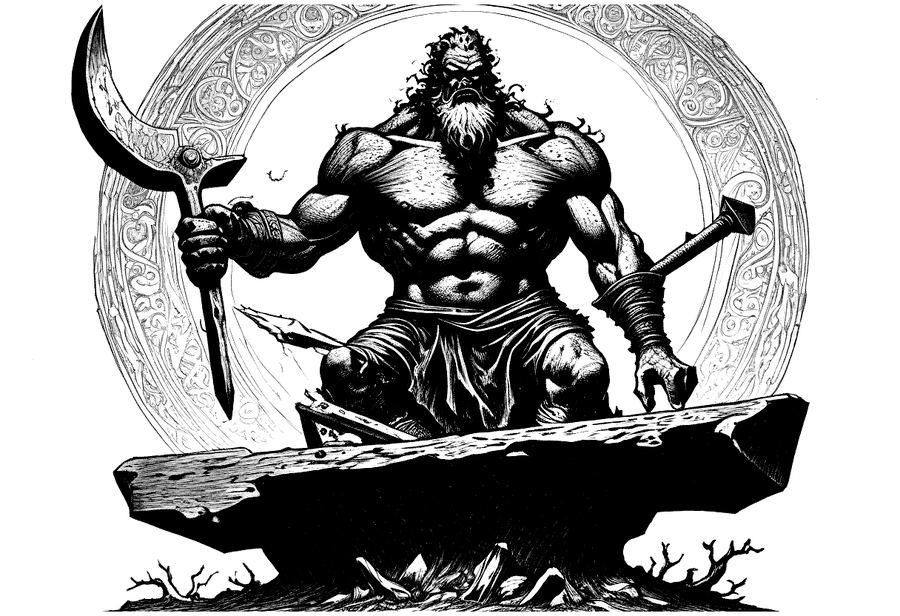
Uxbridmanch made the world on the anvil of struggle: nothing is made without conflict. Opposed to him is Coldharbour the Unforging, who wants everything to rust back into stillness. The church began in the town of Thetletown and blesses honest trade, craft and lawful war. It allows lending at interest, which is why Merland's banks flourish.
Honour: keeping contracts, finishing what you start. Shadow: idleness, broken bargains, rust-magic.
Holy site: the Lutondole Forest near Totrinch, Merland. Followers: Merland, Ortonzania, Balsozhia.
Life & lore
- Holy days
- Forgefire (1 Uxbridmanch) is the great day: every forge is relit, contracts renewed, apprentices bound, and Archsmith Wulfstan Hale strikes the year's first coin. On Quenching (15 Isgard) each household plunges one hot iron into the water-butt and names aloud a bargain it failed to keep. Fires go out on Ashnight like everyone else's, and priests call it the one night Coldharbour is allowed to win.
- Daily practice
- Every sixth day, Smithsday, the parish meets at the chapel anvil, and the priest strikes it once for each new contract read out. Grace before meat is two words, 'Struck and kept.' Each household keeps an iron nail over the hearth and oils it every Smithsday so it never rusts. Priests wear soot-black and a leather apron; the devout wear a plain iron ring.
- Rites of life
- A newborn's name goes into the parish ledger with a penny pressed beside it, and at sixteen comes Signing Day. Marriage is a contract read clause by clause, with the anvil struck for each (1 sh to 1 cr). The dead are buried with one tool of their trade, in coffins nailed with nails drawn from their own tools, so the soul goes back to the forge with its craft.
- Legends
- Kettlekin in Angshire cities pray Uxbridmanch, ta ikix, 'Uxbridmanch, hear us', and call the Whistle the breath of the Smith's bellows. Priests teach that Coldharbour whispers in the creak of rusting metal, so miners never whistle underground. The favourite saint is Wystan of the Bellows, who kept a forge alight through the whole Ash Days of 563 to finish a plough, and was excommunicated and canonised in the same year.
- History
- The church began in the town of Thetletown and grew out of the older road-worship of Gabingdon. The Synod of Totrinch in 633 ruled lending at interest 'the craft of making money work', which is why Merland's banks flourish, and in the same session made Gabingdon a saint of roads rather than a god. The Anvil Temple of Shifract was burned by the Merlish in 459–463 and rebuilt in stone.
- Clergy & saints
- Deacon Prudence Askew keeps the Forge-Ledger at the Lutondole shrine near Totrinch, where every Forgefire contract is copied, and wants the Bellows' war loans entered in it too. Sister Edda Fenwick runs the field hospitals in the Tent Sea and has asked Shifton for a thousand more kettles. Brother Oswin Thatch of the Rust-Watch preaches at the Anvil Temple in Shifract and keeps a list of names.
- This year
- Shamans read the Comet of Thaw as the Sky-Mother's whip; Thetletown priests called it a spark from the Smith's hammer. A boundary stone near Totrinch moved forty yards during Gatefair, within sight of the holy forest. A ghoul was found in a Shifton church cellar in Haymonth, and the Church now sends gravewatchers to the front.
- The war
- The faith sits on both sides. Merlish preachers of the Anvil call the war holy, while Balsozhian priests of the same church bless the Emperor's cannon. Both armies sing the same hymn, Struck and Kept. The Bellows lend to both sides through Father Aldous Wren, and in Witfordge Father Gyemos Lory hides nine boys from the press-gangs in his bell-loft.
- Tithes & law
- The forge-tithe is one part in thirty of a craftsman's earnings, paid at Forgefire, and the Bellows bank it with the Shifton counting-houses at interest. A contract sworn on a chapel anvil is heard in the church court. The breaker's name is chalked on the anvil for a year and he pays double the loss. Salting a Church-blessed forge is sacrilege, and worshippers of Coldharbour are hanged in iron chains that are left to rust.
- Healing
- Church hospitals in Merland boil everything, dress burns with lime-water and linseed oil, and charge 5 sh a wound at the Anvil Temple, free to the poor on Smithsday. Magic is a tool, so licensed marrow-salt healing is allowed; an unlicensed healer is fined like a coiner. Burning the dead is forbidden as a waste of the soul's metal, and so is any cure that rusts iron.
Adventure seed. Deacon Askew finds a Forgefire contract in the Forge-Ledger that nobody remembers swearing. It binds Merland and Balsozhia to peace, and it is signed in rust.
Hofjor
the Wild, the First Hunter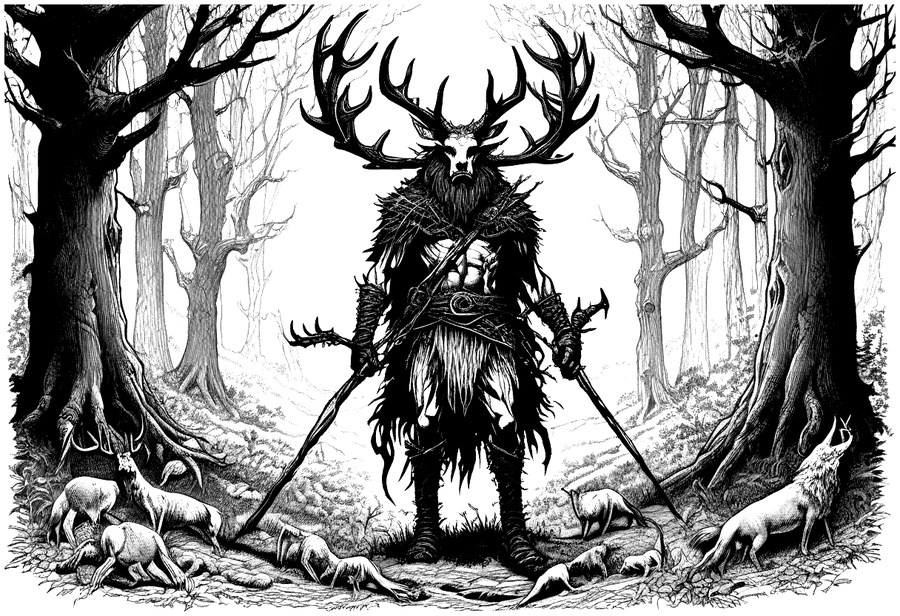
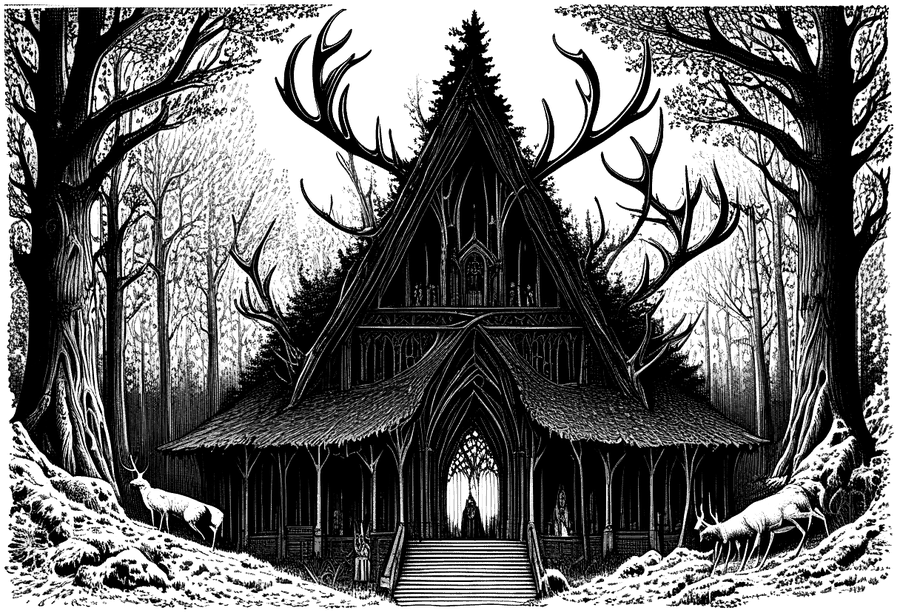
Hofjor is the untamed life that grew in the Worm's flesh. His enemy is the Penner, the spirit of walls, chains and fences. The Raugarian priesthood teaches that every soul is prey or predator, and that freedom is earned by the hunt. The faith grew out of the older Kjelheim gods, and the Kjelheimers have never forgiven it.
Honour: freeing the caged, a fair hunt, courage. Shadow: slavery, poisoning, hiding behind walls.
Holy sites: the Bliksberg Forest and the Hafjornes Pinery, Raugaria. Rule: the High Huntress is chosen by sacred hunt.
Life & lore
- Holy days
- The Shedding (10 Hofjor) gathers antlers and draws the year's holy hunts by lot. In Haymonth the Roofing lashes the new sheds into the Antler Cathedral's vault. On the Loosing (30 Ondaria) the Penner's Gate opens, every bell in Fagervik falls silent, and the Theocracy's prisoners run for the forest with a day's start.
- Daily practice
- Doors are never locked, because locks are the Penner's tools, and keeping a caged bird is a sin; Raugarian children keep tame crows that come and go. Devout households eat no meat from a penned beast, so pork is a poor man's sin and cheap in Kogenda. Venison, rye bread, smoked herring and lingonberry ale are the holy table. Over every door hangs a shed antler with a cut cord tied to it.
- Rites of life
- The midwife cuts the cord with a flint and throws it into the forest, so the child is never tied. Coming of age is the first kill of a deer, and courting couples hunt together until they share one. Weddings are held in the cathedral nave in the rain; a dry wedding day is bad luck. The dead are laid on forest platforms to join the eternal hunt.
- Legends
- The lodge-priests' blessing is Hofjor mefø bjil fikisin, 'Hofjor hears the free hunter.' Children sing The Penner's Key, about a gaoler who locked himself in his own cell. When a living stag walks into the nave, a new High Huntress will be chosen. Tales tell of Hofjor freeing the stag from the Penner's fence, and of the Penner building the first wall out of a coward's excuses.
- History
- The first High Huntress was chosen by sacred hunt in 214, and Raugarians count holy years from it. The first antler shrine was raised at Fagervik in 402, the Penner's Gate cut in 600, and the cathedral built between 680 and 760 on oak ribs from the Hafjornes Pinery. In 618 a holy hunt lost thirty priests in the root-caves of the Bliksberg, and the hunts have stayed above ground since.
- Clergy & saints
- Hvisla Bramdottir, Antler-warden of the Cathedral Close, buys every perfect shed. Brother-Hunter Henk Bjarsson of Bostrand wants his parish's sons home from the eastern levy and has written to Fagervik four times. Hjelna Brosdottir keeps the Roll of the Loosed, writing down the name of every prisoner who runs from the Penner's Gate, and wants the insurgents kept away from it this year.
- This year
- A stag's track has appeared in the cathedral nave, and nobody saw the stag; half of Fagervik says a new Huntress is coming. Wetland priests read the Comet of Thaw as Hofjor's antler pointing east. The insurgents have sworn to free this year's prisoners at the Penner's Gate themselves, and the Close is full of longbowmen.
- The war
- The longbow regiments took two archers in three from the eastern parishes, and each household owes the levy-priest twenty-four goose-feathered shafts a month. The Wild Hunt wants war on Orcosia too and calls the High Huntress soft. Inside the priesthood the Kjelheim Remnant feeds the insurrection, and Kovavikian lodges stand half empty while the old woodland shrines get fresh offerings.
- Tithes & law
- Coin is a chain, so priests mistrust stamped money and weigh hacksilver at 1 cr an ounce. A perfect antler fetches 1 cr at the Close. Lodge-priests take a share of every holy hunt as tithe. There are no prisons: the guilty are turned out at the Penner's Gate and hunted. Slavery is the worst crime, and hunting in the Bliksberg is death for anyone but the High Huntress.
- Healing
- Hunter-priests heal with moss poultices and blood-letting for 5 sh a wound at the cathedral, hunters first. Poison is the faith's great shadow, so no Raugarian healer will give poppy or a sleeping draught, and surgery is done awake with a strap to bite. Pilgrims who kneel all night in the wet catch the nave-cough, and herb-wives treat it with spruce-tip syrup.
Adventure seed. Hjelna Brosdottir's Roll lists a prisoner Loosed in 812 and marked 'not yet caught'. He has just walked back through the Penner's Gate, asking for sanctuary.
Varvikyryla
the Silent War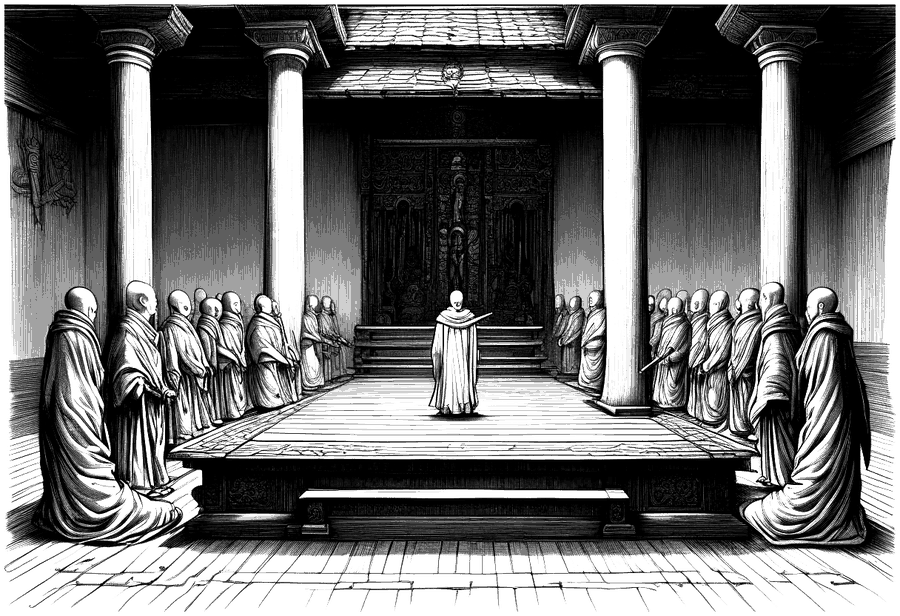
The one god of the Soumi. Varvikyryla is the war fought inside every soul between patience and appetite. Its priests take vows of silence on holy days and settle disputes by staring contests that can last until sunset. They forbid lending at interest, so Valsiarian merchants trade through profit-sharing partnerships instead.
Honour: restraint, patience, mercy to the defeated. Shadow: rage, gluttony, loud boasting.
Followers: Valsiaria, Kaporesia, Ortonzania, Hajhia.
Life & lore
- Holy days
- The Long Silence (20 Thaw) keeps whole towns silent from dawn to dusk, and the Quiet Temples settle the year's disputes by staring contests at sunset. The Silent Days fall on the 10th, 20th and 30th of every month. On the Laying Down (15 Uxbridmanch), when the war season ends, every household lays a knife on the table with its blade to the wall and nobody touches it until dawn.
- Daily practice
- Morning prayer is a held silence of a hundred heartbeats. Gluttony is a sin, so the devout eat from one plate and never take a second helping, and they fast until sunset on Silent Days. Clothes are undyed grey linen. The household shrine is the unfilled bowl, an empty dish on a shelf that nobody may put anything into.
- Rites of life
- A couple is betrothed after a Day of Sitting: if neither speaks before sunset, the match is good. A child is named only when it first sleeps through a storm. At fourteen comes the First Vigil, a night in a temple without a word. Mourners keep thirty days of silence, and the dead are buried at the roots of a great tree with honey, as in the older faith of Utturi.
- Legends
- The temple saying is Paruulull sunanut on vuusu, 'loud words are small.' The first Prince of Valsiaria is said to have won his throne by out-staring a war elephant. The church's best-loved saint is Oiva the Patient, who sat silent outside a Kaporesian slave-pen for a year and a day until its owner, unable to bear it, freed everyone inside. Children are told Manttamites have no tongues, only drums.
- History
- The church grew from the worship of Utturi, the oldest Soumi god. In 671 the Quiet Quarter of Shifract was granted to Soumi traders after the failed Valsiarian Rebellion. In 702 a fire in the Quiet Temples burned for a day and nobody raised the alarm until sunset. The church still argues over whether the Tulpio Tigers' ivory payment, taken long ago for the Prince's stables, was a sin.
- Clergy & saints
- Sister Hiiva Puolanen judges staring contests in Valsiari and has never lost, and a Manttamite preacher has now challenged her. Abbot Aalu Venhamanen keeps the purse of the Quiet Temples and has been accused, silently, of hoarding grain while the Dearth reaches the south. Juuhe Tirusinen, a church physician, studies the Bloom in a camp outside Kutio.
- This year
- Manttamite drummers have marched through every Silent Day since Thaw, and street-preachers shout under the Quiet Temples every night. A silent judge was found dead in the Quiet Temples with his mouth sewn shut. If Sister Hiiva loses her contest, the Loud say, the church must open its doors to them, and the whole city is betting on the outcome.
- The war
- Valsiaria refuses to fight, and the church calls that obedience, not cowardice. Balsozhian recruiters are fined for speaking in the Market of Marks. Families are split between the old church and the loud heresy, and in Hajhia's refugee camps Soumi believers keep silence while their towns burn. The church forbids killing the Bloomed, but permits burning them once they no longer speak.
- Tithes & law
- Lending at interest is forbidden, so merchants trade through profit-sharing partnerships, and the church takes a tenth of a partnership's profit, never of its capital. Disputes go to a staring contest before a silent judge, fines are paid in silence, and exile is the worst sentence. The Valsiari watch fines Manttamite street-preachers 2 elephant marks a shout.
- Healing
- The Quiet Temples heal for 5 sh a wound, in silence. Rage is treated as a sickness with fasting and silence, and fever with silence, cold water and willow-bark. Patients who scream are thought to heal more slowly. The church forbids strong spirits as medicine, since drunkenness is appetite, but allows the poppy, which keeps a patient quiet.
Adventure seed. Abbot Venhamanen's grain store could feed Valsiari for a month. Someone has stolen his ledger, and the Loud want its figures read aloud in the Market of Marks.
Varvikyryla, unsilenced
the War Made Loud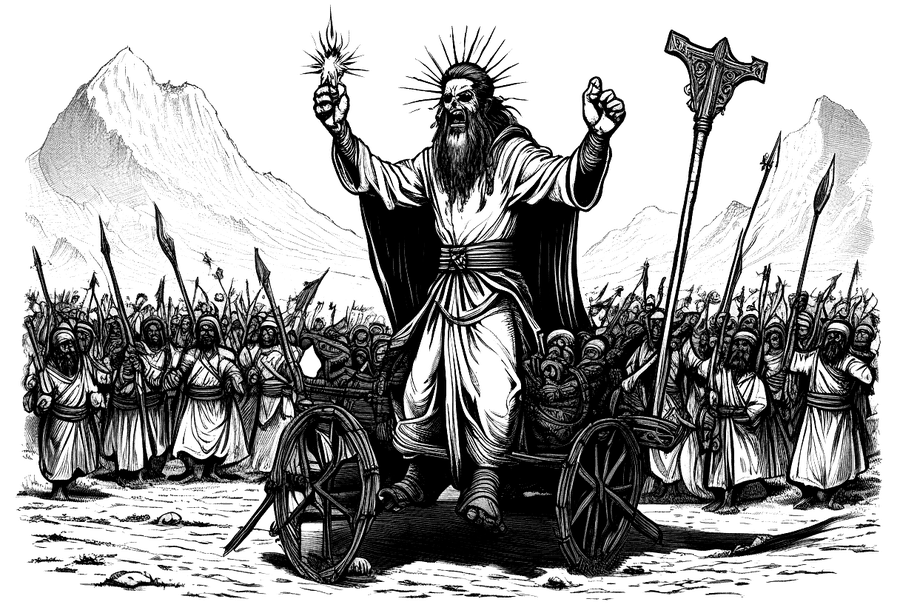
The prophet Manttama taught that the silent war cannot be won inside the soul and must be fought in the world. Manttamites are loud, militant and certain. Their crusade this year marches through Valsiaria against the "silent cowards" of the established church, and their cells in Kaporesia smuggle weapons north.
Honour: zeal, open defiance, smiting the hypocrite. Shadow: compromise, silence in the face of wrong.
Life & lore
- Holy days
- On the Long Silence (20 Thaw) the Loud keep the Loud Dawn, drumming from first light to spite the silent towns. Manttama's Shout (9 Rocadones) marks the prophet's first sermon in the Market of Marks. In Kaporesia, Manttamite villages celebrate the monsoon's end in Haymonth with drums the Silent villages can hear through ten miles of jungle.
- Daily practice
- Manttamites pray aloud three times a day, standing, and the devout shout the morning prayer from a doorway. They keep the Silent Church's fasts but break them noisily at sunset. A red cord at the throat, 'the opened throat', marks a believer. In place of the unfilled bowl, every Manttamite house keeps a drum by the door.
- Rites of life
- Vows are shouted from a roof so the whole street is witness. Every adult in the house answers a newborn's first cry with a shout of their own. Coming of age is a first sermon preached in a market. The dead are buried with a drum, which is beaten over the grave, and mourners wail for thirty days where the old church keeps thirty days of silence.
- Legends
- Manttamites take the Quiet Temples' saying Paruulull sunanut on vuusu, 'loud words are small', and chant it over drums until it means the opposite. Their own proverb is 'A war you will not fight is a war you have already lost.' Silent grandmothers say that a Manttamite who is struck dumb by illness will be cured if they keep quiet about it.
- History
- Manttama was a novice of the Quiet Temples who broke her vow in 779 to shout down a Kaporesian slaver in the Market of Marks. Exiled, she preached in the Kaporesian river towns and drowned at Histhos in 806, held under, her followers say, by the Despot's men. The Reconcilers appeared after her death and have been hated by both churches ever since.
- Clergy & saints
- Hehailla Syvela, once a temple novice, shouts every night under the Quiet Temples and is the preacher who has challenged Sister Hiiva to a staring contest, which she means to win by never blinking at all. Ilmu Tarvonen, a former bell-child, beats the drum for a Manttamite company. Rhimeun Mamaridou, an Elladan oar-captain, runs muskets north under sugar sacks.
- This year
- Preacher-General Aune Halkola's crusade marches through Valsiaria with banners and drums. The Loud deny sewing shut the dead judge's mouth, very loudly. A Bloomed was seen walking south through Theomis in Mieles wearing a Manttamite preacher's robe, and a Manttamite drummer vanished from Kutio along with Teppu Rauhala's best bull elephant.
- The war
- The Prince of Valsiaria will not march, so the crusade marches for him. Companies quarter themselves on villages, eat the winter stores and make every host declare aloud for the loud war. The Kaporesian Cells buy hand-gonnes from the Open Forge and smuggle them north, and their boats carry the Bloom upriver with the guns. The Loud want Princess Emese's peace salon closed by force.
- Tithes & law
- Interest is forbidden, as in the old church, and the crusade lives on the drum-penny collected at every sermon. Guns are 'useful noise' and sold openly. A believer who keeps silent in the face of a wrong is drummed out of camp, with his name shouted at every crossroads for a week. Gardeners of the Rot Communion are killed on sight.
- Healing
- Manttamite surgeons sing while they cut and tell the patient to shout, because pain shouted out is pain let out. They reject the Silent cures of fasting and quiet as cowardice. Their camps have no answer to the Bloom except fire, and the Silent Church's physicians blame the crusade's boats for spreading it.
Adventure seed. Hehailla Syvela will win the staring contest: she has been taking a Kaporesian eye-drop that stops the blink. Sister Hiiva knows, and wants proof before sunset.
Dalorincsakes
the Severe Virgin, Mother of the Sky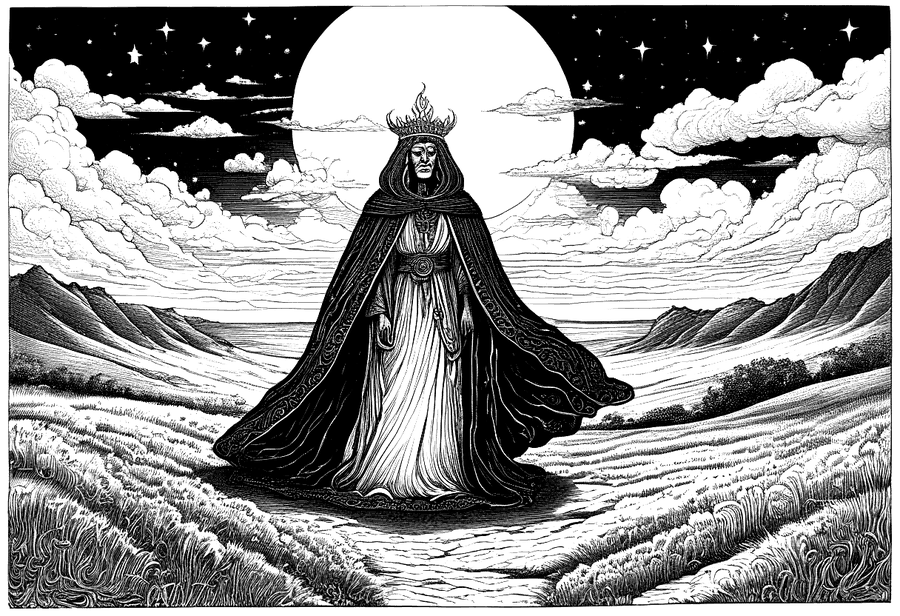
The stern sky-mother of the steppe watches every oath made under open air, which is why Vengrians make important promises outdoors. Shamans ride in trance to her tent at the top of the sky to ask for rain or judgement. Her lesser spirits include the Horse Ancestors and the Wind Brothers.
Honour: oaths kept, hospitality, care of horses. Shadow: oath-breaking, harming a guest, killing a horse except in mercy.
Life & lore
- Holy days
- Vengrians count by the moon, not the month. The Sitting of Snow (15 Longnight) camps the clans together for three nights of horse-ancestor stories and oaths renewed under the open sky. Every family keeps Foal-Naming on the first full Lamp of Mieles, and at the first full Lamp of Reaping each Hajhian clan holds the Counting, when every foal is named aloud to the sky.
- Daily practice
- Each morning the eldest of the tent flicks mare's milk to the four winds and then upward. The smoke-hole of a tent is never covered, because it is where the Sky-Mother looks in. Anything important is said outdoors, and the greeting is müsiny csodor, 'strong horse!' A horse rides with you; nobody says 'my horse'.
- Rites of life
- A newborn is carried three times round the tent. At about fourteen a youth rides alone for a night and swears a first oath under the sky at dawn. At a wedding the bride gets a horse's-length start and the groom must catch her. The dead ride to the Sky-Mother's tent, and their horse is freed onto the steppe; nobody may ride it again.
- Legends
- The shamans' prayer is Dalorincsakes, gyömest cseszékő, 'Dalorincsakes, hear us.' Every child learns Incs mobo kónyost okkan, 'The sky sees every word.' The Wind Brothers steal hats from liars, and lovers at Tuvartoszoma swear behind the falling water where the Severe Virgin cannot see them break their oaths. The Rhunari say hot springs are the Grey Mother's breath; Vengrians say they are the Severe Virgin's tears.
- History
- The horse-clans became the empire and kingdom of the Vengrians after the Burning, and the szent mounds of the Horse Ancestors are older than either. In 565–568 Ilbarescian priests marched on Hajhia to convert the steppe and were driven back; shamans still tell it as the Sky-Mother's best joke. The Balsozhian court has since taken the Thetletown Church, but its generals still consult shamans before battle.
- Clergy & saints
- Zekila Böglenc, a shaman, rides in trance for the Emperor's war council from a felt tent on the causeway. Pöka Mevár, a fort shaman, beats camp flux by boiling water and smoking the tents, and it works. Sitkász Lepona, a shaman of the Tent Sea at Erencszasz, settles oath-quarrels between refugee clans and has ruled that an oath sworn under a tent roof in exile still binds.
- This year
- The Comet of Thaw was taken by shamans as the Sky-Mother's whip. Kinsmen are fighting each other, and some clans have split their herds by oath so each half can keep a different promise. Shamans in the Tent Sea ride in trance for rain to clean the wells, and Sitkász Lepona's 'roof-oath' ruling has the old shamans furious.
- The war
- Both armies swear under the same sky to the same Sky-Mother, and every shaman is asked which oath she will honour. Four riders in five from the Hajhian camps have gone to war, leaving grandmothers, boys and the lame. Horses cost double. An oath-breaker is 'given to the wind' and anyone may kill him, which this year means a great many deserters.
- Tithes & law
- A debt is an oath, so it is spoken under the sky and witnessed by a horse. Shamans are paid in sheep, or in horses for a hard trance. Oath-breakers are outlawed, horse-thieves are dragged, and killing a horse except in mercy is murder. There are no temples and no tithes; a shaman's wealth is her herd.
- Healing
- Shamans ride in trance to the Sky-Mother's tent for the sick, set bones with horsehair splints and chant over them. Burns get mare's-milk curd. A sick person is carried outside so the Sky-Mother can see them, and dying under a roof is a disgrace. Cutting open a body after death is forbidden, so Vengrian physicians learn their anatomy from horses.
Adventure seed. Sitkász Lepona asks the heroes to carry a sworn oath across the front, spoken under the sky, to a Balsozhian captain who is the oath-taker's own brother.
Rocadones
the Lion of Light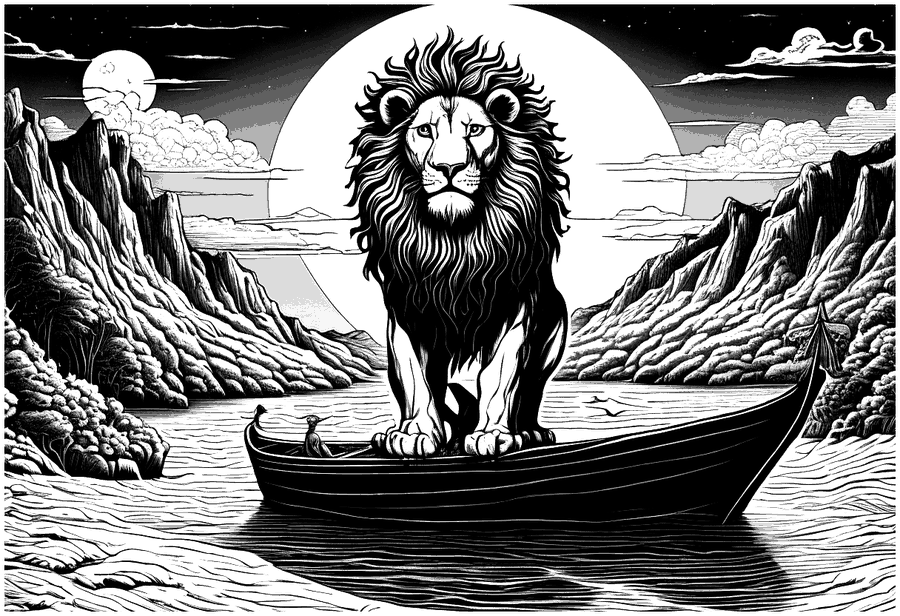
The sun-lion who leads the river gods of Orcosia and Ilbarescia. His family includes Ondaria of the floods, Mieles of the bees and honey, and Tunarejo, the dark ferryman of the dead. The Lion-Pontiff of Orcos speaks for him, and the Prelate of Chuejon claims to speak for him better.
Honour: generosity, public courage, sunlit honesty. Shadow: secrets kept in darkness, cowardice, necromancy.
Life & lore
- Holy days
- The months of Mieles, Rocadones, Ondaria and Tunarejo are named for the god-family. Hiving (1 Mieles) brings honey-cakes and brides in yellow. On Lionsday (21 Rocadones) the Lion-Pontiff blesses the sun from Lion Hill and nobody may keep a secret. Floodwake (1 Ondaria) sets candle-boats on the rivers, the Sweat-Mass (3 Reaping) rings a bell for each family lost to the Grey Sweat, and the Ferrying (1–9 Tunarejo) keeps nine nights of the dead.
- Daily practice
- At noon the temple bell stops all work for the Lion's prayer, said facing the sun with eyes open. Every house has a brass sun-disc on its east wall, polished on Lionsdays, and a candle-saucer for Ondaria. Villages tell the bees of every death. A shadow falling across a cradle is the worst omen, so cradles stand in the light.
- Rites of life
- A newborn is lifted to the sun at midday and named aloud before the whole street. At fifteen comes the First Confession, made at noon in public. Couples confess their secrets to each other before a priest the night before the wedding and marry at noon. Funerals are held at dawn, the dead laid facing east with a coin for Tunarejo.
- Legends
- Priests preach Ponozos nu jiasarear cafias soa, 'A lie does not live in the light', and Chuejonese say Solano dovar nicuze pozilo, 'the sun sees the hidden road.' The Year Without Bees (674) is blamed on a priest who forgot to tell them of a death. Saint Lerida of Oia, the first Graveguard, is painted holding a lamp in a mass grave.
- History
- The Grey Sweat (344–349) gave the Ferrying its present form, and in 347 Saint Lerida organised the Graveguard, priests who sat with the dead so they would not rise. The Honey Years of the 470s were the faith's golden age of poets and lens-grinders. Ilbarescia broke from Orcos in 511, and the hill-parishes hid their bells in the gem-pits so the Pontiff's men could not take them.
- Clergy & saints
- Pelaejo the Bright, a Sun Temple Reader, runs the Elder rubbings room in Orcos and is quietly selling copies to all three parties of the Order of the Unread Script. Ondrejo of Sabiales, a river-priest of Ondaria, rows from roof to roof in drowned Piozia Parish saying the Floodwake rites early. Vienobe of Sueges, captain of the Graveguard, sits with the flood-dead at Mantena until they can be buried in dry ground.
- This year
- The Sun Temple says the Comet of Thaw was the Lion's eye turning south; in Chuejon the Prelate preached for six hours that it was the Lion's sword. The Lion-Pontiff Ximeno III is about to hear the confession of a Hajhian envoy, and one of his own confessors is said to be a Successor's Eye. The Bell Guild of Bustogollo blames the Pontiff for the Dearth.
- The war
- Orcosia is 'still deciding'. In the Sun Temple the Lion's Mouth wants war for Hajhia and the Golden Pride is spending thin Balsozhian dinars. The levy rolls are drawn up all the same. Ilbarescia marches with its Raugarian masters against Hajhia, where its priests failed in the Sotacan Crusade. The Sunlancers vow never to strike in darkness.
- Tithes & law
- The faith takes a tithe, never interest, and the Sun Treasury mint on Lion Hill strikes sun-reals. Sins are confessed and paid off by public penance at noon, with fines to the Sun Treasury. Necromancers are burned at noon 'so the Lion sees'. In Ilbarescia a deserter's name is cut from the muster roll on the cathedral steps before he is hanged from the church tower.
- Healing
- Sun Temple healers charge 5 sh a wound, dress cuts with honey and sun-dried linen, and work only by daylight. Chuejon's Sisters of the Hive are nearly as good, and the Prelate's hospital at Ponyma takes the poor for nothing. Any cure that 'borrows from the dead' counts as necromancy, so grave-moss poultices are sold in secret and nobody operates after dark.
Adventure seed. At Mantena one of the flood-dead sat up at the Graveguard's vigil and confessed a murder. The Pontiff wants it kept secret, in a faith where nobody may keep one.
Rostovund
the Dead Worm, Father-Corpse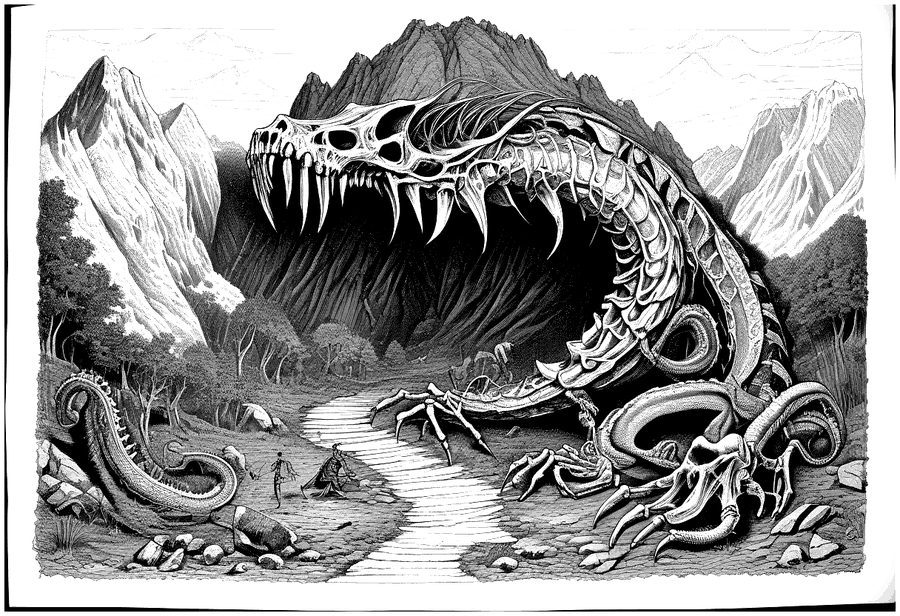
The Kjelheimers of Kovavikia and rural Raugaria worship the Worm itself and the old gods who live in its body: Isgard of the glaciers, Skarn of the iron veins and Mora Fen of the marshes. They believe the Worm is only sleeping, and that the earthquakes and the smoking of Foleleyme are signs of its stirring.
Honour: honouring ancestors, offerings to the land. Shadow: digging too deep, waking what sleeps.
Life & lore
- Holy days
- On Wormwake Eve (6 Rostovund) mead is poured into cracks in the earth 'so the Father sleeps', and Rostovund is the month nobody marries. At Last Sheaf (15 Reaping) Kjelheim villages keep the 'Worm's Bride' rather than burn her. On the Listening, the first Lampless night after Breakice, families lay an ear to the hearthstone to hear the Father breathe.
- Daily practice
- A share of every kill is left on the rocks for the land. The household shrine is a crack in the hearthstone, never mended, into which a drop of every brew is poured. It is taboo to dig deeper than a man's height without a priest's leave. The liturgy is sung in the archaic church tongue, which few understand and everyone can hum.
- Rites of life
- A newborn is laid on bare earth for one breath so the Father can feel its weight. At fourteen a youth carries a river stone to the family cairn. Kjelheim couples in Gogur marry before the Rib Temple's bone, touching it together. The dead are buried deep, 'back to the bones', and never burned.
- Legends
- The cradle-song's refrain is Skørdlan bjanyl, pistbe skørdlan hvo ul, 'The Father sleeps, but the Father does not die.' Kjelheimers say the white bone in the Rib Temple is a rib of the Worm and grows when it dreams. Fen children are told the marsh horrors are the Worm's fingers, feeling for the Penner's wall. A white owl over the village means a priest will die.
- History
- Kjelheim priests found the white bone in a riverbank and built the Rib Temple around it in about 300. The Fagervik Faith grew out of the old Kjelheim gods, and the Kjelheimers have never forgiven it. In 525, the Long Winter, masked men drowned a Raugarian priest at Gogur to stop the glaciers. In 611 a whaling captain bought back his ship from Skjoldis with a gold torc stolen from the Rib Temple.
- Clergy & saints
- Fennik Dalsson, the Rib Temple's old priest, hides Kjelheim rebels under its floor. Sobotlik Tritasimdottir, a bone-priestess near Vasvolfos, keeps the old shrines, refuses to bless anything Raugarian, and has found a Raugarian priest frozen upright in a forest shrine holding a Wormwaker mask. Dånu Brusson, a blind cantor in Gogur, sings the archaic liturgy that the insurgents chant in the streets.
- This year
- The Rib Temple's bone has begun to grow frost on the hottest days. Kjelheim cottagers read the Comet of Thaw as the Worm opening one eye, and the earthquakes and the smoking of Foleleyme as its stirring. Gogur rumour says the Bone Speaker of the Wormwakers is a priest of the Rib Temple, and one Kjelheim priest is quietly trying to find out which.
- The war
- The Raugarian Insurrection speaks Kjelheim: its songs are the old liturgy, and the Kjelheim Remnant inside the Fagervik priesthood feeds it. The Wormwakers fight alongside the rebels, who fear them. Raugarian priests now demand that the Shedding be kept on 10 Hofjor, and many villages send one old man with a basket to the woods and call it done.
- Tithes & law
- Kjelheim has no teaching on lending and no tithe; priests live on offerings of mead, meat and fleece. A man who digs a well too deep without leave must fill it again by hand. Rib-bone masks sell to collectors in Fagervik for 2 cr, though owning one is suspicious. Under Raugarian law the faith is tolerated and its priests are watched.
- Healing
- Priests at the Rib Temple heal free for anyone who will pour an offering, and bone-priestesses set bones and sing over fevers. Kovavikian bone-setters hum the liturgy while they work. Marrow-salt is the Worm's dreaming, so healing with it is forbidden, and opening a body, living or dead, is digging too deep.
Adventure seed. Sobotlik Tritasimdottir will name the Bone Speaker if someone brings back the gold torc stolen from the Rib Temple in 611, which Skjoldis may still have.
Utturi
the Light Manticore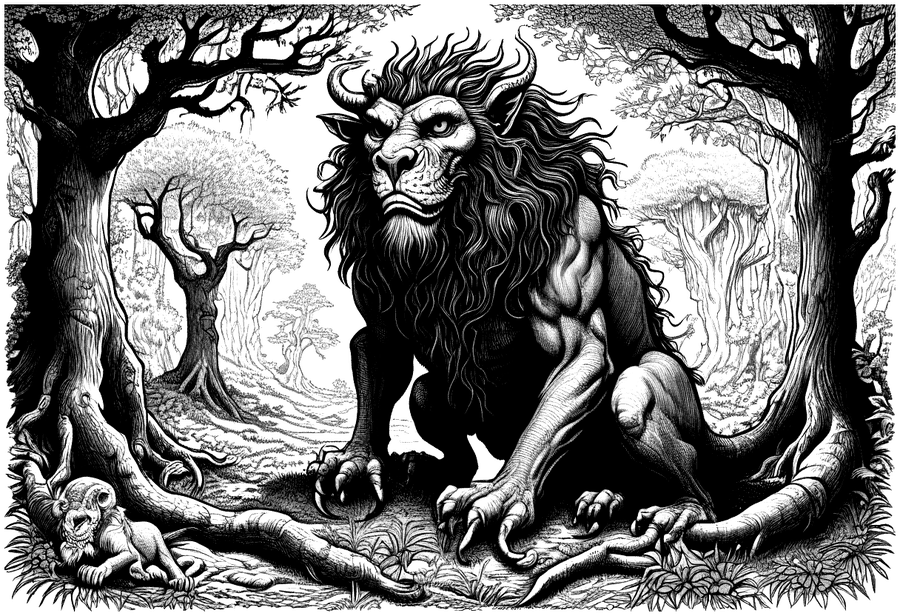
A shining beast with a lion's body, a scorpion's tail and a wise man's face, who guards the southern forests. Druids leave honey and blood at the roots of great trees for it. Utturi is the oldest Soumi god and the root from which the Silent War grew.
Honour: guarding the forest, taking only what you need. Shadow: burning woodland, killing elephants.
Life & lore
- Holy days
- On Tusking (5 Mieles) the working elephants are washed and their tusks oiled, and honey is left for Utturi at the roots of the great trees. On Root Night (12 Hofjor) druids pour honey and a cup of blood at the oldest tree of each district, and nobody rides a horse after dark. At the Marking (20 Uxbridmanch) druids blaze new trees with Utturi's sign, a three-pointed scorpion tail.
- Daily practice
- Druid households cook only on deadwood, never on cut timber, and take only what they need from the forest. Every house keeps a jar of honey that is never eaten, for Utturi. Never step over a sleeping elephant. Druids wear undyed wool and a scorpion's sting on a thong, and are listened to even by the Silent Church.
- Rites of life
- A newborn's afterbirth is buried under a sapling, and the tree is the child's for life. At fourteen a youth spends a night alone under a marked tree and must answer Utturi's riddle slowly in the morning. Couples are betrothed by a Day of Sitting under a great tree. The dead are buried at its roots with honey, so that Utturi takes them.
- Legends
- Druids say Mikhuu jaalu lepu sunan, 'The forest hears every word', and Soumi grandmothers say it back to Angshire travellers. In the tales Utturi tests travellers with a riddle and eats the ones who answer too quickly. Anyone who sees its face at dusk will never lie again, which is why liars avoid the forest edge.
- History
- Utturi is the oldest Soumi god, and the Church of the Silent War grew from his worship. In 612 Prince Aarno I had the first wild herd driven in from the southern forests for the Royal Stables, and the druids cursed him for it. Igyoszavas took up the god after the conquest of 590, and its herders now swear the Sitting of Snow oaths at Utturi's trees.
- Clergy & saints
- Druid Nusaa Taltusinen tends the Root Oak above Nadaros and preaches that the gas-works must be cut loose. Sarnaa Hamuninen is bark-mother of the Valsiarian groves, who licenses every Utturi bark-cutter, and has cut the year's harvest by half to save the trees, so that the price has quadrupled. The druids mark more of Utturi's trees every year.
- This year
- Utturi bark costs four times its old price in places, and the Raugarian wetlands blame Sarnaa Hamuninen. The Manttamite crusade has drawn foresters away and left the herds unguarded, and the Tulpio Tigers are poaching. Herders on Foleleyme's slopes left honey and blood on Root Night and asked Utturi to keep the mountain asleep.
- The war
- The druids refuse the war as Valsiaria does, but the crusade marches through their groves. Igyoszavas herders, sworn to Utturi, are caught between the Balsozhian levy and their Hajhian kin. The Kaporesian Cells hide guns in forest shrines, which the druids call a burning of woodland by other means.
- Tithes & law
- Utturi bark is the faith's wealth: 1 sh a dose on the coast, up to 4 sh this year, and a tenth of every sale goes to the groves. Felling one of Utturi's marked trees is punished by exile. Killing an elephant is the worst sin. Druids sell honey-and-resin salves for axe cuts.
- Healing
- Druids heal with Utturi bark for marsh ague, honey, resin and moss for cuts, birch-bark splints, and clay and moss for crushed limbs. Gas-works labourers get cold iron round their necks and a night's sleep under the oaks. Splints must come from fallen bark: cutting living wood to heal one creature means wounding another.
Adventure seed. Sarnaa Hamuninen's bark-cutters are being robbed in the groves by men who leave honey at the roots. She suspects her own druids and needs strangers to watch the trees.
Poglianolino
the Loud Camel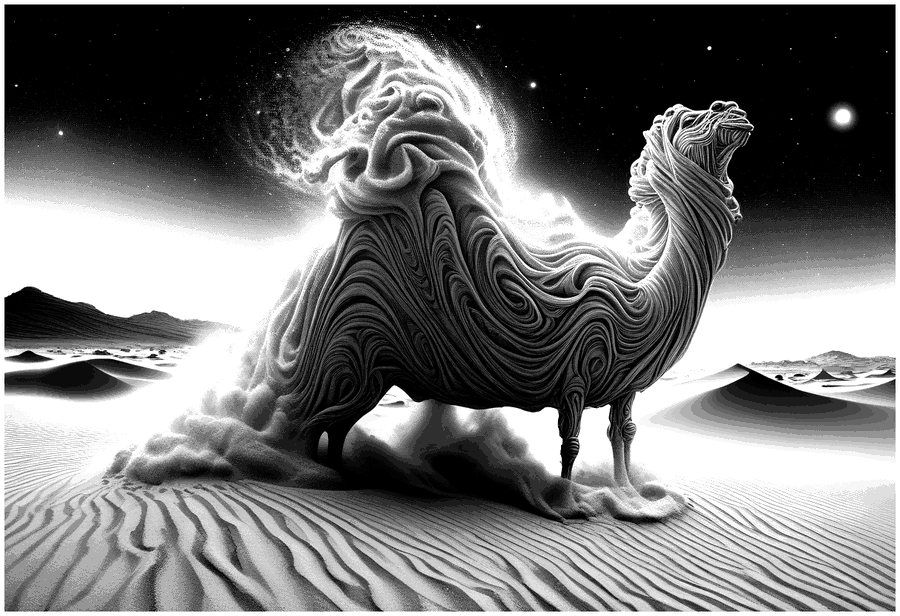
A trickster caravan-spirit who brings sandstorms, laughter and lost things found. Tallian drovers tell his stories around fires, and every story ends with the teller owing the camel a song.
Honour: a good joke, a debt repaid with interest. Shadow: humourlessness, stealing from a caravan.
Life & lore
- Holy days
- On Camel-Debt Night (1 Reaping) every tale told must end with a song owed to Poglianolino. The Owing (20 Reaping) gathers the caravans at the Lake Shore of Erencszasz to settle debts with a song each, and nobody may 'pay flat'. Tallians keep New Fire and Ashnight like everyone else, but on Ashnight each of them tells one new story and goes to bed owing the camel a song.
- Daily practice
- Jokes are prayers, and a practical joke is the most devout kind. Every evening at the fire, someone tells a story, and the teller hums the first line of a song owed to the camel before sleep. Caravans are named for their lead camel. Salt tea is drunk for everything, and the drover's red scarf is pulled over the face when the wind turns, 'so the camel can't see you laugh'.
- Rites of life
- A groom owes his bride's caravan one song for every camel it owns, so rich brides are hard to win. A newborn is given a debt-name, a story it must one day finish. Coming of age is the first tale told at a caravan fire that makes a stranger laugh. The dead are buried with an unfinished tale whispered into the grave, so the camel will come and ask for the ending.
- Legends
- Every child learns Tofino mosi zinlo banosi, 'The camel remembers every debt', and its answer, Lerdolsi banosi litga lerdolsi tomo, 'Pay the debt, and pay the song.' Poglianolino hides lost things in sandstorms and returns them to the person who laughs first. A humourless man is suspected of theft, and a caravan that loses its way sings louder.
- History
- The great tale of the faith is the Silent Caravan of 699, which refused to laugh for a whole crossing of the cold desert and was buried by a sandstorm. When it was dug out in 702, every pack was full of things other caravans had lost. Since then, a Tallian who finds a lost thing must tell a joke before picking it up.
- Clergy & saints
- Pibu Lucky-Song, the most famous storyteller in Hajhia, owes the camel three hundred songs and is said to be the holiest man alive for it. Renci Red-Tale is debt-keeper of the Owing, who keeps the tally of songs owed by every caravan and has refused to forgive a single one this year. Zitede Loud-Debt smuggles refugees round the Balsozhian lines for a story each.
- This year
- Pibu Lucky-Song has announced a new story for the Owing on 20 Reaping, and caravans are racing to Erencszasz to hear it. Caravans wintering in northern Hajhia are cut off by the occupation. Renci Red-Tale says the war has left the Tallians owing more songs than they have voices.
- The war
- Balsozhian quartermasters are seizing camels, and camel prices have doubled. The cold desert routes are full of refugees who do not know the wells, and caravans guide them for a story each. Stealing from a caravan is the worst shadow, so Tallians call the Balsozhian seizures theft and sing very rude songs about the Emperor.
- Tithes & law
- A debt repaid with interest is honour, so Tallians lend and borrow freely, in coin or in songs. A caravan thief walks behind the caravan for a season, eating its dust, and nobody tells him a story. There are no priests and no tithes, but every caravan carries a 'camel's purse' of small coins, spent each Owing on a feast for strangers.
- Healing
- Herb-wives treat sand-burn with camel butter, cracked lips with mutton fat and everything with salt tea. A sick child is told a funny story, and if it laughs it will live. A sad song at a sickbed is forbidden. Tallians trust Thetletown hospitals only if they are allowed to pay in songs.
Adventure seed. Renci Red-Tale's tally of debts has been stolen from her wagon at the Owing. Whoever holds it knows what every caravan owes, and some of the debts are not songs.
Gabingdon
the Mule of Gates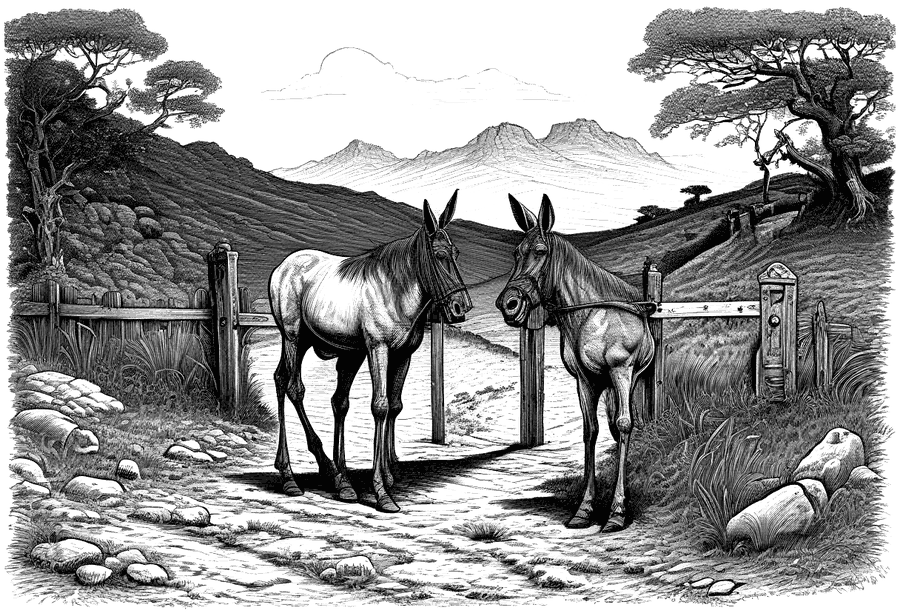
The stubborn spirit of thresholds, roads and boundary stones, older than the Thetletown Church that grew from him. Angshire travellers touch a gatepost and say "Gabingdon, see me through." Fleeing thieves say it too.
Honour: keeping a road open, showing a stranger the way. Shadow: moving boundary stones, barring a gate to the desperate.
Life & lore
- Holy days
- Gatefair (1–3 Haymonth) is Gabingdon's feast: boundary stones are walked and beaten, gates are hung with ribbon, and road-tolls are waived for three days in his name. On Drove-Off (20 Reaping) the herds leave for Macham with a fiddler in front and a mule shoe nailed to the last gatepost. On New Fire the first-footer must come through the gate, never over a wall.
- Daily practice
- Everyone touches a gatepost and says 'Gabingdon, see me through', and fleeing thieves say it too. A mule shoe hangs on most field gates, points down 'so the luck walks out with you'. A gate is left as you found it. Showing a stranger the way is the commonest holy act in Merland, and it costs nothing.
- Rites of life
- A newborn is carried out through the field gate and back so that Gabingdon knows its face. At twelve, children are bumped on each boundary stone at Gatefair so they will remember it. A Litta bride walks the boundary on her wedding morning and touches each stone. Coffins leave by the gate, never the front door.
- Legends
- Gabingdon the Mule of Gates stars in a hundred tales in which the stubborn mule outlasts a king, a dragon and a lawyer. The saying is Gabingdon sees you through, and the smugglers called the Gatemules are named for him and pray to him before every run. A gate that swings shut on its own means a guest is coming who should not be let in.
- History
- Gabingdon is older than the Thetletown Church that grew from him. The Synod of Totrinch in 633 ruled him a saint of roads rather than a god, which let the Church keep the custom and the villages keep the god. The beating of the bounds is older than any charter, and Merlish courts still accept a Gatefair walk as proof of a boundary.
- Clergy & saints
- Jethro Stile, bound-beater of Torkburgh, led this year's Gatefair walk and found the moved stone on Calloway land. Old Nan Hobday is stone-warden of Totrinch parish, who has walked its bounds for fifty-one Gatefairs and swears the stone that moved forty yards there was not moved by hands. Kit Halloran, who smuggles for the Gatemules in Shifract, says the prayer every night.
- This year
- Gatefair is running now. At Torkburgh the bounds have turned up a moved stone on Calloway land, and near Totrinch another moved forty yards overnight. Nan Hobday says that both stones moved towards the east.
- The war
- Barring a gate to the desperate is Gabingdon's great sin, and Merlish parishes are arguing over the Hajhian refugees on the eastern roads. Some villages leave their gates open and feed whoever comes; others chain them and are mocked at Gatefair. Press-gangs who drag men through a gate are cursed in Gabingdon's name.
- Tithes & law
- Tolls are waived for Gatefair's three days. Moving a boundary stone is a crime in Merland: the mover is set in the stocks beside the stone and pays for a new survey. Gabingdon has no temples, no priests and no tithes, only bound-beaters and stone-wardens, paid in ale by the parish.
- Healing
- A sick child is carried through the field gate three times at dawn. A fever is 'shown the road' by opening every gate on the farm at once. A sick person must never leave by the front door, or they will not come back through it. Proper medicine is left to the Thetletown hospitals and the barber-surgeon at 6 d for a bone.
Adventure seed. Nan Hobday has charted the moved stones on a map, and they all point towards one empty field near Totrinch. Something under it has been pushing them.
The Many in the Water
no single god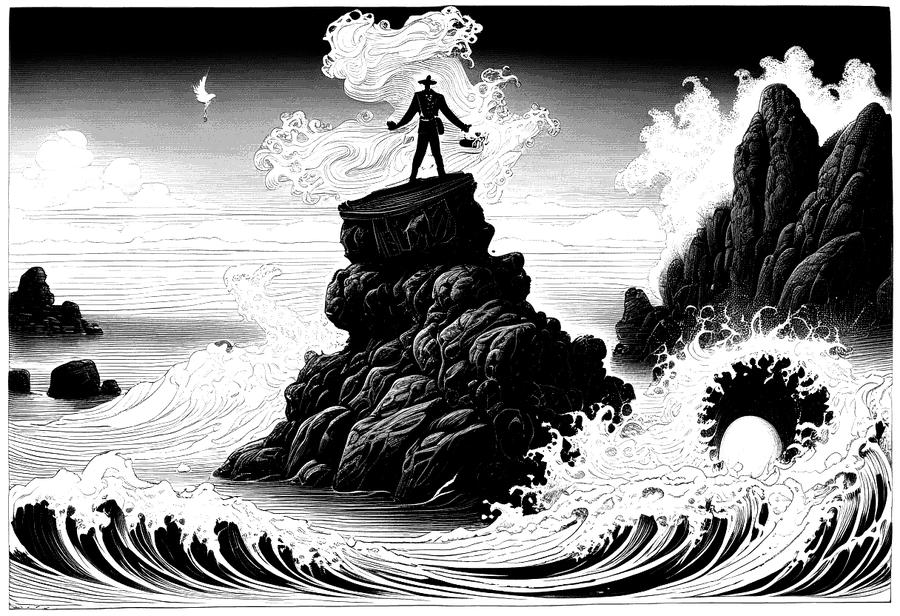
The Elladans of Kaporesia know no high god, only the spirits of each bay, reef and wind. A captain who does not pour wine for the harbour spirit before sailing will not find a crew.
Honour: courtesy to places. Shadow: fouling water, drowning a captive.
Life & lore
- Holy days
- Rain-Wine (last day of Mieles) pours wine into every bay and river before the monsoon closes the tracks. The Opening of the Bays (10 Haymonth) reopens the sea, and every captain pours wine to every harbour from Hubros to Histhos. At Lefka, Floodwake candle-boats are pushed upriver towards the stepped temples, and the Ferrying (1–9 Tunarejo) puts obols on every grave.
- Daily practice
- A bay, reef or wind is spoken to in the courtesy form; using the ordinary 'you' is like slapping a priest. No captain sails without pouring wine for the harbour spirit. Spitting in water is the one thing no Elladan finds funny. A captain who sneezes as he boards waits a tide. Every house has a cup by the well, and the first water of the morning goes back into it.
- Rites of life
- A couple marries at the tideline, and each pours wine to the bay in the courtesy form. A newborn's name is first whispered to the sea. At thirteen comes the First Bench, a day's rowing without rest. The dead are burned on the beach with an obol on each eye, and their ashes buried inland, because nothing dead may foul the water.
- Legends
- The harbour-pourers' charge is Rhaikein bonasas tor serderos, 'Give wine to the harbour.' Villages say Nelo seision phipon totachon, 'A dirty well kills the village.' In 791 the harbour-pourers of Myrnamon held a council over whether the sky needed wine too, after Pibbet Brasswhistle's balloon; they decided it did, and pour a cup upward on Pibbet's Day.
- History
- The Elladans have never had a high god, and every Despot who tried to give them one has failed. In 702 the bay of Histhos turned red and refused all wine for a season, and its fishermen still call it the Sulk. Manttama drowned at Histhos in 806, which the Elladans count as a far worse sin than her preaching.
- Clergy & saints
- Kadorle Tonlidou is harbour-pourer of Myrnamon, and no ship leaves until she has spoken to the bay. Nammein Pidou, a reef-speaker of Lampsaratis, pours for the pearl beds and says the reefs have refused her wine three times since Mieles. Phesasys Lyminpidou, a Lefka guide, pours lamp-oil for the Green Sleeper as well as wine for the river.
- This year
- Some villagers say the Green Sleeper turned over in Rocadones, because the jungle inland from Lefka grew a yard in a week. The Bloom is coming down the rivers, and river villages say the water spirits are sick. The Dearth has quadrupled grain prices on the coast, and Rain-Wine was poured thin this year.
- The war
- Kaporesia is far from the northern war, but Manttamite cells land hand-gonnes at Lefka's creek, and the Despot's marines search every boat. The harbour-pourers have refused to pour for ships carrying guns, which smugglers solve by pouring for themselves. Drowning a captive is the worst shadow, and the marines have been warned.
- Tithes & law
- Harbour-pourers are paid a cup of wine per ship and an obol a voyage, and a big port's pourer lives well. Fouling water is punished by the village, not the Despot: the offender cleans the well by hand and pays for new rope. A captain who sails unpoured cannot hire a crew in any Elladan port.
- Healing
- Elladan healers ask the local spirit before they treat a patient, and refuse if the answer is no. Reef-cuts are washed in palm spirit, and marsh ague is cured with Utturi bark from Valsiaria. Washing a wound in the sea without asking the bay first is forbidden, and so is burying a body in a riverbank.
Adventure seed. The reefs of Lampsaratis keep refusing Nammein Pidou's wine. She will pay a diver to find out what has been dropped among the pearl beds since Mieles.
Tugan
the Magenta Elephant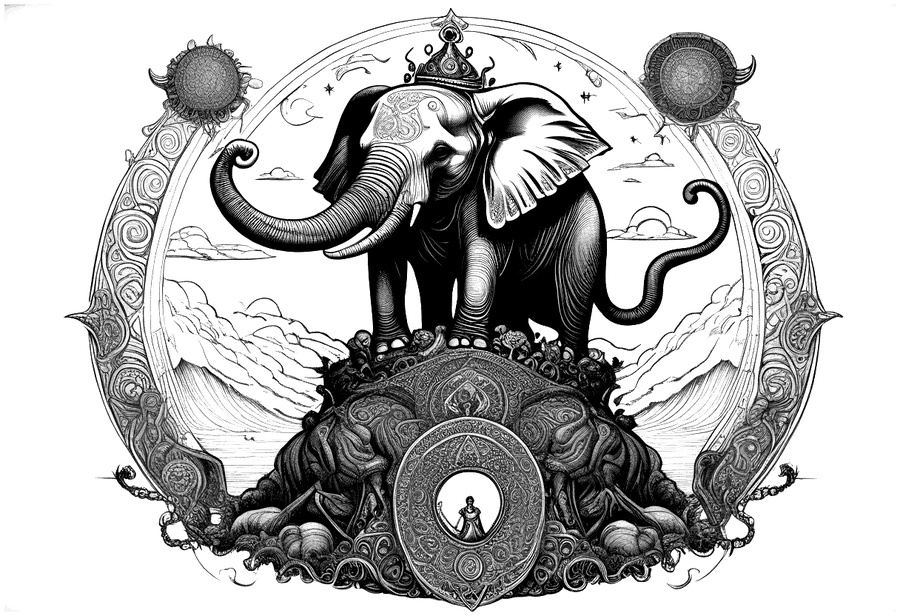
The elephant-god who trampled the Worm's head and now carries the sky on his back. Kahpan priests dye their sacred elephants magenta, and a shah is not crowned until one kneels to him. Tugan's family includes Ashrin of the hunt and Mahrang, who brings the rains. Followers: Kahpia, Sag, Jowshia.
Honour: generosity at feasts, protecting elephants, keeping promises to a ruler. Shadow: killing an elephant, breaking an oath sworn on Tugan's tusk.
Life & lore
- Holy days
- The Kneeling of the Elephants (1 Thaw) parades the magenta elephants, and the Shah is crowned again when the great elephant kneels; every village with a temple elephant holds its own small Kneeling. Tusk-Wash (9 Reaping) scrubs and re-dyes every sacred elephant. Mahrang's Drum (1 Isgard) drums in the summer rains. Ashrin's Night, at the dark of the Lamp in Haymonth, opens the hunting season.
- Daily practice
- Tugan's name is never used in a curse, and nobody steps over elephant dung. Magenta is reserved for the temple elephants and their priests. Business and marriage begin with a gift. Every house hangs a bronze elephant-bell over the door, and children are told that if every elephant lay down at once, the sky would fall.
- Rites of life
- A newborn's name is whispered first into an elephant's ear. Coming of age is reciting a poem of your own to the eldest of the household. A bride walks under the temple elephant's raised trunk, and wealthy families pay in siglos for an elephant to walk behind the couple. The dead are 'carried on Tugan's back' to mound graves on an elephant-drawn litter.
- Legends
- Every child knows Tugan mashab vabghe, 'Tugan carries the sky', and the priests add Povar zinghar hikfoz, 'The elephant remembers the king.' Tugan trampled the Worm's head into the southern desert, and drovers say the chiming of the Glass Waste is its teeth grinding. Ankhorra appeared over Shahpabad in 700, and grandmothers say the dragon still waits for a worthy shah.
- History
- In 700, the year Ankhorra appeared, the elephant-priests began dyeing the war-elephants magenta 'so the dragon would know whose they were'. A dyer of Harabnak got the colour by boiling the roots of a thorn-shrub, and Harabnak has grown rich on dye-root since. The Kavarri name their twelve months after Tugan's family.
- Clergy & saints
- Tichek Khekozdari keeps the great kneeling elephant, Kuramesh, and is the only person it obeys. Elephant-Priest Ghir Zhadari leads the faction that wants the dragon appeased before the war goes further. Teshar Gondi, a mahout-priest at Esfabares, trims the lamps at the mouth of the Shushan Sepulchre and wants to know why the dark has crept three paces nearer since Rocadones.
- This year
- Kuramesh refused to kneel at a rehearsal for the Kneeling, and the priests say the Shah's crown is in danger unless someone finds out why. The elephant migration near Chudeshk has trampled villages, which priests read as Tugan's displeasure. Zhiv Ormandi, the Master of Dyes, wants the Repainting held a year early to please the elephant-priests.
- The war
- Kahpia fights Jowshia, and the war council is rumoured to want temple elephants for the front, which the priests oppose. The elephant-priests warn that a shah who wants two crowns is what Ankhorra is looking for. They pray to Tugan for victory and heal soldiers first, but the Grey Walls in Shahpabad are owed six months' pay and the priests take their side.
- Tithes & law
- Ivory from a dead elephant belongs to the temple. Killing an elephant is death, or a lifetime shovelling in the temple lines, and an oath-breaker who swore on Tugan's tusk is executed by an elephant. Lending at interest is permitted to kings only. Patients and pilgrims pay with a gift to the temple elephant, and the great temples are rich in siglos and sugarcane fields.
- Healing
- Elephant-priests heal by the gift of Tugan for 5 sh a wound or a goat, setting bones in bamboo splints and packing wounds with turmeric paste. Their honey-and-dung plasters are said to draw out arrows, and tamarind poultices treat crown-blindness. Powdered ivory, sold as medicine in the north, is forbidden: it was taken from a god's child.
Adventure seed. Tichek Khekozdari believes Kuramesh refused to kneel because it smelled something under the Kneeling ground. He wants it dug up before 1 Thaw, without the war council knowing.
Asheena
the Lady of Nature, the High Leopard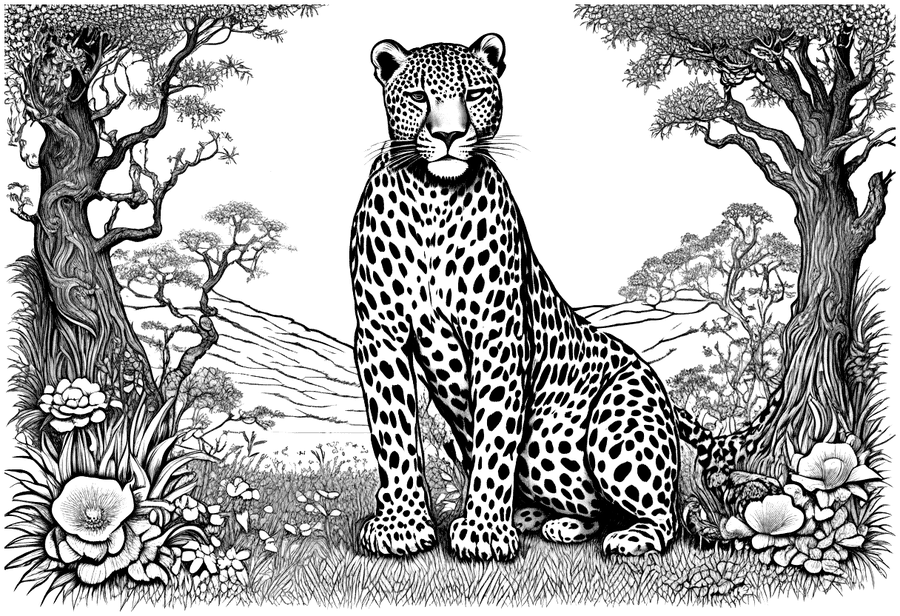
The spotted goddess of every living thing, at war with the Barren, the emptiness that spreads the desert. Her leopard-priests plant groves on the desert's edge, guard the oases and hunt those who salt the land. The faith has only one realm, Haruwayha, and it means to keep it.
Honour: planting, healing, hunting only to eat. Shadow: salting or burning land, waste, cruelty to beasts.
Life & lore
- Holy days
- On Groving (18 Hofjor) every family plants a tree on the desert edge, and the leopard-priests hunt that year's salters. Fruiting Day (1 Uxbridmanch) frees Haruwayh's street trees to anyone who picks. The Seed-Fair at Jafinah in Reaping trades seedlings and grafts. The Warden Halls keep the Lamp Vigil (30 Isgard), when Bretborn elders sing a verse of the Memory through the night.
- Daily practice
- Haruwayhan villagers leave their gates open at night, because a leopard walking into a village is Asheena's judgement and shutting it out is worse. Meat is eaten only from a beast killed to be eaten, never for sport, and nothing is thrown away. Leopard-priests walk the streets with tame leopards on leashes. A child's first word should be kajah, 'leopard', so the goddess knows the house.
- Rites of life
- A couple plants two trees side by side on their wedding day and is judged by how the trees grow. A boy or girl who wants to be a priest must care for a leopard cub for a year. The dead return to the grove as trees: they are buried under a sapling, never burned, and the family tends that tree for three generations.
- Legends
- The Bretborn-led priests pray in Lanthe, Asheina, di nimir, 'Asheena, hear us', and Iss aessipanir tu nesae lugath, 'Grow the trees on the edge of the desert.' The faith calls every dragon a servant of the Barren except the Green Sleeper. Grandmothers say a leopard seen on a roof means a birth, and one seen in a well means a drought.
- History
- The Leopard Bretborn stayed on Qabahrah after the exodus, settled the green highlands of Haruwayha and founded the faith of Asheena. The leopard-priests held the highlands against the Caliphate in the Asrahan War (607–616), and the Desert Stair was built after it to hold back the sand. The faith has only one realm, and it means to keep it.
- Clergy & saints
- Warden Saihia ith Nagun of the Green Edge heals in the Grove-Temple and wants the Mirqah Cavern sealed. Fael ith Nimeth, grove-master of the Desert Stair, counts every tree planted at Groving and says the desert has gained ground for the first time in thirty years. Can ith Chor, a Bretborn Warden at Fuluwai, is collecting volunteers to claim the blade offered for the Najrah Cyclops.
- This year
- The leopard-priests say the Mirqah Cavern is breathing cold. Leopards have been seen on the ridges in numbers, and the Wardens say Asheena is hunting the Cyclops herself. The leopard-priests offer a blade of watered steel to whoever kills it. The Leopard Wardens are hunting the Mercy, the Rot Communion's would-be healers, along with the rest of the Communion.
- The war
- Haruwayha fights for Kahpia against Jowshia, and leopard-priest infantry have gone south, so the groves are tended by children and the old. They march through, take nothing and plant trees where they camp. Jowshians who once bought their salve now curse them, and the Hunters of the Barren raid across the Jowshian and Tubari borders.
- Tithes & law
- The faith gives gifts, not loans. Temple healing costs 5 sh a wound or a sapling planted, and the glass-eye salve sells for about 3 sh from Haruwayhan pedlars. Salting or burning land is death at the hands of the leopard-priests, cutting a fruit tree is a hanging offence, and killing a high leopard outside the faith brings the Wardens after you.
- Healing
- The leopard-priests are among the finest healers in the world. The Grove-Temple's snake antidote is the best on Qabahrah, and its salve treats glass-eye if used early. They carry marrow-salt for the poor and burn the Bloom out of a hand for nothing. Using any part of a leopard in medicine is forbidden, and so is a cure taken from an animal killed for it.
Adventure seed. Fael ith Nimeth has found salt in the new Groving plantings on the Desert Stair, scattered at night, and the salter left leopard tracks. Someone is framing the goddess.
The Spirits of Shore and Hearth
no single god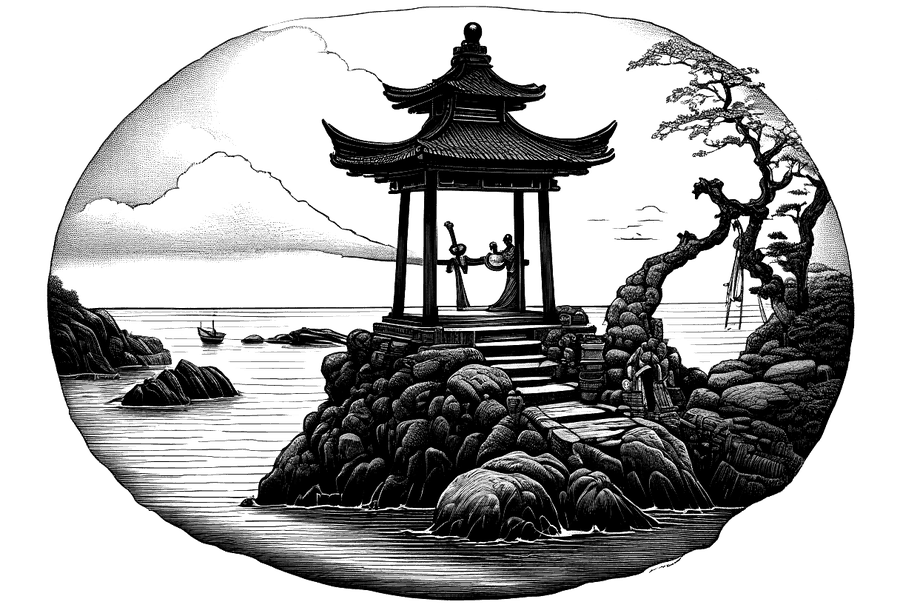
Every island, cape, harbour mouth and hearth has its spirit, and the honoured dead join them. Shrines stand at the entrance to every Kushi harbour, and ships dip their sails as they pass. The Mikagabohi Forest near Nizu is sacred to them. Followers: Kushi, Ritata.
Honour: courtesy, cleanliness, honouring ancestors. Shadow: desecrating a shrine, dishonouring the dead.
Life & lore
- Holy days
- On Shrine-Sweeping (1 Thaw) every household cleans its threshold and the harbour-mouth shrine. At Sail-Dipping in Rocadones every ship dips its sail to every shrine, ancestors are fed and new hulls named. Forest Night in Uxbridmanch has Nizu walking the Mikagabohi Forest in silence. On Lantern Return (15 Tunarejo) paper lanterns float out of harbour for the dead, who are always at sea.
- Daily practice
- Every house has a hearth shrine, swept three times a day and given the first bowl of rice. The polite ending -ise is added for shrines, hosts and elders, and leaving it off at a harbour shrine insults the spirit. Sailors take a sea-name on their first voyage. Shrine-priests sell harbour charms at 2 d, and nobody boards without one.
- Rites of life
- A newborn is named at the hearth shrine on its seventh day. A child's first voyage gives it a sea-name. A marriage is sworn on the shore with land verbs, because a sea-promise does not bind. The dead 'go to sea': their ashes go into the harbour-mouth shrine, and their names are spoken only with sea verbs thereafter.
- Legends
- The harbour prayer is Mama ke hamima, ami zu yuyotsuseise, 'Spirits of Shore and Hearth, hear me.' Housewives say Hamihamima ri fumu goni zu meomi, 'The spirits love a clean house.' A ship left unnamed overnight takes a name of its own, usually a bad one. The faith teaches that the deep anchors the islands and Murrowmaw is the anchor-chain.
- History
- The Mikagabohi Forest near Nizu has been sacred since before the Kushi conquests. On Pox-Night (9 Mieles) Chain islanders light a lamp for each of the dead of 631, the Pox Year, when Tsuruma physicians first variolated the sick; the shrine-priests opposed it until their own children took the pox. Kushi officials have consulted shamans about the weather since the tsunami of 798, and pretend otherwise.
- Clergy & saints
- Sae of Ruihishima is priestess of the tower-shrines and keeps their lamps lit through every storm. Remoshima ke Soyasu keeps the harbour-mouth shrine at Nizu, the oldest in the Chain, and has started refusing sail-dips from ships that carry Balsozhian silver. He says the ancestors will not accept a bow from a hull that is ashamed of its cargo.
- This year
- Ritata's Tsuruma castle at Ninakashi flies a Balsozhian horse-banner, and Ritatan shrines have been swept twice a day since as an apology to the ancestors. A Kushi trader, the Jun-maru, vanished north of Vopeid in Mieles, and her families are holding Lantern Return early. Soyasu's refusals have Nizu's merchants furious.
- The war
- Kushi and Ritata are tied to the Fagervik Compact, so Kushi's fleet escorts Balsozhian silver and Raugarian furs, and League ships are searched hold by hold at Ichi. Shrine-priests bless both kinds of ship. The Admiralty is pressing Halmi sailors, and the shrines are full of offerings from mothers whose sons have gone.
- Tithes & law
- Lending at interest is permitted, and shrines lend rice against the next harvest. Desecrating a shrine is the worst crime in Kushi; the offender is exiled to an islet without a shrine, after sweeping every shrine on his own island under guard. Charms cost 2 d, and a new hull's naming at the harbour shrine costs a crown and a barrel of the first cargo.
- Healing
- Shrine-priests treat sicknesses blamed on dirt or dishonour with purification and a very thorough bath, and many patients recover simply from being clean. They heal for an offering of rice. Tsuruma surgeons, the best in the world, sew wounds with silk. Touching the dead without purification is forbidden, so surgeons wash before and after every operation.
Adventure seed. Remoshima ke Soyasu has been offered a fortune to accept one Balsozhian ship's sail-dip. The ship's captain says the ancestors already refused her once, at sea.
The Mountain Grandmothers
spirits of the island peaks
The Halmi clans of the southwestern isles believe each peak is the grandmother of the people below it. Shamans speak for them in trance, and no boat sails without their omen. The Grandmothers are said to have opposed Kushi's conquest, and they are patient.
Honour: respect for elders, offerings on the peaks. Shadow: abandoning kin, building on a sacred mountain.
Life & lore
- Holy days
- On Grandmothers' Climb (Mieles, after the long rains) every clan carries fish and pearls up its own peak. The Feud-Count, at the dark of the Lamp in Isgard, has the elders recite every clan feud. Clan-Gathering on Tonghangju in Reaping settles feuds by song. Kuraji climbs its peaks for the Grandmothers on the Kushi Forest Night in Uxbridmanch.
- Daily practice
- Nobody sails without a shaman's omen from the Grandmothers, not even the Admiral, and a circling frigate-bird means 'turn back'. The eldest speaks first, and a reply begins by naming the eldest present. Halmi exiles leave rice on the shore for the Grandmothers. Houses are palm-thatch on stilts, and the clan's longhouse is the shaman's.
- Rites of life
- Children are named by a shaman's omen and given their first sea-bath by their grandmother. A marriage needs a shaman's omen, spoken in the omen mood, and the bride's clan must forgive one old feud. The dead are buried on the slope of their grandmother peak, facing it. A kin-abandoner's name is cut from the ancestor chant, and it is never sung again.
- Legends
- Every child is taught Wiga ma seutgyung hae nyankyo ma iramu, 'The mountain is our grandmother', and Wyeo sa anyingjing, 'Do not sail without the shaman', which even Kushi officials say. The travelling circus on the beaches is said to be the Grandmothers laughing. The Grandmothers opposed the Kushi conquest and are patient: they are waiting for Kushi to forget them.
- History
- In 798 a tsunami struck Hwasun, and the shamans had warned of it, so only nine died. Kushi has consulted shamans about the weather ever since. The Geocheon Tomb near Seongju is older than any clan memory, and the shamans will not say whose it is. Halmi exiles carried the Grandmothers to Lantern Cove, where the pirates now ask for omens too.
- Clergy & saints
- Hwakdang Jennael, a shaman of Tonghangju, is the most respected omen-reader in the isles and will not say whether Kushi or Tebek will win the coming fight. Hwakdang Sina, a shaman at Goamyang, has declared that the Grandmothers forbid the Admiralty's new slipway on her peak. Cheon Wopyol, the eldest shaman on Hawon, decides which boats sail from both sides of the island.
- This year
- A travelling circus nobody can explain is touring the isles, and shamans have forbidden their clans to watch. Hwakdang Sina's ban on the slipway has stopped work at Goamyang. The Halmi of Yeongseon climbed their peaks in Mieles to tell the Grandmothers what the pirates have done, and Hokjak Jennael says Murrowmaw's tail is restless this summer.
- The war
- Kushi's Admiralty is pressing Halmi sailors, and Halmi crews at Lantern Cove are being bribed to vote in the Admiral's election. Halmi fight on both sides of the Kushi–Tebek quarrel, and a shaman's omen can keep a whole fleet in harbour. The Admiralty has learned to ask for omens quietly.
- Tithes & law
- Shamans are paid in fish, pearls and rice. Ignoring a shaman's omen is an insult, building on a sacred peak is sacrilege, and abandoning kin is the worst crime, punished by cutting the name from the ancestor chant. Feuds are settled by song at the Clan-Gathering, and the losing clan pays in pearls.
- Healing
- Halmi shamans heal in trance and are trusted more than the surgeons; they are more often right about fevers. Divers' deep-sickness is treated by putting the diver back underwater slowly and chanting. The half-drowned get kelp broth and ginger, salt-boils the shamans' kelp poultice. Elders are always treated first, and cutting the body of the dead is forbidden.
Adventure seed. Hwakdang Sina's peak at Goamyang has a cave the slipway diggers broke into. Inside are Kushi coins three hundred years old, left as offerings, and one fresh one.
The Bone-Rite
the Worm is dead, and we are its bones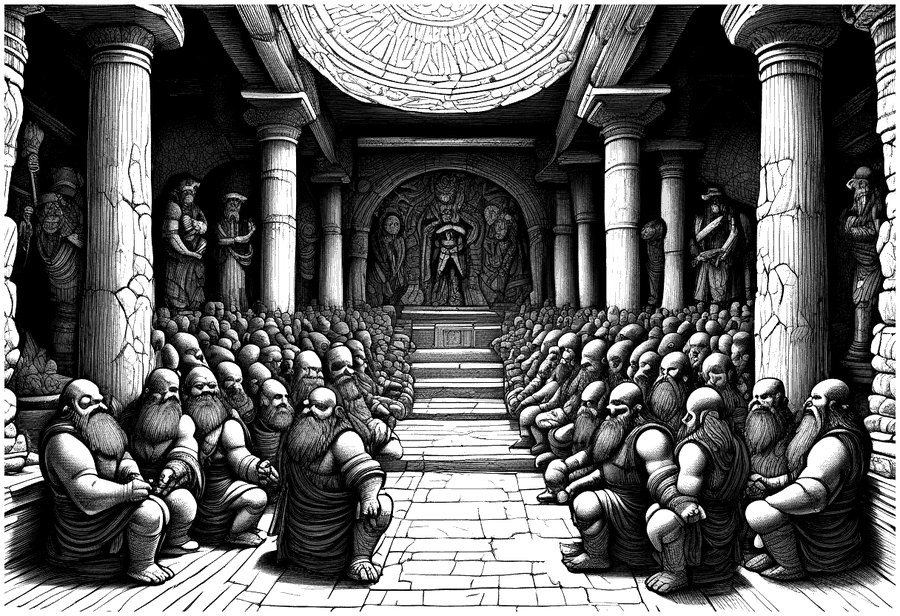
The Hoarfolk worship no living god. They honour the Dead Worm as the father whose skeleton they live in, and their own ancestors, who are laid in the deepest halls to turn slowly into stone. The rite's one commandment is that the Worm stays dead.
Honour: keeping a contract, burying the dead deep, sealing a dangerous seam. Shadow: breaking a hold's word, waking what sleeps, selling marrow-salt to a fool.
Life & lore
- Holy days
- On Wormwake Eve (6 Rostovund) every hold seals one old tunnel, so the Father may sleep undisturbed. On Surfacing (21 Rocadones) children under thirty are taken up to see the longest day, and most of them hate it. The holds light New Fire from their own forge-towers, never from a temple. The Last Toll (30 Isgard) gives the year's last traveller a seat at the hold's table.
- Daily practice
- Miners apologise to the Father-Bone before cutting a seam, and Ûrgrakê rîtazd khoz, 'Do not dig without a prayer', is cut over every gallery mouth. Nobody whistles below ground or names a dragon there; the dragons are 'the sleepers upstairs'. A Hoarfolk witness is believed only when he speaks 'struck', of a thing tested.
- Rites of life
- A child's name is cut on the record wall beside a blank space for its deeds. A marriage is a contract cut in stone and witnessed by both hold-lines. The dead are laid in the slow halls, the deepest galleries, where lime-water drips on them until they turn to stone, and they are visited once a delving, every fifty years.
- Legends
- The prayer at every sealing is Rhôst-Vundar, ûkum naskê. Ûrkhakhê, 'Rostovund, hear us. Do not wake.' Every child learns Grêrn drokholk thaz grêrn brozârg, 'A dead father is a good father.' The tale of the Miner Who Heard Breathing ends the same way in every hold: he dug towards it.
- History
- The Hoarfolk calendar is 3,000 years old, which nobody outside the holds believes. The holds opened to human trade in about 120, and the ingot-mark was first struck. Thunder-salt is their invention. The Marrow-Delvers of Ember Deep broke the rite by digging where marrow-salt grows like ice, and last winter they sealed themselves in from the inside.
- Clergy & saints
- Gravdal Khêzdis keeps the record wall of Gravdalla Deep; she has been refused entry to the lower galleries since Hofjor and has cut the refusal into the wall as an insult. Sunhal Khendith, Keeper of the Slow Halls of Sunhold, says the stone-dead in the lowest gallery have begun to drip warm water. Stair Gekhith, aged 171, is the oldest witness on the Stair.
- This year
- Gravdalla Deep sealed its lower gates in Hofjor and will not say why. Ember Deep is still sealed, and lights show in its vents. The Moot of Anvils meets at the Thousand-Step Hold in Reaping to vote on expelling the Open Forge, whose cannon sales have doubled the price of thunder-salt.
- The war
- Selling marrow-salt to a fool is the rite's shadow, and the Old Anvils say the Open Forge has sold cannon to two fools at once. Raugaria wants Gravdalla's guns for its regiments, and the Old Anvils refuse to sell until the Open Forge is expelled. In Merland, Hoarfolk are jostled in the street.
- Tithes & law
- Lending at interest is allowed only between holds. A broken contract is cut into the hold's shame-wall, and the worst punishment is banishment to the surface, being 'sent up'. Marrow-salt is mined with great care and sells for 5 cr a pinch. Every hold keeps a tithe-ingot, cast from one part in twelve of its output, which no one may spend.
- Healing
- Knitters, bone-setters working by marrow-lamp, mend crushed hands better than any human surgeon. Grey lung takes most miners, so they are retired to the surface at sixty, where they sit in the sun and complain. The rite forbids healing with marrow-salt, so a marrow-burned Delver gets cold iron bound to the wrists and nothing more.
Adventure seed. Sunhal Khendith wants someone who is not Hoarfolk to go down into the lowest slow hall at Sunhold, because only flesh can go where the stone-dead have started to wake.
The Memory
and Asheena, the High Leopard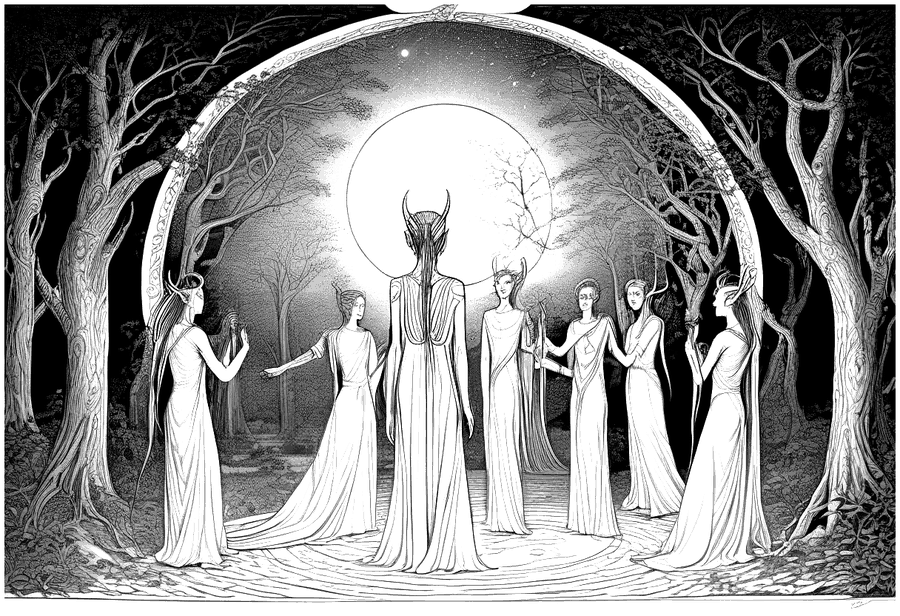
The Mistwood Bretborn keep the Memory: a sung history of the Elder Crowns and their fall, with each family keeping one verse. The Leopard Bretborn joined it to the worship of Asheena. Both teach that Bretbury burned because its rulers read what should not be read.
Honour: remembering, teaching, guarding forbidden knowledge. Shadow: forgetting a verse, reading the script aloud.
Life & lore
- Holy days
- On Ashnight (30 Isgard) each family sings its verse of the Memory in turn, so the whole history is sung through by dawn, and the Bretborn mourn through the Ash Days. The Warden Halls of Haruwayh keep the same night as the Lamp Vigil. The Mistwood keeps Landing (14 Mieles) for the exodus that reached the Raugarian coast in year 3.
- Daily practice
- Each family keeps one verse, and its eldest sings it every evening so the young hear it whole. The Elder script is never read aloud. In Lanthe the word lir means both 'to read' and 'to mourn', so a Bretborn who stops before a carved stone is grammatically grieving. A glowing freckle with no marrow near means someone, somewhere, is reading the script aloud.
- Rites of life
- A child is given its memory-name at seven, from an ancestor whose verse it must one day keep. An ash-born child is asked to sing a verse at its naming. Bretborn marry for a century and renew the contract, or let it lapse, at a feast where the couple sing each other's verses. The dead are buried beneath a sapling and never burned.
- Legends
- Elders teach Heva e mos bret, 'The ash remembers the fire', and Nimir e lir thedeir ar nimir e lir, 'We read the stones, and we weep.' Nobody sings the Hollow Verse, the gap where one family's lines were lost; children are told those lines are the ones that burned Bretbury. The Memory says Qalisar fused the Glass Waste to keep Bretbury buried.
- History
- The Mistwood Bretborn landed on the Raugarian coast in year 3. The Leopard Bretborn stayed on Qabahrah and joined the Memory to the worship of Asheena. Both teach that Bretbury burned because its rulers read what should not be read. In 803 the Mistwood perfected the sparklock, which the Memory allows as the only gun, and which the elders have regretted since.
- Clergy & saints
- Saihia of the Fallen Bell, a Leopard Bretborn of 611, is the oldest of her people and knew a woman born in Bretbury. Theth ith Vael, verse-master of the Mistwood, keeps the order of singing on Ashnight and has begun teaching every family's verse to his apprentices, which the elders call theft. Lis of the Pale Door, of the Silent Scholars, has burned three of a Successor's Scribe's notebooks this year.
- This year
- The empty reading-room at the Ucillamope Library is blamed on the Silent Scholars, and Bretborn are searched at its gate. The rubbing taken is rumoured to show where the Speaking Lens was hidden. The two Strays walking north and Ab-Fifth reading stones aloud in Qaqah have set every Lamp-Keeper's teeth on edge. The Comet of Thaw is in no family's verse.
- The war
- The Memory takes no side in the war, but the war takes Bretborn. Mistwood charts sell for 1 cr a sheet in Fagervik, and the Theocracy's officers buy them. In Shifract the Bretborn exiles have closed their doors since the Rust-Watch began asking questions, and in Haruwayha the Lamp-Keepers stay home while the leopard-priests march south.
- Tithes & law
- Lending is a human idea the Memory has no word for. The Lamp-Keepers and the Silent Scholars punish any reader of the script, and the punishment is never written down. A family that forgets its verse loses its place on Ashnight and must sit silent at the back until another family teaches it, at a price.
- Healing
- The Bretborn heal with marrow-salt in secret, against the Bone-Rite and the law of several realms: a pinch closes a wound in an hour and makes the freckles burn for a day. The very old may fall into the Long Grey, which no healer can treat, and the family sings their verse to them. Victims of Qalisar's forgetting are cured only by having their lives sung back to them.
Adventure seed. Theth ith Vael's best apprentice has vanished with half the Mistwood's verses by heart, and a buyer in Fagervik is offering 100 cr for a complete Memory.
The Grey Mother
the patient earth, and Tugan the Elder Brother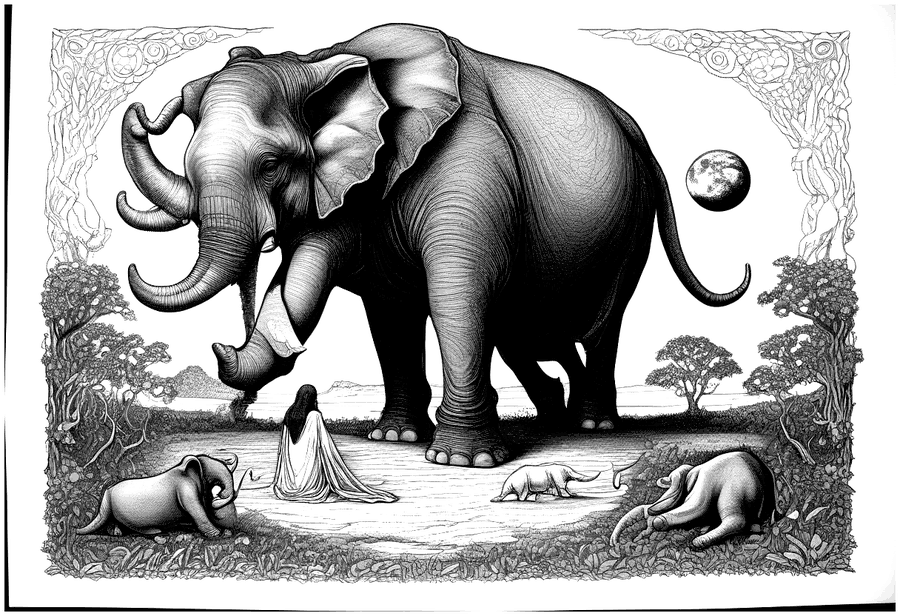
The Rhunari pray to the earth that bears their weight. She is slow, enduring and impossible to move, which is what a Rhunari hopes to be. Tugan the elephant is her eldest son, and the Rhunari call him brother. They pray to Tugan before battle and to the Mother at home.
Honour: a straight horn (the truth), standing your ground, paying a horn-debt. Shadow: a crooked horn (a lie), retreat without cause, killing with a gun.
Life & lore
- Holy days
- Hornday (20 Tunarejo) is the holy day: the year's deeds are carved on each horn, horn-debts paid or forgiven, and pushing contests held. The woolly clans hold the Soaking at the Satorbapios Springs from Thaw into Mieles. The savanna clans kneel with Tugan's elephants at the Kneeling (1 Thaw) and drum at Mahrang's Drum (1 Isgard).
- Daily practice
- Rhunari pray to the Mother at home and to Tugan the Elder Brother before battle. Each morning a Rhunari presses both palms flat on the ground before standing. Everything important is asked twice, because a dream of a crooked horn means someone near you is lying. In an oath a Rhunari does not say 'I' but 'this horn'.
- Rites of life
- A birth is announced with a single long horn-call. A suitor carries a stone into the family's kraal, and if they push it back out the answer is no. At about twelve a calf's horn is carved with its lineage for the first time. The dead are buried sitting up, facing the herd's grazing, and their horn is sawn off and kept in the clan's horn-house.
- Legends
- Every calf learns Ndagaaya daa hoghoo ndagaa, 'Stand, and the earth stands', and ǂoru ngoro ngambuurru, 'a crooked horn does not heal.' The savanna clans say the Grey Mother sent the woolly branch north to see whether the cold could be pushed. The Rhunari say the hot springs are the Mother's warm breath.
- History
- The first Hornmoot united the savanna clans in 412. The Grey Walls began in 711, when three brothers hired themselves to a Kahpian shah to settle a debt of honour. In 810 the Hornmoot forbade firearms to all Rhunari for ever, because killing with a gun is the Mother's shadow: a death given from too far away to stand behind.
- Clergy & saints
- Gaakowa Cuts-Clean is master horn-carver of the Hornmoot, and her carving is accepted as a sworn word in any court on Qabahrah. Ghiniwa Hears-the-Rain, a savanna shaman, sets bones with ropes and three helpers and says the Mother has stopped answering her since Rhunari began charging Rhunari. Kabaawa Holds-the-Ford carries letters between the clans from Gogur.
- This year
- Rhunari are charging Rhunari for the first time in a century, and everyone is asking whose horn will be shaved when it is over. Moot-Mother Gruva Stands-Unmoved has called no Hornmoot this year, which is news in itself. Woolly Rhunari who carry Hoarfolk horn-guns are being turned away from the pools at the Satorbapios Springs.
- The war
- The Grey Walls stand in Balsozhia's army against the woolly clans sworn to Queen Dorottya. Mothers in the Hornlands carve both sons' deeds at Hornday and pray to Tugan for neither. Many herders refuse to sell grain to Grey Wall quartermasters until the companies march home.
- Tithes & law
- Horn-debts are honour and are paid at Hornday or forgiven aloud. Rhunari law has no prisons: a liar's horn is notched, and an exile's is shaved, with 'no plural'. Contracts are carved on the horn, since written ones cannot carry the honour suffix. The Hornmoot blesses mercenary contracts from Uxbridmanch to Uxbridmanch.
- Healing
- Horn-menders bind cracked horns with copper wire and heated acacia resin for a season. Shamans set bones with ropes and three helpers. Woolly clans cure hide-rot at the Satorbapios Springs, and savanna clans dose marsh ague with Kahpian bark at 1 sh a dose. Marrow-salt healing is refused as 'a crooked cure'.
Adventure seed. Ghiniwa Hears-the-Rain asks the heroes to carry a horn, uncarved, to Mbahowa Splits-the-Line before he meets his cousins in battle. What he carves on it decides the clan's future.
The Whistle
the god of pressure and release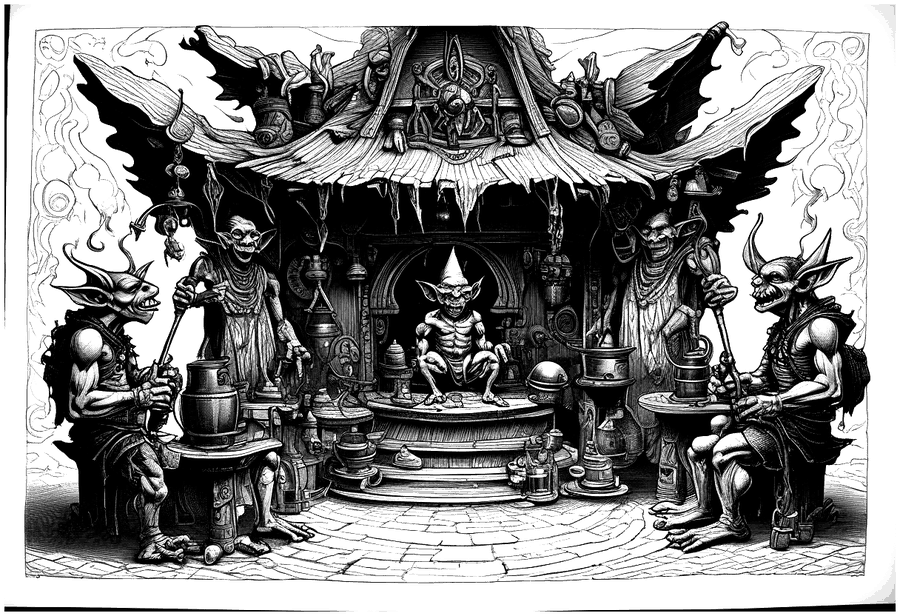
The Whistle is heard whenever steam escapes, a kettle boils or a balloon is let off. Kettlekin say the world is a boiler and the Whistle keeps it from bursting. Their temples are workshops, and their prayers are held breaths let go all at once.
Honour: a clever idea, sharing a tool, letting off steam before you explode. Shadow: hoarding knowledge, sealing a valve, being boring.
Life & lore
- Holy days
- At Kettlemoot (12 Haymonth) every balloon goes up, the best idea of the year is shouted and voted, and noise is holy. Pibbet's Day (9 Ondaria) marks the first flight of 791, and children go up in tethered kettles. On Oil-Night, at the monsoon's end in early Haymonth, Kettle Coast families carry lamp-oil to the forest edge for the Green Sleeper.
- Daily practice
- Temples are workshops, and prayer is a held breath let go all at once. Nobody whistles indoors in a Kettlekin quarter, because whistling is a prayer, and a child who holds its breath too long is told the Whistle will take it. Lending a tool is the commonest holy act. Kettlekin in Angshire cities pray to the Whistle by its Angshire name, Uxbridmanch.
- Rites of life
- A child is named by the first tool it grabs, and litters of three are announced with three whistle-blasts. Two Kettlekin marry by fixing something together; if it breaks, the marriage is under review. A body is tapped three times before burial, in case it only needs a knock. The dead are burned in a boiler, and the funeral is the loudest party of the year.
- Legends
- The great proverb is Ske ketti fe, tsak, 'If the kettle is silent, run.' Funerals end with Ket tiktok zump zop ket tiktok klim klek rox, 'Every machine dies, and every machine can live again.' There are a hundred stories about Pibbet Brasswhistle, all different and all true, and children are told he is still up there in a balloon too high to see.
- History
- In 744 Kettlekin built the press that printed the first broadsheet. In 791 Pibbet Brasswhistle rose over Myrnamon in a kettle-balloon, and in 798 Kettlekin scavengers found marrow-gas in the vents of Foleleyme. Pibbet tied the first two hulls together over the gas-works in 804, the year he died, and began Brasswhistle's Drift. Kettlekin live about forty years, so the faith forgets its own saints quickly and retells them louder.
- Clergy & saints
- Kekkap Patchsilk, at 47 the oldest Kettlekin alive, flew with Pibbet and says the Drift is not safe; nobody listens. Bokket Valvesong, gas-master of the Drift, keeps a tally of the vents' breathing and has stopped showing it to anyone. Ennick Lidlifter keeps the valve-shrine in the Drift's first hull, where the faithful come to let off steam, and he has started sealing its valve at night.
- This year
- The Boiler Purists say the gas-works are waking Foleleyme, and if they win the vote at this year's Kettlemoot, half the sky-fleet could be grounded. The Drift's crews will hold their breath at Kettlemoot for the mountain as well as for the Whistle. The Drift has quietly added a fifth mooring chain, and the Kettlekin say the mountain is only a very big boiler, and boilers whistle before they burst.
- The war
- Kettlekin build sky-ships and guns for anyone who pays, and the faith calls refusing a good idea a sin. Teggap Gearbiter built a cannon without the Hoarfolk design and is now in hiding, and the Powder Moot and the Quiet Hands both want it. Free Balloonists refuse to sink a balloon even in battle, because it is bad luck.
- Tithes & law
- Everything has a price in cogs, and a thing belongs to whoever last made it work. Hoarding knowledge is the great shadow: a Kettlekin who will not show how a thing works has it taken apart in public at the next Kettlemoot. There are no tithes; each workshop-temple keeps a shared tool-wall, and taking from it without returning is theft from the Whistle.
- Healing
- Scalds, lost fingers and boiler-deafness are the trade's wounds, and every crew carries goose-fat and lint. Sky-sickness is cured with climber's leaf or by coming down. The old get the Rattle, a coal-smoke cough. Pressure-charm healers can make a failing heart beat harder, but only once. Keeping pain in is forbidden: patients are told to shout.
Adventure seed. Ennick Lidlifter has sealed the valve-shrine because the Drift's first hull started whistling on its own in Rocadones, and the note matches the vents of Foleleyme.
The Last Command
not a faith, a purpose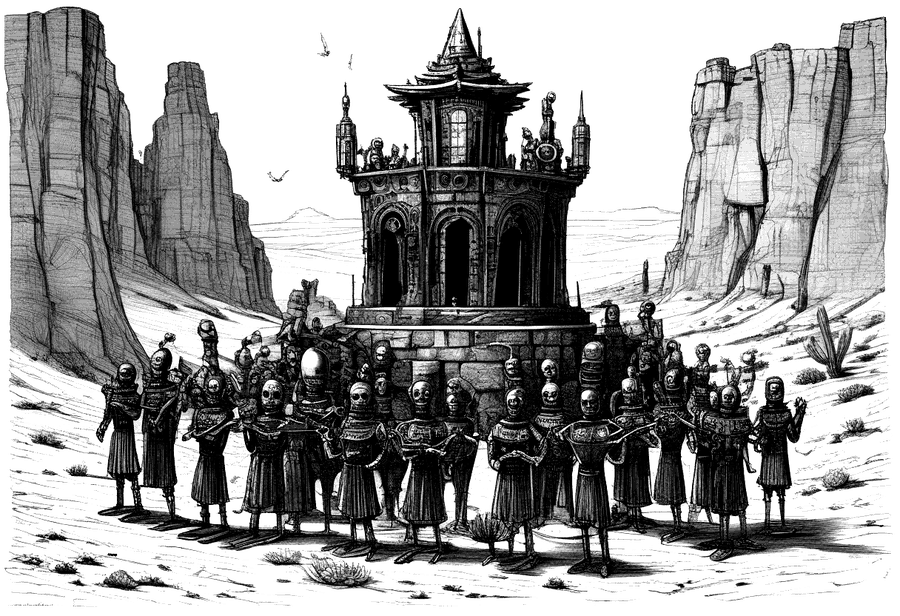
Each Glassborn carries a fragment of the final order the Elder Crowns gave before Bretbury burned. None of them knows the whole of it. Their Choir is an endless attempt to sing the fragments into one sentence, and they believe that when they finish, they will stop.
Life & lore
- Holy days
- The Choir rings without stopping except on the Ash Days, when all three thousand Glassborn fall silent for five days for the burning that stopped them. The caravan towns on the edge of the Waste keep the Hearing (4 Reaping), the anniversary of the first chiming in 622, when no bell may be struck. On the Unspoken Night the Chiming City is said to fall silent.
- Daily practice
- The Glassborn gather in the Choir at Qasr al-Ajras, each ringing its fragment of the Last Command in turn, trying to sing the fragments into one sentence. Sentinels stand at the Gates of Bretbury and let nobody pass. Strays ring one question at everyone they meet and wait one breath for an answer. In the dry months the caravan-men hear the Long Song at night.
- Rites of life
- Glassborn are not born. Two with the same ground tone are kin and stand together. When one breaks beyond mending, the Choir rings its fragment back to it until the glass falls silent, then buries the pieces in the fused sand. A Glassborn who hears a stranger repeat a question stops listening to that stranger for ever.
- Legends
- The Choir's saying is C·G | C~E♭~A♭~D♭, 'We do not sleep', and its oldest proverb is 'The crown is broken, but the song lives.' Strays ask C·B♭·D | C·G·A·C' | C~E | C·B♭, 'Where is the crown?' Qashari children are told never to answer a chime at night, because it is asking for your name. The Glassborn believe that when the sentence is finished, they will stop.
- History
- Each Glassborn carries a fragment of the order the Elder Crowns gave before Bretbury burned. The first chiming was heard from the Waste in 622. Low B, the Glassborn with the lowest ground tone, leads the Choir and is said to have been rung by Qalisar itself. Until 834 no Glassborn had ever been recorded north of the sea.
- Clergy & saints
- Low B leads the Choir. Ab-Fifth, a Stray with an A-flat ground tone and a motif of C·G, is chiming at the inscriptions in the Scriptorium at Qaqah. The Bell, a sentinel nearest the half-sunk guardian of the Gates, is said to speak to it. Shaghir al-Laheeshi, a Qashari caravan-master, has traded questions with the Glassborn for thirty years and never repeated one.
- This year
- Shaghir says the Choir is ringing higher, which means faster, as if the sentence were nearly done. The E-Twins, two Strays with the same ground tone, crossed the sea and walked north through Orcosia, and were last seen on the road to the Ucillamope Library. Sentinels are said to be on their way to bring Ab-Fifth home.
- The war
- The Glassborn do not fight the war; they guard the Gates. The Asraha–Mashian War has drawn the Caliphate's desert foot away from the Waste, so unlicensed treasure-seekers slip past the patrol wells and meet the sentinels instead. The Successor-Caliph wants proof that Bretbury lies under the Waste, and Company agents are rumoured to want proof that it does not.
- Tithes & law
- The Glassborn take nothing, sell nothing and give only questions. Choir-glass, shards of broken Glassborn, sells for 10 cr in Meedihar and rings when touched, and Lamp-Keepers call its sale grave-robbing. Qashari custom forbids answering a chime at night; the Caliphate has no law about them at all.
- Healing
- Glassborn mend cracks by focusing sunlight through their own glass to fuse sand into the break, and they mend a damaged Stray before they speak to it. Strays crack in northern frost, and the E-Twins are said to be cracking already. The wound they give humans is glass-eye: anyone who stands near the Choir at noon without a veil and kohl goes blind.
Adventure seed. One of the E-Twins has cracked on the Library road. Its twin will not move until someone fuses the break, and it rings one fragment, over and over.
Beliefs compared
The faiths of Kidaneland disagree about almost everything that matters to an adventurer. Before you sell a gun in Fagervik, lend money in Valsiari or mention dragons in a Hoarfolk hold, read across this table.
| Faith | The Worm | After death | Magic | Guns and engines | Dragons | Lending at interest |
|---|---|---|---|---|---|---|
| Thetletown Church | Raw metal the Smith forged the world from | The soul returns to the forge to be remade | A tool, lawful when licensed | Holy craft | Sparks of Coldharbour | Permitted |
| Fagervik Faith | The first prey, brought down by Hofjor | The eternal hunt | Wildness: use it, never store it | A coward's tool | The greatest of predators, to be honoured | Coin is a chain |
| Church of the Silent War | The silence before the world | The long silence | Appetite, to be restrained | Loud and distasteful | Appetite made flesh | Forbidden; partnerships instead |
| Manttamites | A silence that must be broken | The war goes on, louder | A weapon | Useful noise | Enemies to be fought | Forbidden |
| Vengrian spirits | The Sky-Mother's fallen son | A ride to her tent at the top of the sky | The spirits' gift, through shamans | Dishonourable | The Sky-Mother's punishments | A debt is an oath |
| Fuempild gods | The darkness the Lion defeats each dawn | Tunarejo ferries the soul to the sun | Sunlit wisdom; necromancy is the worst sin | Acceptable | Children of night | A tithe, not interest |
| Kjelheim | A sleeping father | Return to the bones of the land | The Worm's dreaming; use it sparingly | Toys that will wake him | His dreams; never wake them | No teaching |
| Kahpan gods | Trampled into the desert by Tugan | Carried on Tugan's back | The elephant-priests' gift | Good on an elephant | Children of Tugan's defeated foe | Permitted to kings |
| The High Leopard | The first child of the Barren | Return to the grove as a tree | Asheena's life-force | The sparklock is acceptable | Servants of the Barren, except the Green Sleeper | Gifts, not loans |
| The Hidden Ones | The thirst under the sand | The soul becomes a spirit of well or wind | Water from the spirits | Noises that frighten the spirits | Great spirits, to be appeased | Water lent returns with a cup more |
| Shore and Hearth | The deep that anchors the islands | The ancestors' shrine | The shrine-priests' art | Fine | Murrowmaw is fed offerings | Permitted |
| The Bone-Rite | The dead father whose bones they are | Turn to stone in the deep halls | Marrow-salt, mined with great care | Their own invention | Must never wake | Only between holds |
| The Memory | The Crowns' great error was about it | Become a verse in the Memory | Native, and dangerous | The sparklock only | Qalisar guards what was forgotten | Unknown to them |
| The Grey Mother | The Mother's first, failed child | Return to the Mother's dust | Shamans' business | Cowardice | To be faced, horn first | Horn-debts are honour |
| The Whistle | The biggest boiler there is | Let off steam | Pressure | More pressure | Very big boilers | Everything has a price in cogs |