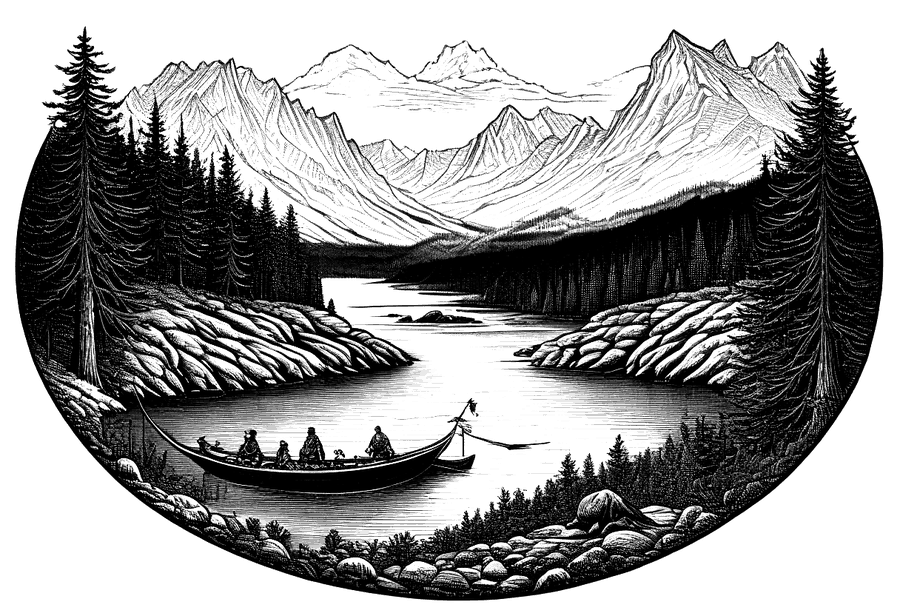
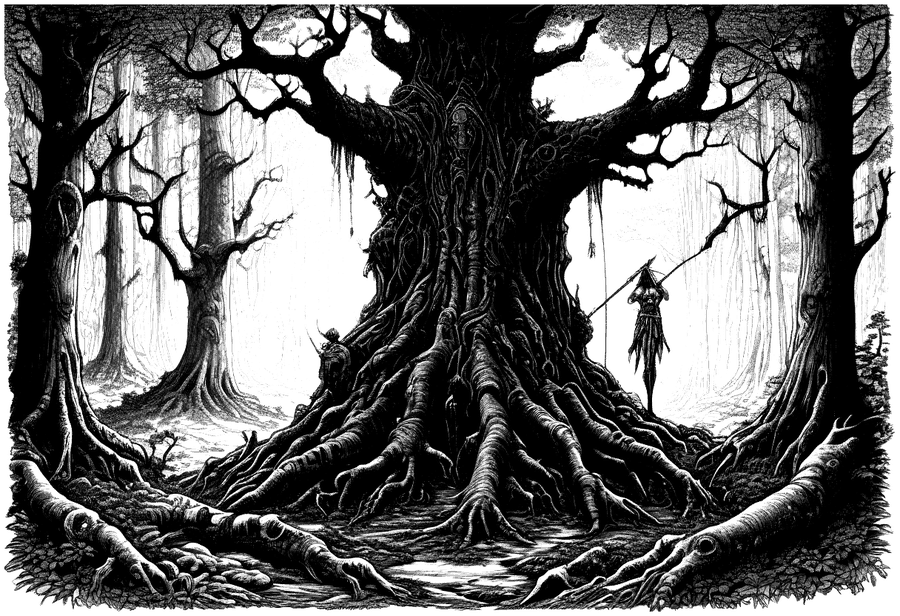
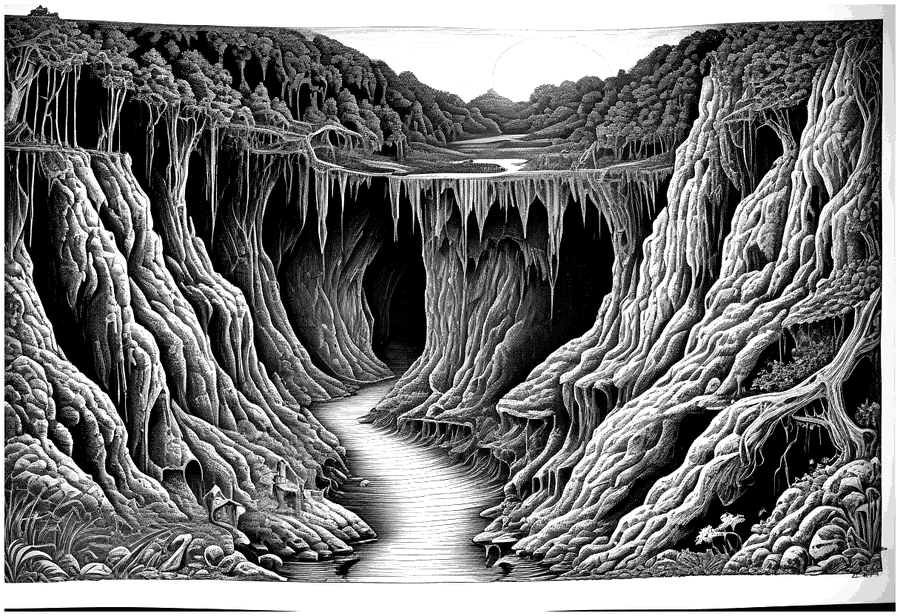
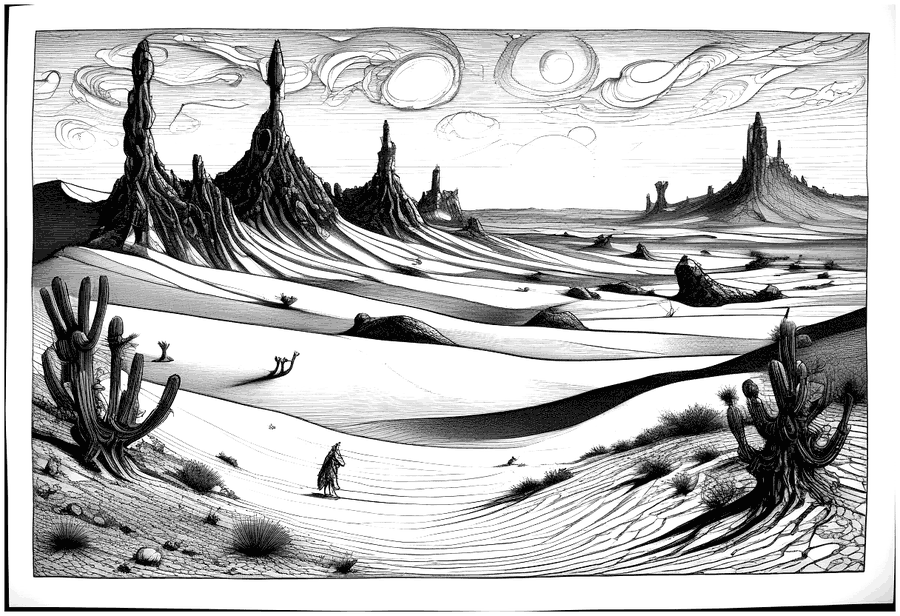
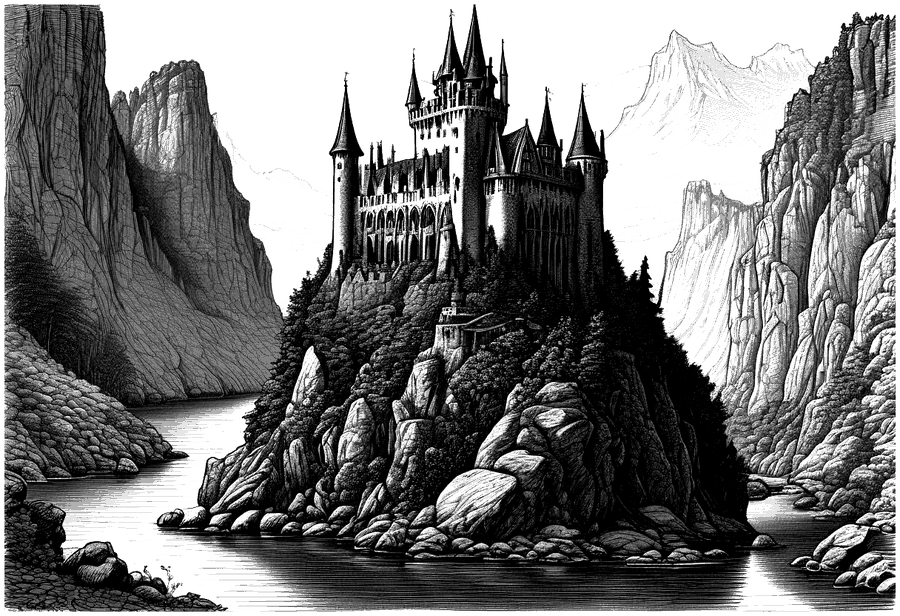
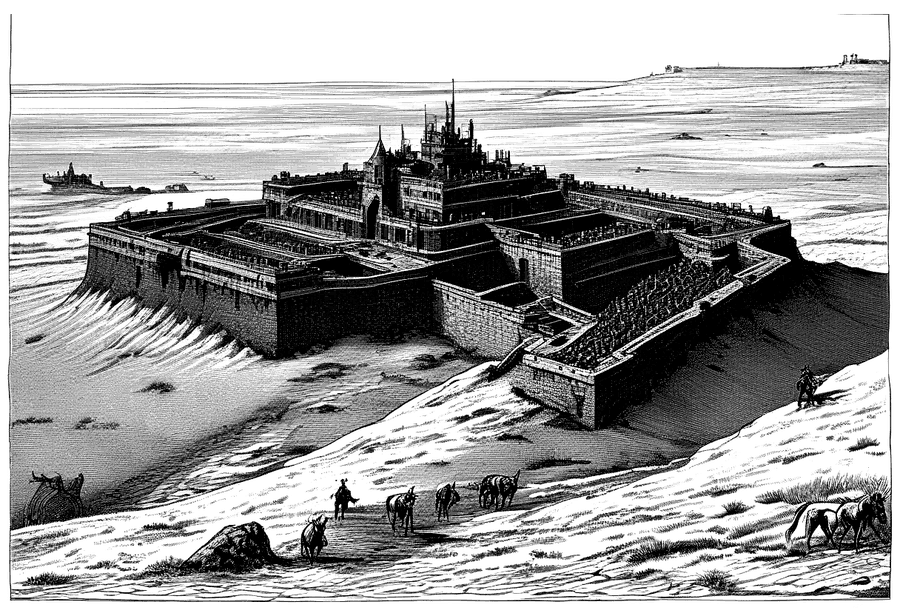
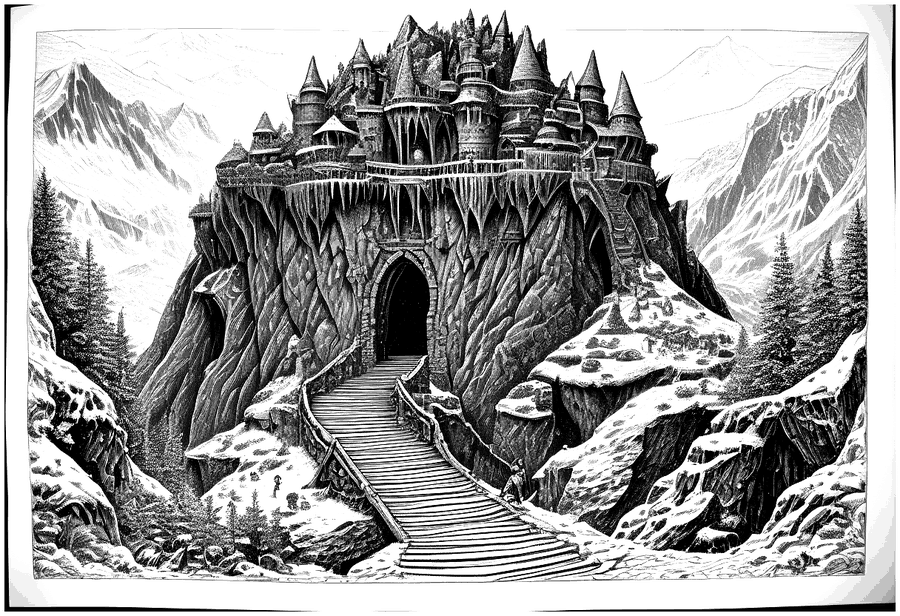
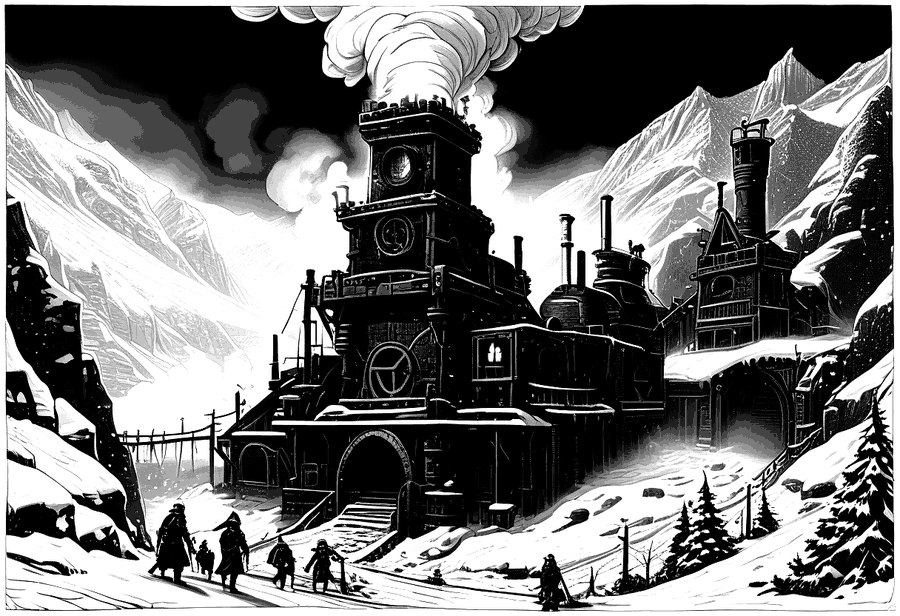
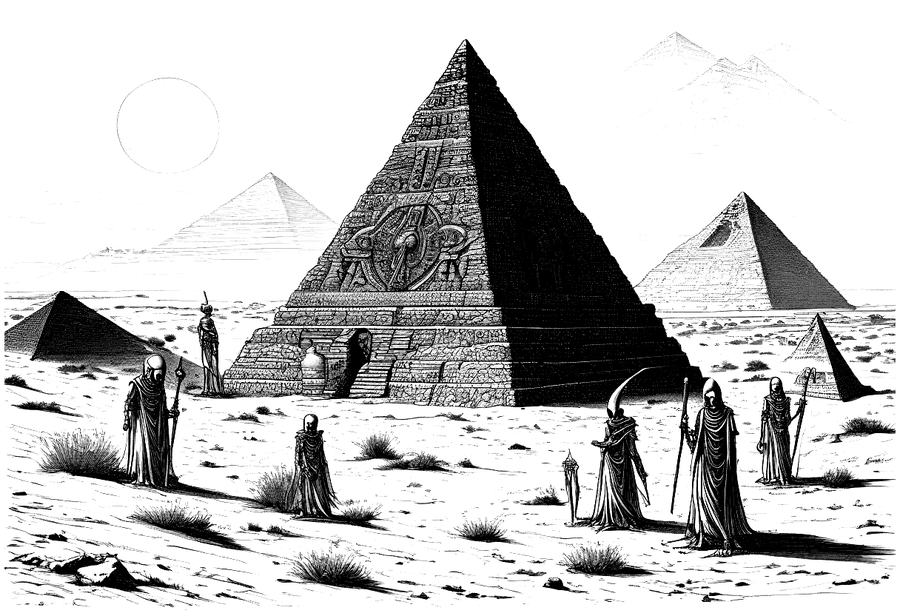
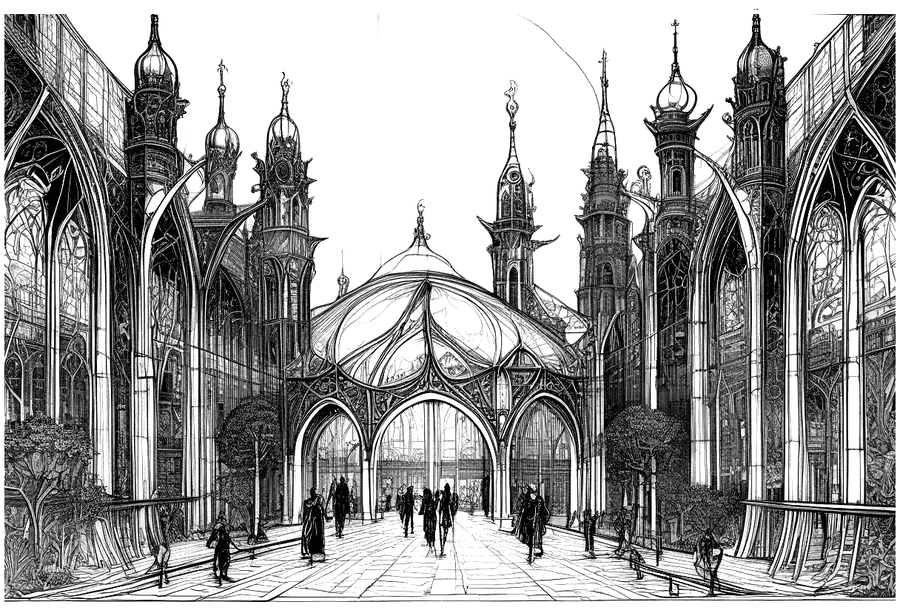
Scholars of the Ucillamope Library keep two lists: eleven works of hands that no traveller should die without seeing, and eleven works of the world itself. Both lists are argued over every year, and both are marked on the map.
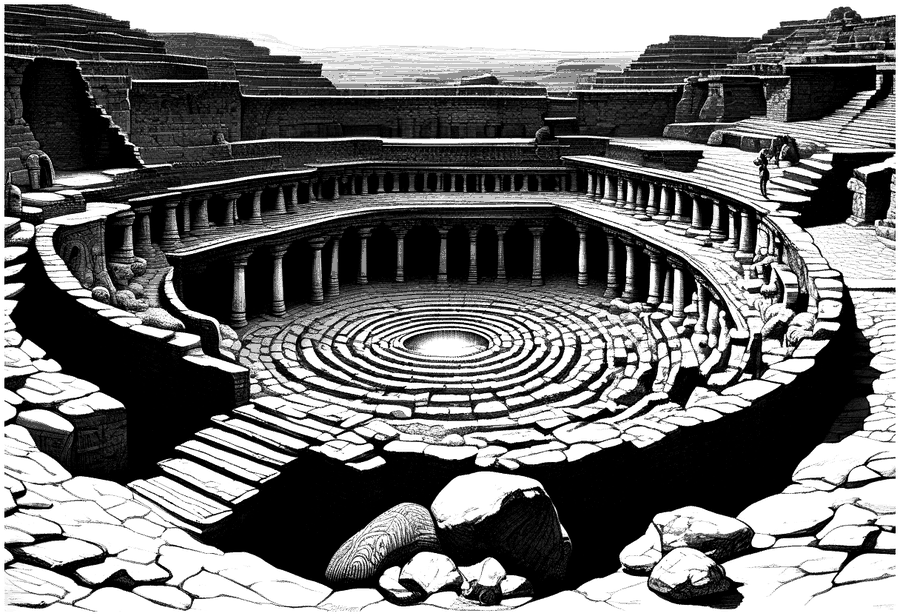
A stepwell a quarter of a mile across, cut down through the desert rock in nine hundred and ninety steps to a pool that has never run dry. The Elder Crowns dug it; the Successor-Caliphs have kept it. Every caliph is crowned at the bottom step, and every caravan on the continent pays a drop of water there in tribute.
Legend: the pool reflects the sky as it was on the day Bretbury burned.
Life & lore
Feasts
Wellwater, at the first rain in Longnight, is the great day: every well in the Caliphate is blessed, and the Successor-Caliph walks down all nine hundred and ninety steps to drink first. On the Unspoken Night in Haymonth the steps are lit with lamps and no name is spoken, and pilgrims sleep on the stone until dawn.
Daily life
Before sunrise the water-bearers of Qaqah carry goatskins up the steps, and the hawkers set up on the top terraces with dates, flatbread and blue glass beads. The well smells of wet stone and camel. Step-Wardens in white sweep the treads with palm brooms, and the guides at the Caravan Gate count their customers in steps rather than hours.
Customs
Every caravan pours a cup from its own skins into the pool, the Drop, and a warden chalks its name on the wall of the forty-first landing. Brides are washed on the bottom step on the morning of their wedding. A Qashari guest offered water here may not refuse it, and nobody wears shoes below the hundredth step.
Folklore
The pool is said to show the sky as it was on the day Bretbury burned, and children are told that if they look long enough they will see the smoke. Drovers who leave say Nakh hadoob daqar al, "No one owns the well", which is not quite what the Successor would like them to say. A fallen bucket is an omen of drought.
History
The Elder Crowns cut it. The caliphs say they found it full of sand and spent a hundred years clearing it, and the cleared sand still stands in a long white ridge north of the city called the Spoil. In 41 the First Wells Compact was sworn on the bottom step, and guest-right became law.
People
Hadish al-Nagheebi is Warden of the Bottom Step, very old, and wants to die before the Successor descends again. Shuwaanah al-Rashati runs the water-sellers' stalls at the top and knows every caravan master by his camels. Dhareed al-Thameedi is a young guide who takes Flokburgh scholars down the steps and sells them copies of the forty-first-landing chalk lists.
This year
The GlassbornStray who walked into the Scriptorium comes to the Well each evening and stands on the four-hundredth step, chiming at the water. The wardens are not allowed to move it and are frightened to try. Since the Comet of Thaw, pilgrims swear the pool shows a second moon.
The war
Fewer caravans come up from the Company's ports since the invasion of Masha, so the Drop is thin this year and the water-sellers are poorer. Camel cavalry water their beasts at the outer cisterns before riding east. Queen Dorottya's envoys wait in a rented house on the Caravan Gate road, and the Successor has still not received them.
Market & law
The Well is free to drink from, but a step-guide costs 2 siglos for the climb down and back, and a warden's blessing on a waterskin costs a mithqal (1.3 cr). Fouling the water, even by spitting, is a capital crime, and so is refusing a stranger a drink on the steps. Beads, chalk-list copies and tiny clay buckets are the usual souvenirs.
Healing
The commonest complaint is the climb itself: pilgrims collapse on the six-hundredth landing, which the wardens call the Fainting Step and keep shaded with an awning. Glass-eye comes in with every caravan from the deep desert, and the Qashari kohl-sellers on the top terrace do a quick trade. Well water is drunk against fevers, with no proven effect.
Adventure seed. A caravan's chalked name on the forty-first landing was scrubbed out overnight. Its master swears he paid the Drop, and the Successor's Eyes want to know why.
Near Allavillo, Orcosian Theocracy · founded c. 300
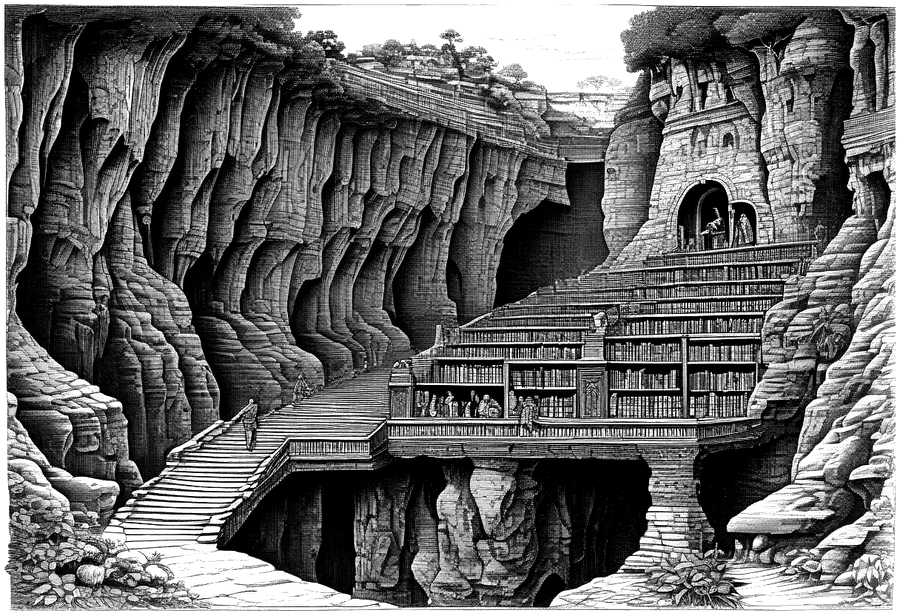
The greatest store of books in the world: four hundred thousand volumes in a cliff-cut library of seven terraces, with reading rooms lit by Orcosian lenses. It holds the largest collection of Elder inscription rubbings anywhere, and the document Queen Dorottya would give a barony for.
Rule: the librarians lend nothing, and a reader caught stealing loses the hand that stole.
Life & lore
Feasts
On Reckoning Day, 15 Thaw, the librarians read aloud the calendar decree of 311 from the top terrace. In Reaping they publish the year's two lists of wonders, and the argument at the Allavillo inns lasts until the Ferrying. Lionsday is kept with every lens uncovered, so the reading rooms blaze at noon.
Daily life
Readers queue at the Lower Gate from dawn with ticket and ink. Copyists in grey smocks work in the lens-lit rooms, and porters carry book-crates up seven terraces by rope and windlass. No flame is allowed past the gate, so Allavillo's inns are full of scholars reading by candle at night. The village lives on ink, paper, lodgings and lentil stew.
Customs
A new librarian swears on the Reckoning, with both hands laid flat on the table so that everyone can see them. Readers who die at their desks are buried in the Readers' Yard under a slate carved with the shelf-mark of their last book. It is the worst manners to read aloud inside, and a reader who coughs on a rubbing pays for a new copy.
Folklore
Copyists say there is an eighth terrace cut behind the seventh, and that the books there read you. A favourite Astellian saying is carved over the Lower Gate: Solano dovar nicuze pozilo, "The sun sees the hidden road." Dropping a book is said to cost a year of your life, and readers never open one on an Ash Day.
History
The Library was founded about 300 and fixed the calendar in 311. In 455 a candle set the third terrace alight and nine thousand volumes burned, which is why flame was banned. The lenses that replaced it were ground in the Honey Years of the 470s, when the Orcosian lens-grinders were at their best.
People
Ilvesa of Corbada, Keeper of the Lock, has cut off two hands in her twenty years and wants a third this summer. Pelaejo the Bright, a Sun Temple Reader, runs the Elder rubbings room and is quietly selling copies to all three parties of the Order of the Unread Script. Ruela of Vastiejo keeps the Inkpot inn at Allavillo and hears everything.
This year
In Mieles a reading room was found empty of its reader and one rubbing. The Library has not said which, and readers are now searched to the skin at the gate. Allavillo is full of strangers this summer, and half of them are looking for the document Queen Dorottya would give a barony for.
The war
Every side in the war has sent readers to search the Library for proof that the Réka marriage was or was not lawful, and the Keeper of the Lock has banned three Balsozhian copyists for carrying lamp-oil. Paper is dearer, because the rag trade from Hajhia has stopped, and the Library is buying old sails.
Market & law
A reader's ticket costs 1 sh a day or 5 sh a season, and copying is charged at 1 d a line. Nothing is lent, and a reader caught stealing loses the hand that stole, cut off at noon in the Lower Court so that the Lion may see. Library-trained physicians charge 2 sh, and the Inkpot sells a bed for 5 d.
Healing
The Library's School of Physic teaches anatomy from Tsuruma books, and its students treat Allavillo for free twice a month. Copyists suffer from lens-squint and a cramp in the writing hand called the clerk's claw, which the herb-wives treat with hot wax. Ink-eaters, readers who lick their pens, get the black gum.
Adventure seed. The missing reader's bag still lies at the Inkpot, holding a key that fits no door in Allavillo. The Keeper of the Lock wants it first.
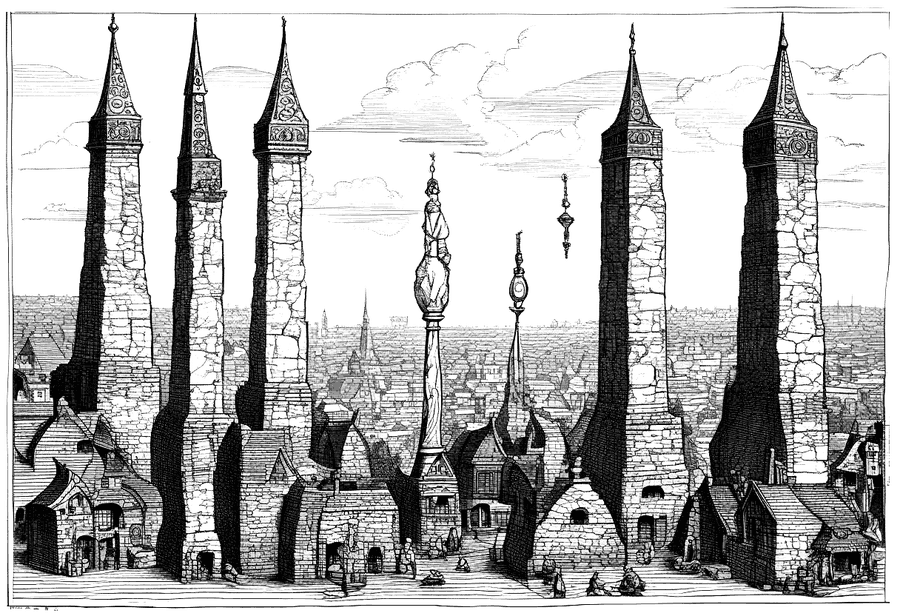
Seven banking towers of white stone, each crowned with a brass scale that turns with the wind and is said to tip whenever the Shifton Standard is in danger. The vaults beneath hold more gold than any realm's treasury. The Quiet Hands have robbed them once, and nobody knows how.
Fact: the towers are joined by bridges at the fifth storey, so a banker never has to touch the street.
Life & lore
Feasts
On Forgefire, 1 Uxbridmanch, every bank in the Towers renews its contracts and the clerks parade the year's ledgers across the fifth-storey bridges. On the five Ash Days the vault doors are shut and no debt may be called. On Vane Day, 12 Isgard, steeplejacks climb to oil the brass scales, and the crowd in the Towers bets on which will tip first.
Daily life
The Towers district wakes to clerks in black running between vault doors and coffee-houses, and porters wheeling chests of crowns under guard. Street-sellers sell hot pies to runners who never sit down. Bankers cross on the fifth-storey bridges and never touch the street, while everyone below looks up at the scales to see which way the wind is blowing money.
Customs
Merlish banking families marry in the Moot Hall and sign the marriage contract in a vault, in front of witnesses and a notary. Apprentice clerks are bound at Forgefire by having their first coin weighed in front of the Guild. When a banker dies, his last ledger is closed with a black ribbon and kept for a hundred years.
Folklore
When a scale tips, people say the Standard is in danger, and the broadsheets print it the next morning. Clerks say "a crown in the Towers is worth two in the hand", and thieves say the opposite. Nobody whistles under the bridges, because whistling is the Quiet Hands' signal and the watch arrests first.
History
The Towers were built from 640 to 702, a new one each decade, and each bank paid for its own. The scales were added in 712, when the Shifton Standard was declared. The Quiet Hands robbed them once, and the stolen gold has never been seen since. The banks still argue about which tower lost the most.
People
Hollis Penwarden is Keeper of the Bridges and hates the Kettlekin who want to hang a lift between the towers. Margery Thewlis is a scale-watcher who logs every movement of the brass scales and sells her logs to speculators. Jory Fettle, a former roof-runner, shows visitors where the Quiet Hands are said to have got in.
This year
The scale on the Calloway tower tipped twice in Rocadones, and Calloway & Daughters' notes have fallen in value in the coffee-houses. The Moot is debating whether to seize the Powder Moot's warehouses. The Paper Men have begun printing samples of a Shifton note, which the Guild of the Scales calls heresy.
The war
The Towers pay for Merland's war with Calloway loans, and taxes are up to one part in fifteen. Casualty lists are posted on the tower doors every Smithsday, and crowds gather to read them. Balsozhian bankers in the Torkburgh Lanterns' tower walk in pairs, as if they expected trouble.
Market & law
Deposits pay 1% a season for keeping, loans run at 12–20% a year, and a letter of credit costs 2 sh to write. Counterfeiting the crown is a hanging offence, a debtor goes to the Ledger House, and a thief is branded with a T on the second offence. A guided walk through the Calloway tower's public hall costs 1 sh.
Healing
Clerks suffer from the crooked back and the coffee-shakes, and the Thetletown Church's hospital on Moot Square treats both. A physician visiting a banker charges 2 sh, or 5 sh if he crosses a bridge to do it. Bankers keep their own Library-trained physicians, who bleed them for apoplexy every quarter-day.
Adventure seed. A scale-watcher's log shows the Calloway scale tipping the night before each of the Quiet Hands' known burglaries. Someone inside the tower is signalling the thieves.
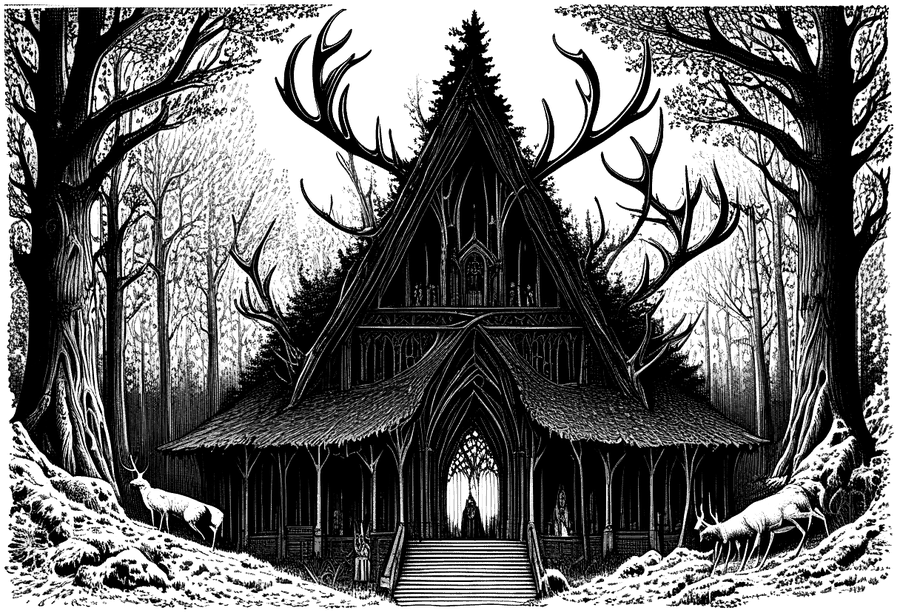
A cathedral roofed with the shed antlers of ten thousand elk, woven over oak ribs into a vault taller than any stone church. Rain falls through it, and the Raugarians think that is the point: Hofjor will not be shut out by a roof.
Legend: the High Huntress is chosen when a living stag walks into the nave.
Life & lore
Feasts
At the Shedding on 10 Hofjor, hunters bring the year's shed antlers into the Close, and the year's holy hunts are drawn by lot in the nave. In Haymonth the Roofing begins, when antler-weavers lash the new antlers into the vault. On the day of the Penner's Gate, every bell in Fagervik is silent while the prisoners run.
Daily life
The nave is always wet, and its floor is pine boughs that the vergers change every week. Antler-weavers work on rope cradles under the vault, and the Close smells of elk-fat, moss and dog from the Kennels of the Hunt. Pilgrims in oiled elk-hide cloaks eat smoked salmon and rye on the steps, because no food is allowed inside.
Customs
Fagervik couples marry in the nave in the rain, and a dry wedding day is bad luck. A newborn child is carried into the nave to be rained on for the first time. A covered head inside is an insult to Hofjor, so hoods come down at the door. A dead hunter lies one night under the vault before burial.
Folklore
The High Huntress is chosen when a living stag walks into the nave. Weavers say every antler in the vault remembers the elk that shed it, and on stormy nights the roof creaks like a herd. The saying carved over the door is Fjallic: Renin er flytbrøn trulo banutåld, "The wolf in a house is a dog."
History
The first Antler was a shrine raised in 402. The cathedral was built between 680 and 760 on oak ribs from the Hafjornes Pinery. In 731 the northern vault collapsed under a winter's snow and killed nineteen worshippers, and since then the weavers have left gaps in the roof deliberately so that snow can fall through.
People
Brann Tetsson is Master Weaver of the vault, and wants the High Huntress to forbid sales of antler-tips in the Close. Snorv Bjelksson, a verger, is quietly of the Kjelheim Remnant and passes messages under the pine boughs. Brånd Holmsson keeps a pilgrims' hostel at the cathedral gate and charges by the dry bed.
This year
A white stag has been seen on the inlet shore three times this summer, and the Antlers fear it is a sign against Sigrun. The insurgents have promised to free this year's prisoners at the Penner's Gate themselves, and the Close is full of longbowmen. Pilgrims say the Comet of Thaw was a stag's antler drawn across the sky.
The war
Half the antler-weavers have gone east with the longbow regiments, and the Roofing is behind for the first time in living memory. Wetland mothers come to the nave to pray that the Huntress will send their sons home. Kennel dogs have been taken for the army, and the Close is unusually quiet.
Market & law
Entry is free, but a blessing at the antler-rail costs a ring-piece of hacksilver. Antler-tips are sold outside the Close at 4 d each, though inside the Close it is forbidden. Taking an antler from the vault is punished by being turned out at the Penner's Gate, and so is selling a forged one as holy.
Healing
Pilgrims who kneel all night in the wet catch the nave-cough, which the Fagervik herb-wives treat with spruce-tip syrup. Antler-velvet tea, boiled from the soft skin of new antlers, is sold for strength at 2 d a cup. Marsh ague comes in with wetland pilgrims, and Utturi bark is dear in Fagervik.
Adventure seed. An antler-weaver found a Kjelheim rune carved into a new antler before it was lashed into the vault. Whoever carved it wanted the Worm's mark over the Huntress's head.
A palace on an island, reached by a causeway wide enough for forty riders abreast. Its great hall, the Hall of Ten Thousand Horses, has a horse carved on every beam, one for each warrior who died in the Hajhian Campaign. Emperor Zsolt has ordered a new beam for every rider lost this year.
Life & lore
Feasts
Breakice on 1 Thaw is the palace's own day: the Emperor's barge is launched from its water-gate when the lake ice first cracks. For a month at midsummer, from Rocadones into Haymonth, a hundred thousand riders camp in the Tent Ring around the lake. On the Sitting of Snow in Longnight the clan chiefs camp on the frozen lake itself.
Daily life
Grooms water horses at the causeway steps from first light, and the palace kitchens send out mare's-milk curd, millet and mutton to the guard. Carvers work in sheds at the shore end of the causeway, and you can hear their mallets across the water. In winter the lake freezes, and sledges run straight to the palace across the ice.
Customs
Vengrians never swear an oath under a roof, so all palace oaths are taken on the causeway under the open sky, and the Hall of Ten Thousand Horses is the one room where nothing binding may be said. Imperial weddings are held on the causeway at noon. A dead rider's family pays for a horse to be carved on a beam.
Folklore
It is said that on Ashnight the ten thousand carved horses whinny in the hall, and that the guard is changed outside so nobody has to hear them. Grooms quote the proverb Ticsazon tepélő, "Never swear under a roof", to any visitor who tries to make a promise indoors. A horse that will not cross the causeway is a bad omen.
History
The palace was built from 590 to 655, after the Hajhian Campaign ended in a marriage treaty. The causeway was laid over sunk oak piles and is wide enough for forty riders abreast. The first beam-carver, Mivár the Left-Handed, carved four hundred horses before he went blind. Every carver since has copied his left-facing horses.
People
Gády Vetika is Master Carver, and she has ninety apprentices and not enough timber. Csász Dor is Warden of the Causeway and decides who crosses it on foot and who on horseback. Kász Laszolt, a clerk at the Dinar Mint, knows exactly how much gold is left in the dinar and is trying to sell that knowledge to the Torkburgh Lanterns.
This year
Emperor Zsolt has ordered a new beam for every rider lost this year, and the carvers cannot keep up. Unfinished beams lie stacked on the shore under tarpaulins. The Hoarfolk cannon have arrived at the North Harbour, and the horse-lords refuse to escort them. There were bread riots in the city in Rocadones.
The war
The palace is the Empire's war office as well as its court, and messengers ride the causeway day and night. Press-gangs work the harbour. The horse-dinar has been thinned to pay for the war, and the palace kitchens now pay farmers in Hajhian steppe groats taken as plunder, which the farmers dislike.
Market & law
The palace is closed to visitors, except on Breakice, when the Hall of Ten Thousand Horses is opened from dawn to noon. A carved beam costs a family 8 horse-dinars, and the carvers have a waiting list. Horse-thieves are dragged along the causeway. Changers on the shore weigh every dinar, because a dinar is now worth only 0.7 cr.
Healing
Imperial shamans ride in trance from a felt tent on the causeway to ask the Severe Virgin for the wounded. Wounded riders are sent on to the Satorbapios Springs, a week's ride away. Bone-setters at the Tent Ring charge 6 d for a leg, and they set more horses' legs than men's.
Adventure seed. A carver has found a beam that already bears a horse with this year's date, carved before the war began. Someone knew the war was coming.
The Hoarspine, between Hajhia and Ortonzania · 8,872 feet at the summit · Hoarfolk work, ancient
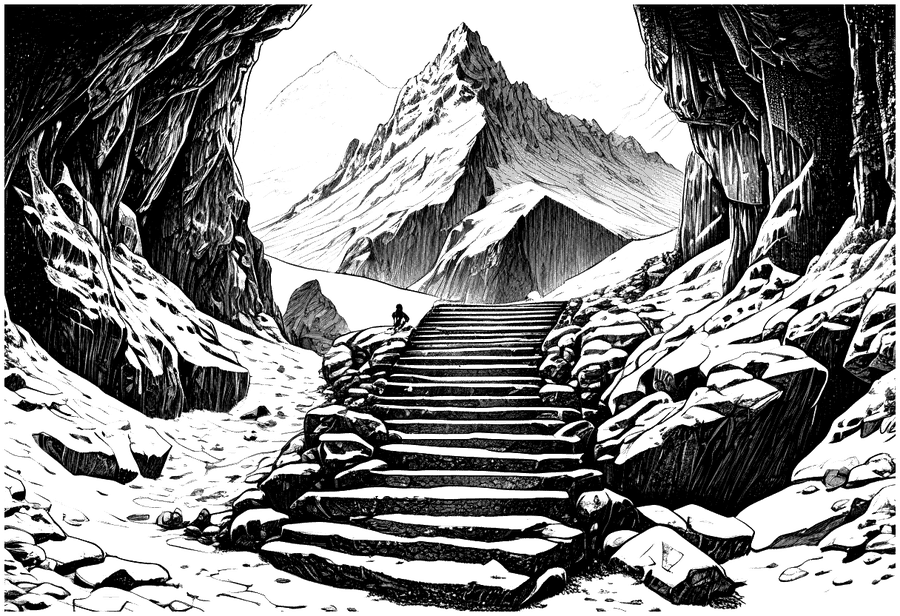
A road of eleven thousand steps cut through the ice and rock of the Hoarspine, half of it tunnelled, with the Thousand-Step Hold at its highest point. It is the only crossing of the range open in winter. The Hoarfolk charge a toll and close it to armies, which is why the war has to go round.
Fact: the Stair takes four days to climb, and three to descend.
Life & lore
Feasts
On Wormwake Eve, 6 Rostovund, the Thousand-Step Hold pours an offering into a crack at the summit and seals one old side-tunnel of the Stair with mortar. Breakice opens the busy season. From Isgard to Thaw, when every other pass is shut, the Stair is the only road over the range and the Hold calls it the Long Toll.
Daily life
Mule-trains, porters and Hoarfolk hauliers climb in single file, roped together on the open stretches. Rest-halls are cut into the rock every thousand steps, with stone benches, a marrow-lamp and a pot of barley-and-mutton broth kept warm on a steam pipe. Porters chew climber's leaf and talk in step-counts: "meet me at four thousand".
Customs
Every walker picks up a pebble at the foot and leaves it on the cairn at the summit gate, and the Hoarfolk clear the cairn into a crevasse each Wormwake Eve. A Hoarfolk host gives a guest a cup of hot salt broth. Nobody whistles in the tunnels, because whistling wakes the frost-wyrm.
Folklore
The Hoarfolk say the Stair was cut down the Worm's own spine, one step for each of its bones. Porters quote the Hoarspeech proverb Brak thaz thrûn khol bodrôrm thaz kûthorg, "The mountain is older than any king", to princes who complain about the toll. If your pebble rolls off the cairn, you will not come back this way.
History
The Stair is older than the calendar, and the Hold's record wall lists forty delvings of repairs. In 525, the Long Winter, the glaciers advanced over the open upper stretch in a single year, and the Hoarfolk tunnelled under them rather than give up the road. That is why half the Stair is now underground.
People
Vegith of the Thousand Steps is Toll-Warden at the summit gate, and she has turned back three Balsozhian companies this year. Serruk of the Thousand Steps runs the porters' hiring hall at the foot and wants a share of the toll. Edwin Marle, a Merlish smuggler, takes people over the glacier beside the Stair for 5 cr, and loses about one in ten.
This year
The frost-wyrm that lairs above the Stair has been seen twice this summer, lower than ever before. Since Gravdalla Deep sealed its lower gates in Hofjor, the Toll-Warden has doubled the guard and refuses to say why. Refugees from Hajhia sleep in the rest-halls and cannot pay to go on.
The war
The Hoarfolk will not let an army use the Stair, which is why the war has to go round it. The Toll-Warden counts any party of more than twelve armed men as an army. Spies come over in twos and threes, and the Hold sells them broth like anyone else. The Emperor has closed the northern passes, so the glacier smugglers have never been busier.
Market & law
The toll is 2 sh a walker, 1 sh a mule and an ingot-mark a wagon, and Hoarfolk pay nothing. Thunder-salt sells at the summit gate for 1 cr a pound, half its price on the coast this summer, but the Hold sells only to buyers who have signed its book. Climbing the Stair with a lit fuse is a banishment offence.
Healing
Sky-sickness strikes above six thousand steps. The cure is climber's leaf at 1 d a twist, or going down. Winter-black takes fingers and toes, and Hoarfolk bone-setters at the summit cut cleanly and charge 1 cr. Wyrm-breath, the frostbite left by the frost-wyrm, is treated with warm stones and has no real cure.
Adventure seed. A porter's cairn-pebble from the foot turns out to be a raw lump of marrow-salt. Someone is smuggling it over the Stair one pebble at a time.
Near Ichi, on the Chain · Principality of Kushi · built 799
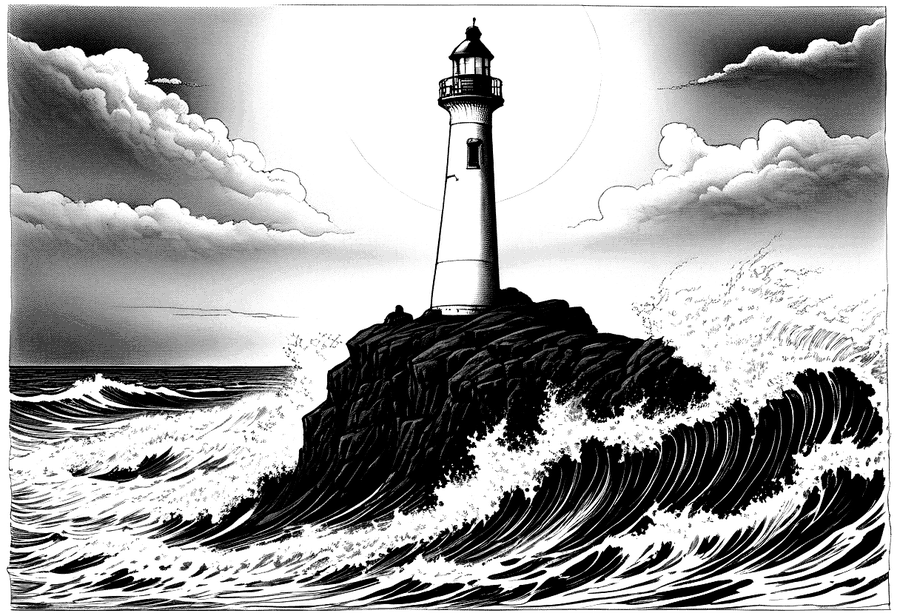
The tallest lighthouse in the world: a tower of black stone on a sea-cliff, with a lantern of Orcosian glass lenses that throws its beam ninety miles. Every ship on the Chain steers by it, and every ship pays the Toll of the Chain beneath it.
Life & lore
Feasts
At Sail-Dipping in Rocadones every ship that passes Ichi dips its sail to the Lamp's shrine, and the keepers answer each with a flash of the shutter. Lighting Day, 9 Thaw, marks the first lighting in 799. On Ashnight the Lamp is the one fire in Kushi that is not put out: the keepers hood it in black silk for a single breath at midnight.
Daily life
The keepers of Ichi, a village of about a thousand under the cliff, live by the Lamp's hours. The oil-bearers carry shark oil up three hundred steps each afternoon, and the lens-wipers polish the Orcosian glass with chamois at dawn. The village smells of oil and rice-wine. The Toll Office clerks sit in a pavilion at the harbour mouth with their brass scales.
Customs
A keeper's child is held up to the lantern at its first new moon. Ichi brides walk once round the tower before the wedding, and widows of drowned sailors hang a white cord on the railing. It is forbidden to point at the Lamp with a finger, so sailors gesture at it with an open hand.
Folklore
If the beam stutters, a ship has sunk somewhere along the Chain that night. Sailors say Kiyaaha ri yomaji zu saronomi, "The shrine watches the harbour", when they pass. Ichi children are told that the shrine spirit of the cliff lives in the lens and counts every ship that has not paid.
History
The Lamp was lit in 799 and opened the Chain to sailing all year round. Its lenses were ground in Orcos and shipped in straw. One cracked in a storm off Mutsu and is still in the lantern, bound with a brass band, and keepers say it throws the brightest light. The older Kagagawan Light, a wooden beacon, stands as a ruin below the tower.
People
Ichi ke Hogoro is Head Keeper and has not slept away from the tower in nineteen years. Sazushima ke Nato is the Toll Office's collector at Ichi, honest and feared. Treviel of Ozuejo, an Orcosian lens-master, came out in 831 to regrind the cracked lens and has refused every order to touch it.
This year
Since the Toll Office began stopping ships that carry Balsozhian silver, Tebek smugglers have tried to slip past Ichi on Lampless nights. A keeper claims the beam picked out a sky-ship hanging dark above the strait in Mieles. Company notes trade at 7 cr in Ichi, not 9, and the toll-clerks take them only at that rate.
The war
Kushi is tied to the Fagervik Compact, so Shifton League ships pay a heavier toll at Ichi and are searched hold by hold. Merlish captains say this is a blockade in all but name. The Admiralty has put two war-junks in the strait under the Lamp, and the village sells them fish at twice the price.
Market & law
The Toll of the Chain is a string of cash (1.5 cr) per mast plus a twentieth of the declared cargo. Under-declaring a cargo forfeits the whole of it. Ichi sells lamp-shaped charms of black stone at 2 d and flasks of "lamp oil" for luck. Pirates caught in the strait are hanged from the toll pavilion's yard-arm.
Healing
Pox arrives with the ships, and Ichi's physician practises variolation for half a string. Keepers get lamp-blindness from looking into the lantern, and treat it with tea-leaf poultices. Burns from the hot oil are common, and the cure is a cold bath in the harbour, which is better than most.
Adventure seed. On a Lampless night the beam flashed the old shutter-code for "ship lost". No ship was lost. The Head Keeper swears he did not send it.
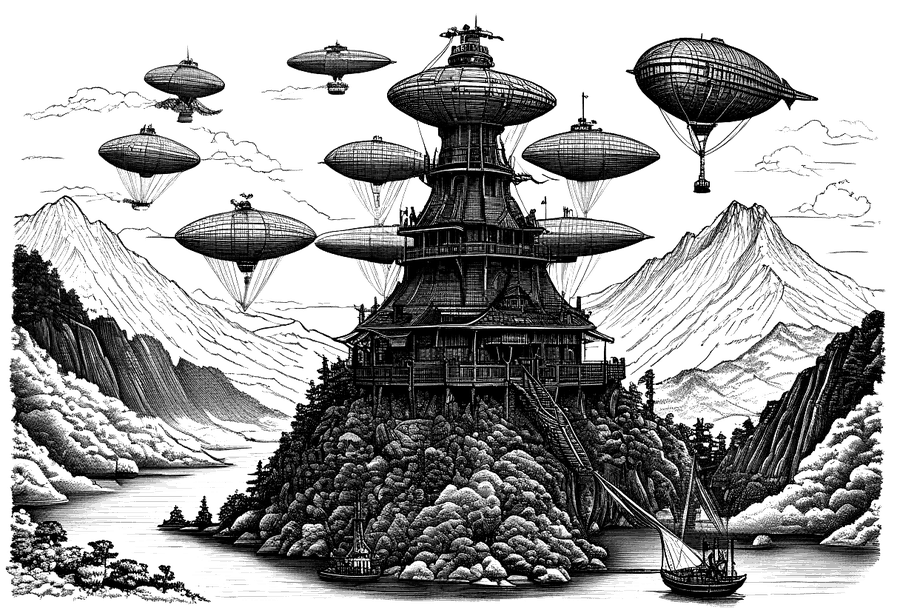
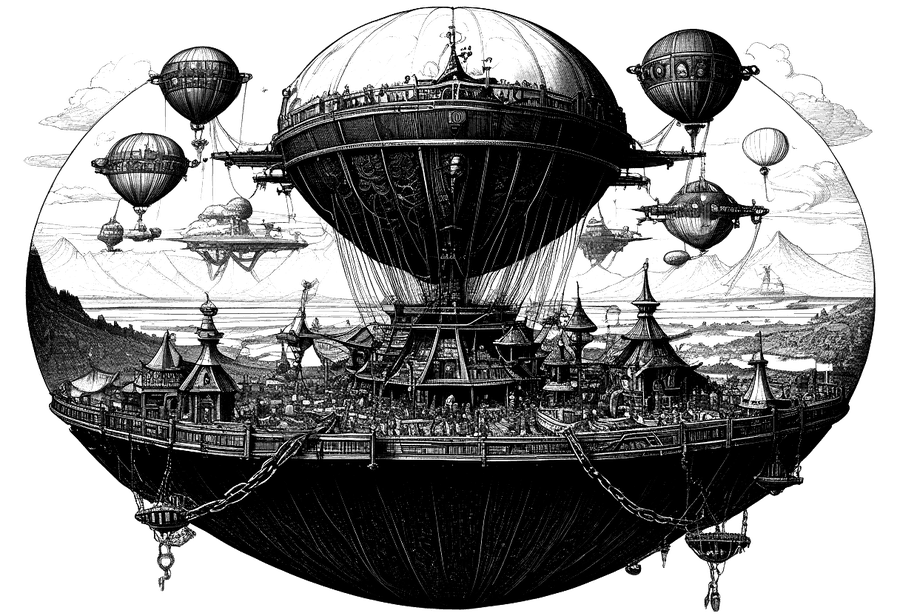
Twelve mooring towers of lacquered timber and iron, each tall enough to hold a sky-ship clear of the ridge winds, linked by rope bridges and lifts worked by Kettlekin engines. A capital with no harbour built itself one in the air, and now three sky-lanes begin here.
Life & lore
Feasts
On Kettlemoot, 12 Haymonth, every sky-ship at the Docks goes up at once, and the Kettle Quarter shouts the year's best idea from the top of the Ninth Tower. At Sail-Dipping in Rocadones the sky-ships dip their envelopes to the shrines of the Shrine Road. On New Fire the Lanternwrights relight their boilers from the Ridge Palace's hearth.
Daily life
Lift-tenders work the Kettlekin engines from dawn, and the creak of rope bridges never stops. Noodle-sellers and ticket-touts crowd the foot of every tower, and Tsuruma customs clerks weigh baggage on brass scales. The Kettle Quarter smells of coal smoke and marrow-gas. The Chartered crews wear blue collars, and the Free Balloonists call them collars for it.
Customs
A new hull is named on the tower-top with rice-wine poured into the envelope's mouth. Halmi and Tsuruma crews bow to the tower-shrine before they cast off, and Kettlekin crews hold their breath and let it out together. Dropping anything from a tower is the gravest taboo: it insults the spirits of the ground below.
Folklore
Kettlekin tell visitors Plangko zat titut zezuk, "The sky has no toll", and the Kushi clerks charge them a mooring fee anyway. Dock-hands say that a ship which casts off on a Silent Day will come home late. A dropped rope that lands in a coil means a marriage in the crew within the year.
History
The twelve towers were raised from 805 to 812, and the first sky-lane opened to Shifton the same year. In 814 the Seventh Tower's lift cable snapped and dropped a cage of envoys sixty feet. Nobody died, but the Ridge Court has used Kettlekin-only lift crews ever since.
People
Michiechia ke Razumasa is Dockmaster and wants the Kettle Quarter's licences renewed every year so that he can raise the fees. Toggit Kri-Zrum-Kri-Zak, a Chartered lift-chief, has run the Fourth Tower's lift for fifteen years and is near the end of a Kettlekin life. Sae of Ruihishima is priestess of the tower-shrines.
This year
The Kamiechia–Balsozha lane opened last year, and Merland would like it closed. An envelope was slit at the Eleventh Tower in Mieles and the Rusted Brethren are blamed. The Prince is keeping envoys of both alliances waiting, and they meet every morning in the same tea-house at the foot of the First Tower.
The war
Balsozhian silver flies in and Raugarian furs fly out, and Merlish envoys count every cargo. Three Iron Tortoises guard the ridge, and the Boilerguard hold the tower-tops. Kettlekin crews are being offered double pay to fly for the Compact, and some Free Balloonists have stolen across to Tebek rather than take it.
Market & law
A passage costs about 1 cr per hundred miles, and Kamiechia to Shifton costs 6 strings of cash (9 cr). A lift ride costs ten cash, and a mooring costs a string of cash a day. Smoking, open flame and sparklocks are banned on the towers on pain of the cane. Marrow-gas may not be sold in Kamiechia except through the Toll Office.
Healing
Sky-sickness is so common that touts sell climber's leaf at every lift. Falls are the commonest death, and the Docks' bone-setter, an old Halmi, splints arms on the tower-top before anyone moves the patient. Kettlekin crews get gas-cough from leaking envelopes, and they swear by ginger.
Adventure seed. A Chartered lift-chief offers good money to anyone who will ride a sealed crate up the Fourth Tower at night. He will not say who it is for.
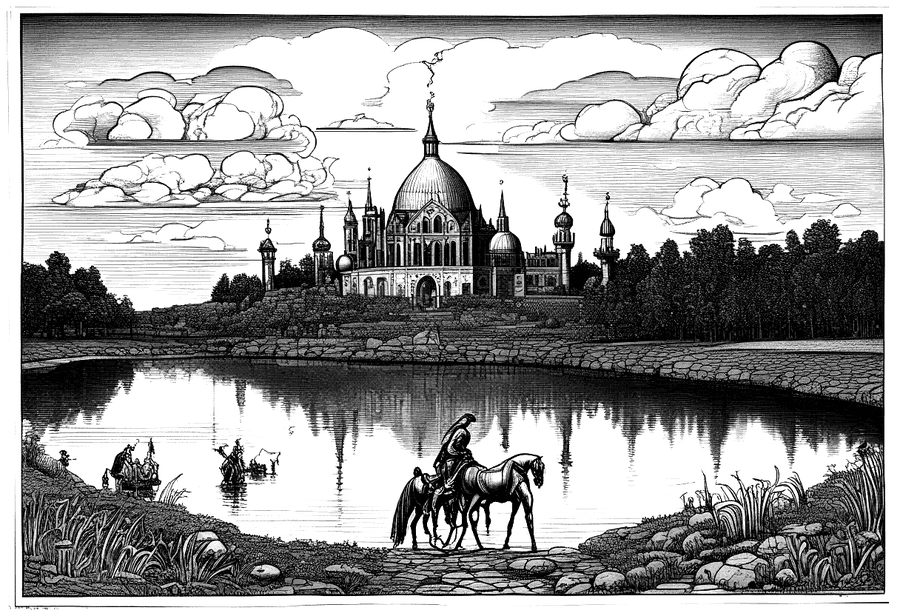
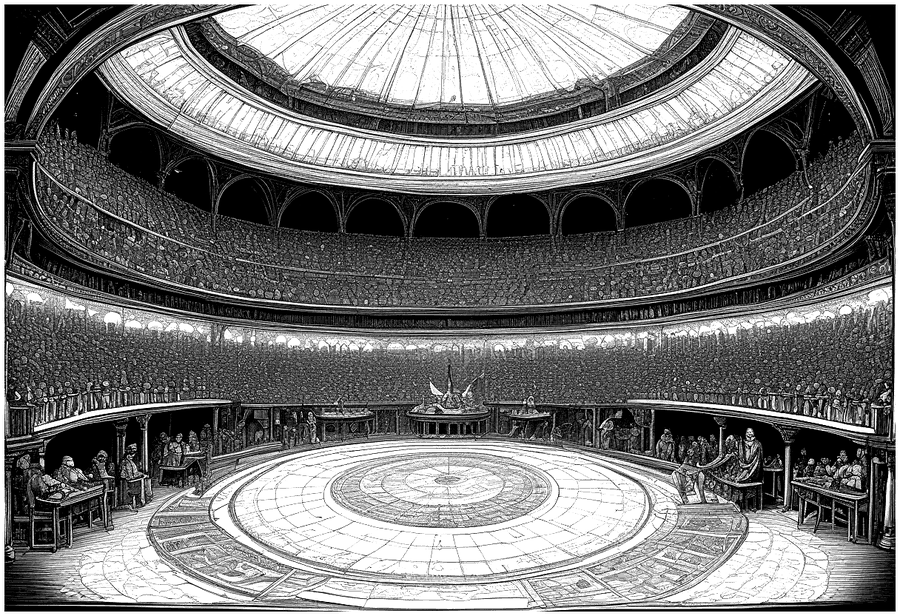
A domed trading hall with a floor of inlaid maps showing every sea route known, and a gallery where clerks chalk prices on boards a hundred feet long. Paper money was born in the print yard next door. If Meedihar falls to the Caliphate, the Exchange is the prize.
Life & lore
Feasts
Convoy Day, when the Kushi convoy is sighted, closes every shop in Meedihar while shares are paid out under the dome. Wellwater in Longnight is kept with water poured on the map-floor's oceans. On the Unspoken Night in Haymonth the clerks chalk only numbers, and the floor trades in silence until dawn.
Daily life
Chalk-boys in white aprons climb ladders to change prices on boards a hundred feet long, and runners shout bids on the floor of inlaid maps. Traders drink bitter-bean coffee from tiny cups and eat date-bread standing. The Print Yard next door thumps all day. Kavarri porters, Qashari clerks and Tsuruma captains argue in four languages.
Customs
A deal is sealed by sharing water from one cup, as guest-right demands. Traders take off their sandals before stepping onto the map-floor, and it is a grave insult to stand on the route of a ship that has just been lost. A trader who goes bankrupt breaks a clay tablet with his name on it, on the steps.
Folklore
Traders say a ship whose route is scuffed on the floor will founder. The Qashari proverb chalked over the main board is Salood shabbaar kil ramooq dahhaar, "The merchant counts; the host gives." A sparrow inside the dome means a rise, and a crow means a fall.
History
The Exchange was built from 742 to 760, as the Mashan ports broke away from Kahpia. The first paper notes were printed next door in 760. In the Ink Panic of 788, forged notes flooded the floor and the Board burned a whole printing in the square, which the old traders still remember as the night money burned.
People
Maud Calloway runs Calloway & Daughters' Meedihar house, and she is quietly calling in loans. Nusaasah al-Naseemi is Chief Chalker and can tell a rumour from a fact by the way it climbs a board. Golzar Hendani is a Kavarri ship-broker who sells shares in Kushi convoys and is short of buyers this year.
This year
The Board of Nine is moving its gold to Kushi in secret, and traders have begun to notice the empty carts going out to the Ledger Docks. Company notes trade at 7 cr in Flokburgh ports this summer. The Sand Ledger's forgeries are now good enough to fool the chalk-boys.
The war
The Caliphate's army is two weeks' march away, and the hired regiments drill in the square in front of the dome. Saizayd is under attack, so its traders now trade on the Exchange floor. Convoy shares have halved in price, and the Land Lords want the Exchange's gold spent on soldiers.
Market & law
A share in a Kushi convoy costs 50 cr and pays a tenth of the cargo. A Qabahran watered-steel blade sells for 60 cr. Sales tax is one part in twenty-five, the lowest in the world. Forging a Company note is a hanging matter; passing one knowingly earns a branded hand and twenty years' indenture on a plantation.
Healing
Marsh ague is common in the dockside quarters. The Exchange keeps a physician on the gallery for traders who collapse when prices move, and he charges a Company note for a visit. Glass-eye comes in with desert caravans, and the kohl-sellers on the Exchange steps do a steady trade.
Adventure seed. One bid on the board always comes an hour before bad news. Find the bidder, and you find who in Meedihar talks to the Caliph.
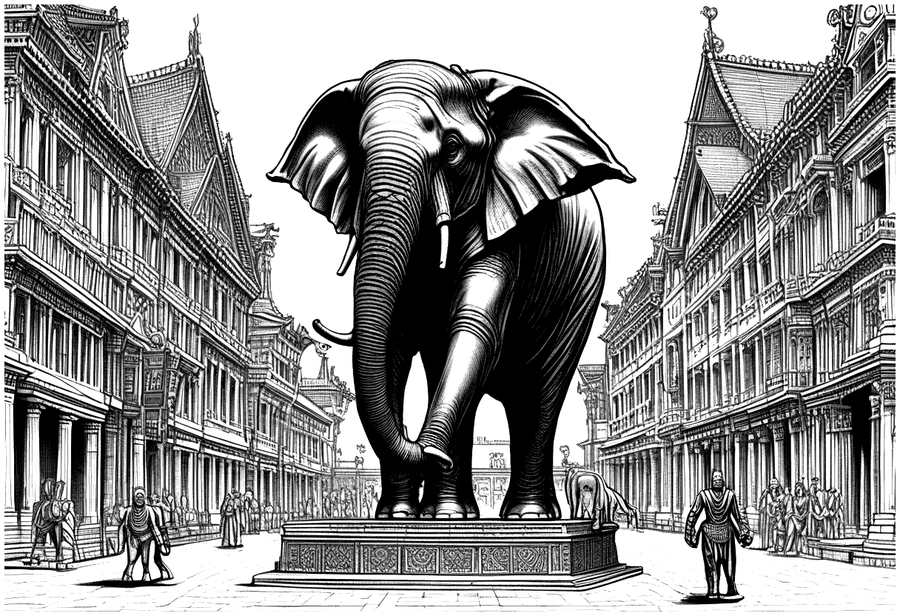
A bronze elephant two hundred feet tall, painted magenta and gilded at the tusks, standing over the square where the Shah gives audience. Petitioners walk between its legs to reach the throne. It was raised after Ankhorra was seen over the city in 700, and the Kavarri say it was built to show the dragon who rules here.
Life & lore
Feasts
At the Kneeling of the Elephants on 1 Thaw the great elephant kneels before the Colossus, and the Shah is crowned again. At Mahrang's Drum on 1 Isgard the rain-drummers play from the Colossus's back, and the poetry contests are held in its shade. Every ten years, at the Repainting, the city turns magenta for a month.
Daily life
Petitioners queue from before dawn, and scribes at folding tables write petitions for them at 1 siglos a page. Painters on rope cradles touch up the bronze. The Colossus Square smells of elephant dung, dye and frying chickpeas. Grey Wall Rhunari guard the legs, and children dare one another to touch the bronze toes.
Customs
Kavarri couples walk between the Colossus's legs on their wedding morning, so that the elephant sees the marriage. A newborn's first name is whispered into a crack in the left foreleg. Nobody may stand under the Colossus's belly with shoes on, and only the Shah may be carried on a howdah through the Square.
Folklore
The Kavarri say the Colossus was built to show Ankhorra who rules here, and that if it ever falls the dragon will come back. Petitioners mutter Povar zinghar hikfoz, "The elephant remembers the king", as they walk between the legs. A bird nesting in the Colossus's ear means a good harvest.
History
Ankhorra was seen over Shahpabad in 700, and the Colossus was raised from 700 to 744. It was cast in sections in pits outside the city and dragged in by elephants. In 726 a poured section cracked and killed the foundry master. His crack is in the left foreleg, painted over every ten years and never mended.
People
Zhiv Ormandi is Master of Dyes and wants the Repainting held a year early, to please the elephant-priests. Nimesh Purzani is the best petition-scribe in the Square and charges double to write in verse. Ndanduuǂo Nambuuwa is a Grey Wall sergeant at the Colossus's feet who has not been paid for six months.
This year
The Grey Walls have hinted that Jowshia pays on time, and the Square is watching the guard more closely than the petitioners. The elephant-priests want the Colossus honoured and the dragon appeased, and have asked for a new coat of gold on the tusks. The elephant migration near Chudeshk is taken as a good sign.
The war
Kahpia's war with Jowshia means more petitions about dead sons. Jowshian siglos are struck light, so Kahpians refuse them, and the money-changers in the Square weigh every coin. Elephant Lines are half empty because the war-elephants have gone south, and the city's carters are short of beasts.
Market & law
Walking between the legs is free, but a place in the Shah's audience costs 5 siglos to the Chamberlain's office. Magenta silk, brass elephants and ground dye are sold in the Square. Defacing the Colossus is punished by death under an elephant's foot. Oath-breakers who swore on Tugan's tusk are executed in the Square the same way.
Healing
The elephant-priests heal at the Colossus's feet for 5 sh a wound, and their honey-and-dung plasters are said to draw out arrows. Dye-workers' hands turn magenta and crack, and they treat them with ghee. Heat-stroke in the long queues is common, and the Square has three water-sellers paid by the Shah.
Adventure seed. A painter on the Colossus's head has found a sealed bronze door behind the right ear. The elephant-priests want it left shut. The Shah has not been told.
The Glass Waste, near Zalfamaq, Asrahan Caliphate · Elder Crown work
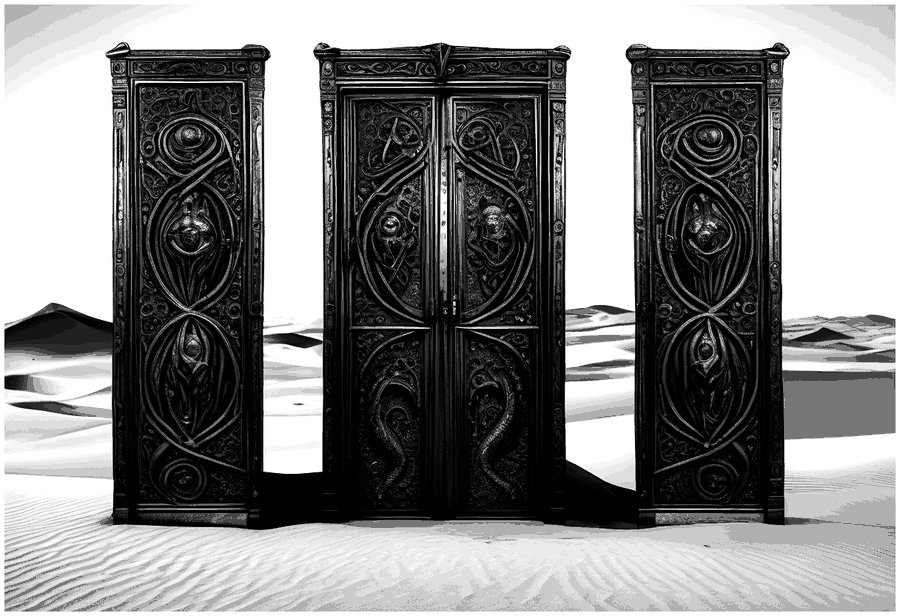
Two bronze doors, each the height of ten men, standing upright in the sand with nothing visible behind them. The sand around them has fused to glass. Glassborn guards stand before them night and day, and nobody who has tried to pass has come back. Most scholars believe Bretbury lies beneath. The Successor-Caliph believes it is his.
Life & lore
Feasts
Nobody keeps a feast at the Gates. Each Wellwater the Successor-Caliph sends a caravan to pour water on the Last Cairn, a mile from the Gates, and it turns back without going nearer. On the Unspoken Night caravans camped at Zalfamaq say the Glassborn's chiming carries six hundred miles.
Daily life
Nobody lives at the Gates. The nearest life is the Last Cairn camp, where Zalfamaq guides wait with camels for scholars and fools. Glassborn stand guard in a ring around the Gates and never move. By day mirages walk across the glass, and the camp eats dates, tea and dried goat.
Customs
Travellers to the Gates leave a stone with their name at the Last Cairn and take it back if they return. Guides refuse to speak the name Bretbury after sunset. Qashari who die near the Waste are buried facing away from it, so that their spirits do not wander in.
Folklore
The Leopard Bretborn say Heva e mos bret, "The ash remembers the fire", when the Gates are spoken of. Some say anyone who passes the Gates will see the Elder Crowns at dinner. The guides say that if a Glassborn turns its head towards you, you have one more day.
History
Nobody knows when the Gates were made. The sand around them was fused to glass in year 0. The Glassborn woke in 622, and since then no one who has tried to pass the Gates has returned. In 703 the Caliph Rashad sent three hundred riders. Their saddles were found in a line on the glass a mile out.
People
Qakiy al-Khameeli is a Zalfamaq guide who has taken twenty expeditions to the Last Cairn and none further. Mateed al-Thakadhi of the Successor's Scribes camps at the Cairn and copies the inscriptions on the bronze through a telescope. Pia ith Veth, a Lamp-Keeper of the Leopard Wardens, watches the watchers.
This year
Two Glassborn Strays were seen walking north through Orcosia this year, and the guides say the ring at the Gates is one short. The Successor-Caliph will pay a fortune for proof that the Waste hides Bretbury. A scholar from the Ucillamope Library reached the Last Cairn in Mieles and left without a word.
The war
The Asraha–Mashian War has taken the camels, and the Zalfamaq guides now charge double. The Successor's riders patrol the edge of the Waste to keep Company spies away. Bretbury is part of his claim to his title, so he is at war for it in a way, even if nobody can reach it.
Market & law
A guide from Zalfamaq to the Last Cairn charges 4 mithqal and wants half in advance. Glass from near the Gates is sold in Qaqah as "Bretbury glass" at 1 siglos a shard, though most of it comes from a kiln. It is forbidden on pain of death to cross the line of the Last Cairn without the Successor's seal.
Healing
Glass-eye is the curse of the Waste. Qashari kohl and veils prevent it, and the leopard-priests' salve cures it if it is used early. Thirst kills more than the Glassborn do. Guides carry salt-and-date paste for the sweat-sickness, and they cut glass splinters out of camel feet with tweezers.
Adventure seed. A traveller at the Last Cairn has taken back his name-stone. He set out for the Gates twelve years ago, and he has not aged a day.
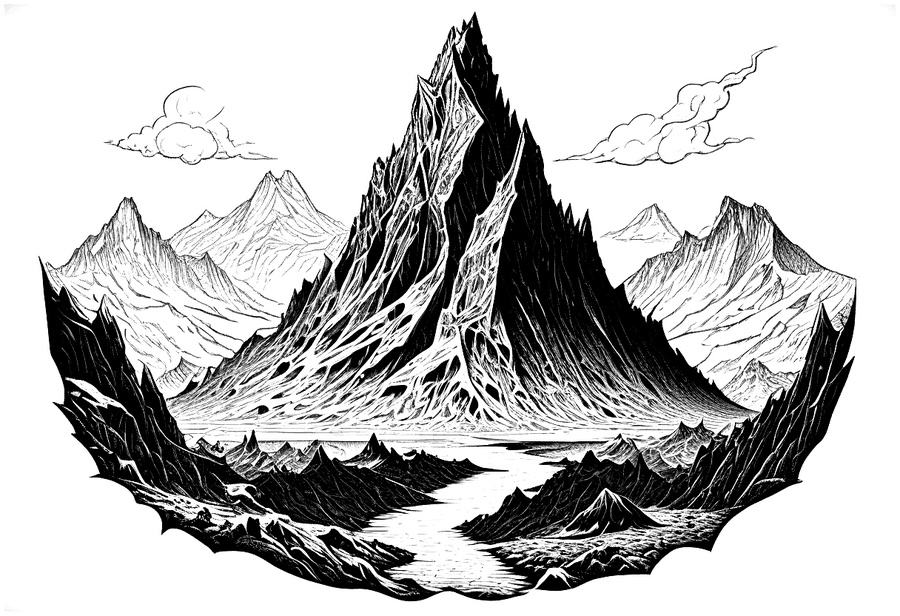
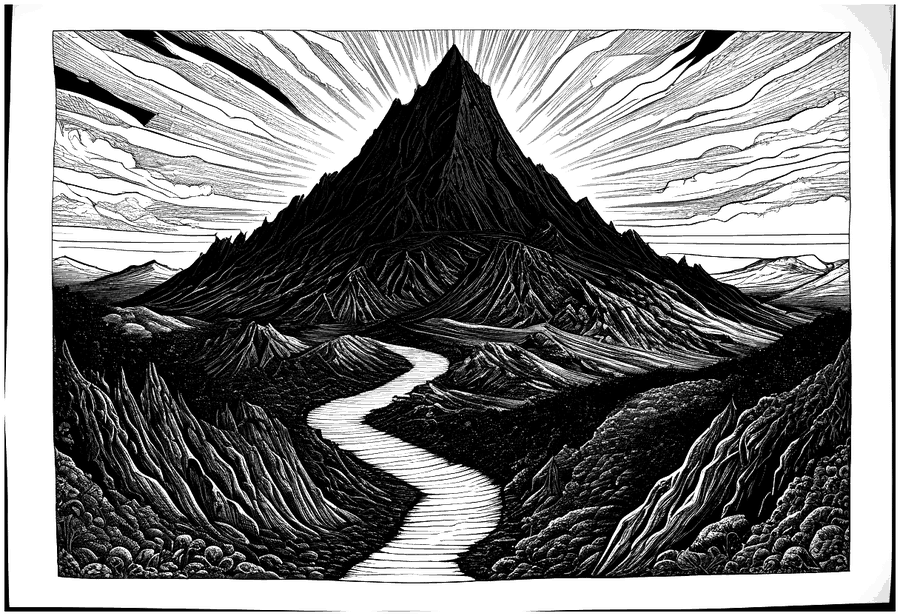
The highest peak on the Flokburgh Continent, a horn of ice above the glaciers where the Worm's spine is said to end in its skull. The Hoarfolk will not climb it, and the frost-dragon Hrimgard sleeps on its flank.
Life & lore
Feasts
On Wormwake Eve, 6 Rostovund, the Soumi and Hoarfolk of Saski pour milk and salt into the crevasses below the Crown so that the Father sleeps. Nobody celebrates on the mountain itself. On the Long Silence in Thaw the valleys under the Crown are as quiet as every other day, because quiet is the local rule all year.
Daily life
Nobody lives on the Crown. The herders of the high valleys below Saski keep no bells, shoe their ponies in felt and speak in low voices outdoors, for fear of Hrimgard. Ice-cutters saw blocks from the lower glacier for Saski's cellars. The Wyrmwatch keeps a stone post above the snowline, and its men eat salt fish and talk in whispers.
Customs
Valley children are named in a whisper. The dead are buried in silence and in ice-caves in winter, and the body is carried down to Saski in the thaw. A guest arriving in a valley house is given a bowl of warm milk and must not speak until it is finished. Shouting near the glacier is the worst taboo.
Folklore
The Hoarfolk say the Worm's spine ends in its skull under the Crown, and that the glacier is its frozen breath. Valley folk say Hoka oi luumuili, "An elephant does not run", meaning that the mountain will come down in its own time. A plume of snow off the summit on a still day means the White is turning in its sleep.
History
In 525, the Long Winter, the Crown's glaciers advanced four miles in one year and swallowed the hamlet of Vuolajar, whose church bell can still be heard in the ice in a thaw. In 788 a Merlish climber, Silas Dunmore, set out to reach the summit with a brass trumpet. He did not come back, and the valleys blamed the trumpet.
People
Watch-Sergeant Dukhdur of Saski has kept the Wyrmwatch post under the Crown for thirty years and has seen Hrimgard's tail twice. Vesku Lahkonen is a Soumi ice-cutter and guide who will take visitors to the Crown's foot for an elephant mark a day, in silence. Bappet Zrum-Zak-Zin, a Kettlekin balloonist, wants to fly over the summit.
This year
Avalanches have fallen out of season since the Comet of Thaw, and one buried the Wyrmwatch's lower hut in Hofjor. The Wyrmwatch says Hrimgard has moved on its flank. Since Gravdalla Deep sealed its gates, Saski's Hoarfolk have stopped selling the valley herders powder for clearing rock.
The war
The Emperor has closed the northern passes, and the smugglers' route over the glacier runs close under the Crown. The Wyrmwatch fears that a cannon fired in the passes will wake Hrimgard, because noise drives it off but it also wakes it. Valsiaria's refusal to fight keeps soldiers out of the valleys, for now.
Market & law
The Crown has no market. Saski sells glacier ice in summer at 1 d a block, and frost-wyrm scales, when one is found, fetch 50 cr from Hoarfolk smiths. Valsiarian law fines any shout in the high valleys a quarter-mark. Firing a gun within sight of the Crown is banned by both Valsiaria and the Hoarfolk.
Healing
Winter-black is the valleys' curse. The herders rub frostbite with snow, which does more harm than good, and the Saski Hoarfolk amputate. Sky-sickness strikes anyone who climbs above the Wyrmwatch post. Snow-blindness is treated by a week in a dark room with tea-soaked rags over the eyes.
Adventure seed. A smuggler crossing the glacier found a brass trumpet frozen upright in the ice under the Crown. The valleys want it buried. A Kettlekin collector wants it played.
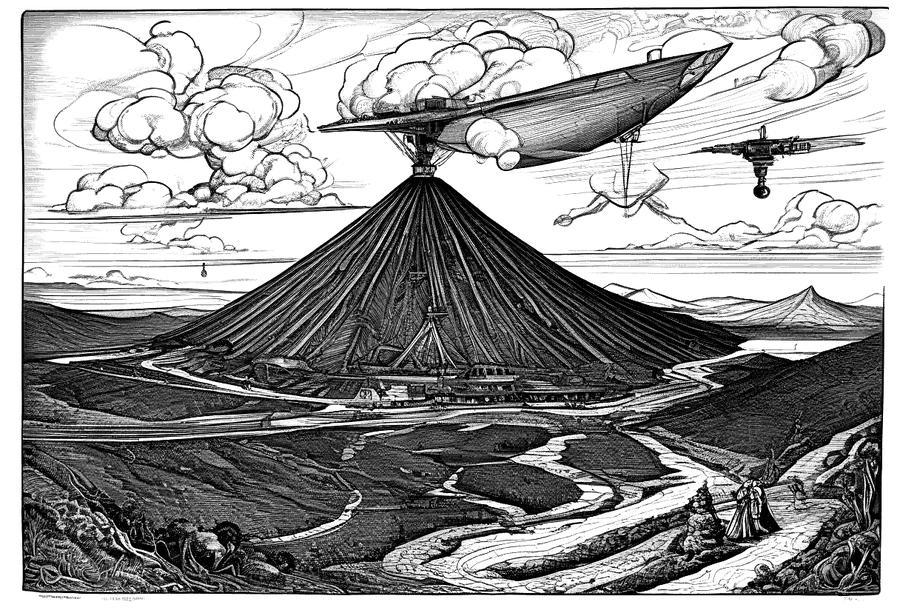
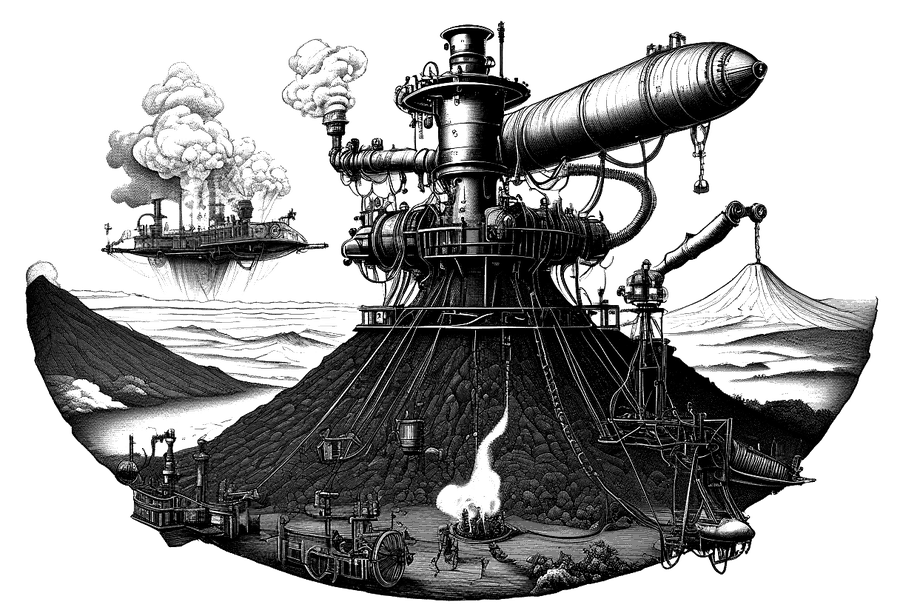
A volcano, dormant for centuries, that began to smoke this year. Marrow-gas seeps from vents on its slopes, which is why the Kettlekin built their gas-works at its foot, and why the Hoarfolk say the dragon Vyrnax is waking beneath it.
Life & lore
Feasts
At Kettlemoot on 12 Haymonth every sky-ship at Brasswhistle's Drift goes up at once, and this year the Drift's crews will hold their breath for the mountain as well as for the Whistle. The Igyoszavas druids keep Root Night on 12 Hofjor, leaving honey and blood at the old pines on the lower slopes for Utturi to guard the mountain.
Daily life
Kettlekin gas-hands work the tanks and pipes on the flank in leather masks, and Vengrian herders graze cattle on the lower slopes and curse the ash on the grass. The air smells of sulphur and hot metal. Sky-ships hang overhead on tethers, and the Drift's ropes creak over the gas-works day and night. Food comes up from Hatlovesd by mule.
Customs
Herder families on the slopes marry across the Hatlovesd stream, so the bride crosses running water, which they say Vyrnax cannot. Kettlekin who die at the works are given to the sky in a burning balloon. Nobody on the slopes lights a fire on the ground after dark, but cooks on raised iron trays.
Folklore
The Hoarfolk say the gas-works woke Vyrnax, and the Boiler Purists agree. Herders say Hitin zügest gipegy zhaza bösz baj, "The grass forgets the fire; the earth remembers." A cow lying down facing the summit means smoke tomorrow. The Kettlekin of the Drift say the mountain is only a very big boiler, and boilers whistle before they burst.
History
Foleleyme was dormant for centuries. In 798 Kettlekin scavengers found marrow-gas seeping from its vents, and the Lanternwrights built the gas-works soon after. Pibbet Brasswhistle tied the first two hulks together over the works and began the Drift, which is now home to about nine hundred.
People
Nix Coilgrabber's foreman at the works, Dattit Mox-Zrum-Zin, wants to cap the three hottest vents and has been refused. Csozh Zevela, a Vengrian herd-woman, has moved her cattle across the river twice this summer and charges the gas-works for every cow that dies. Hroth's Wyrmwatch has sent Watch-Corporal Gekhith of Gravdalla to live on the slope.
This year
Foleleyme began to smoke this year, and in Rocadones three of the vents began to glow at night. The gas-works have gone silent twice for days at a time. The Drift says it is safe while the volcano only smokes, and is arguing about where to move if it does more than smoke.
The war
Every sky-ship flying the Kamiechia–Balsozha lane fills here, so the Compact cares more about the gas than the Lanternwrights do. A company of Igyoszavas light cavalry now camps below the works, either to guard it or to stop the Kettlekin leaving. Ash has spoiled the hay, and horses are dear.
Market & law
Marrow-gas is sold by the barrel at the Drift, at 4 cr a barrel this summer, and only there. Sulphur, gas-works scrap and ash-glazed pots are sold at Hatlovesd. Lighting a flame on the works is punished by being dropped from the Drift in a net and left hanging overnight. Herders are paid 4 d a day to keep cattle off the pipes.
Healing
Gas-hands get gas-cough and the sleepy sickness from leaking vents, and the cure is fresh air and a long rest. Marrow-burn turns up among the vent-tappers, who wear cold iron rings against it. Herders' cattle get ash-lung, and Soumi druids treat the herders' eyes with cold honey-water.
Adventure seed. One of the glowing vents has begun to breathe in time, like something sleeping. The gas-works foreman will pay well for someone to go down and look.
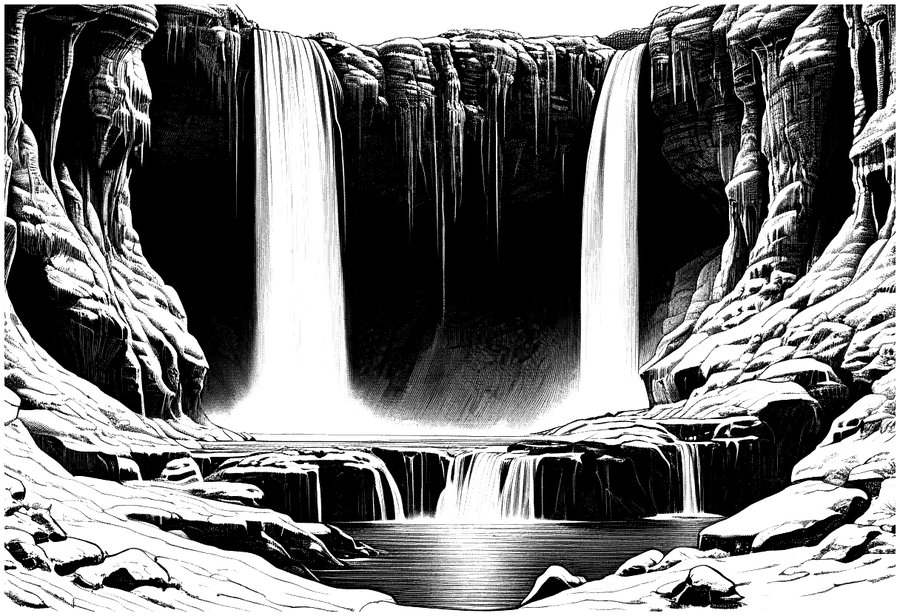
A waterfall that has cut a gorge through the northern plains. Its spray freezes in winter into an ice cathedral, and Balsozhian lovers swear oaths behind the falling water, where the Severe Virgin cannot see them break.
Life & lore
Feasts
From Isgard to Thaw the spray freezes into the ice cathedral, and the people of Tuvartoszoma hold the Ice Lantern on 10 Longnight, when the cathedral is lit with tallow lamps for one night. At midsummer lovers come in hundreds, and the busiest night behind the water is the first full Lamp of Haymonth.
Daily life
Ferrymen and oath-guides from Tuvartoszoma, eighty miles away, keep huts at the gorge rim and lead couples down a wet stair to the ledge behind the falls. Their families sell ribbons, mead and smoked trout on the rim. In winter ice-cutters chip the cathedral's lower pillars for the taverns' ice-houses. The falls drown out all other sound.
Customs
Vengrians swear oaths under the open sky, where the Severe Virgin can see them, so an oath behind the water is the one oath she cannot judge. Lovers who are not free to marry swear behind the falls and tie a ribbon to the ledge rail. Lawful marriages are made on the rim above, in sight of the sky, for luck.
Folklore
Vengrians say Incs mobo kónyost okkan, "The sky sees every word", and then add, "except at Sziksvagyalok". Ribbons that blow free in the night mean the oath will be broken. Grandmothers say a girl who goes behind the water comes back with a husband or with a secret.
History
The falls have cut a gorge through the northern plain for longer than anyone remembers. In 702 the Thetletown priest of Tuvartoszoma tried to have the ledge blasted, calling it a school for adultery, and the mine fizzled in the spray. The scorch-mark is still shown to visitors as proof that the Virgin approves.
People
Lévár Mela is the senior oath-guide and has led couples behind the falls for forty years, and she keeps no list. Genc Csér, a ferryman, rows across the plunge pool and smuggles more than lovers. Father Jenc Dence, the Thetletown priest of Tuvartoszoma, wants the ledge closed and preaches against it every Smithsday.
This year
This year more soldiers than lovers have gone behind the water, to swear oaths they mean to break if they have to, such as to stay alive. The ice cathedral collapsed early last winter, in Rostovund, which the guides call a bad sign. A pair of deserters is said to be living on the ledge.
The war
Press-gangs from the river towns wait at the gorge rim for young men, so lovers come at night. Riders on their way to the war come to swear behind the water that they will come home, which the Virgin cannot hold them to. The ribbon-sellers are making more money than in any year before.
Market & law
An oath-guide charges 2 d a couple, and a ribbon costs 1 d. Ice from the cathedral is sold to Tuvartoszoma's taverns at 1 d a block. Imperial law treats an oath sworn behind the falls as void in court, so contracts sworn there are worthless. Pushing someone into the plunge pool is counted as murder whether or not they drown.
Healing
Falls-chill, a soaking fever caught on the ledge, sends lovers to bed for a week, and the herb-wives treat it with hot mead and mustard. The wet stair breaks ankles, and the bone-setter in the guides' huts charges 6 d. Drownings in the plunge pool are common, and the bodies come up at the Minor Jetty downstream.
Adventure seed. A ribbon tied behind the falls bears the badge of the Emperor's household and the date of Zsolt's wedding. Somebody swore an oath there that they meant to break.
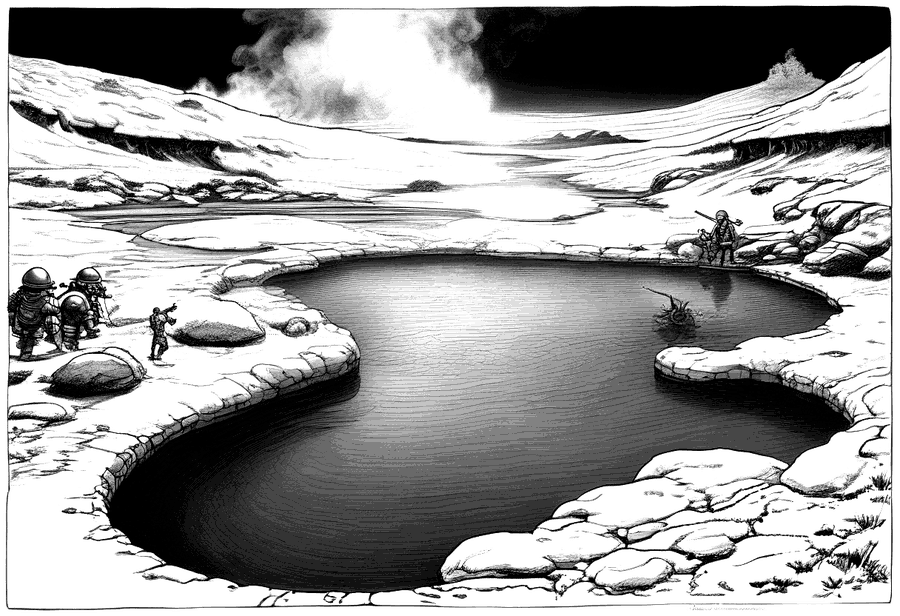
Hot springs in the middle of the cold steppe, steaming in winter like a cauldron. Wounded riders are sent here to heal, and woolly Rhunari come every spring to soak their hides. Both are supposed to keep to separate pools.
Life & lore
Feasts
Every spring, from Thaw into Mieles, the woolly Rhunari clans come down to soak their hides, and the Soaking is their great holiday, with pushing contests on the frozen mud. At the Sitting of Snow in Longnight Vengrian clans camp in the steam. On Hornday, 20 Tunarejo, the Rhunari pay horn-debts at the springs.
Daily life
Steam hangs over the steppe for miles, and the springs smell of eggs and wet wool. Bath-keepers tend the stone pools, wounded riders lie in the Imperial Pool, and the Vengrian camp sells mutton broth and kumis. In winter the steam freezes into rime on every tent pole. Herders bring sheep to be washed for 1 d a head.
Customs
Riders and Rhunari keep to separate pools: the Imperial Pool for riders, the Grey Pool for the clans. The rule is old and nobody remembers who made it. A Rhunari calf is soaked for the first time at three years old. A Vengrian rider who dies at the springs is wrapped in a steaming hide and buried with his horse.
Folklore
The Rhunari say the springs are the Grey Mother's warm breath, and the Vengrians say they are the Severe Virgin's tears. The Rhunari proverb heard at the pools is Ngoma gaanaam ba, "The herd is the wall." Throwing a stone into another people's pool is said to bring on a fight within the year.
History
In 588, after a brawl in which three riders and a Rhunari bull died, the Emperor and the woolly clans agreed the Pool Peace: separate pools, shared steam. A carved horn and a horse-tail standard still hang together on the bath-house wall to mark it. The bath-house was rebuilt of stone in 640.
People
Mudgenc Gér is the imperial bath-keeper and wants the Rhunari moved to a new pool downstream. Khanguro Hinowe is a woolly matriarch who has soaked here for sixty springs and will not be moved. Szely Ha is a Vengrian herb-woman who runs the infirmary tent and treats riders and Rhunari alike.
This year
This spring the woolly clans arrived and found the Imperial Pool full of wounded riders from the Hajhian front, and riders also bathing in the Grey Pool. The Pool Peace held, barely. Since the clans are sworn to Queen Dorottya, the riders now call them enemy spies and the Rhunari call the riders invaders.
The war
The springs lie only sixty-four miles from the Hajhian town of Zsamronalsoz, close to the front, so the wounded come by cart in every week. The woolly clans fight for Hajhia, and the Grey Wall Rhunari in imperial pay come here to heal too, so Rhunari who fight Rhunari bathe a pool apart.
Market & law
A soak costs 2 d for a rider, a groat for a stranger, and a horn-scrip for a Rhunari. Spring-salt, scraped from the pool edges, is sold for wounds at 1 d a twist. Imperial law makes it a flogging offence to bathe in the wrong pool. Starting a fight at the springs is punished by flogging and a ban from the pools for life.
Healing
The warm water helps healing wounds, stiff joints and winter cough, and the riders swear it sets bones faster. Szely Ha packs wounds with spring-salt and moss. Rhunari hide-rot, a cracking of the hide in cold, heals in a week of soaking. Camp flux broke out in the infirmary tent in Hofjor.
Adventure seed. A wounded rider in the Imperial Pool is a Hajhian spy, the clans whisper, and he has been passing messages to the Rhunari through the steam.
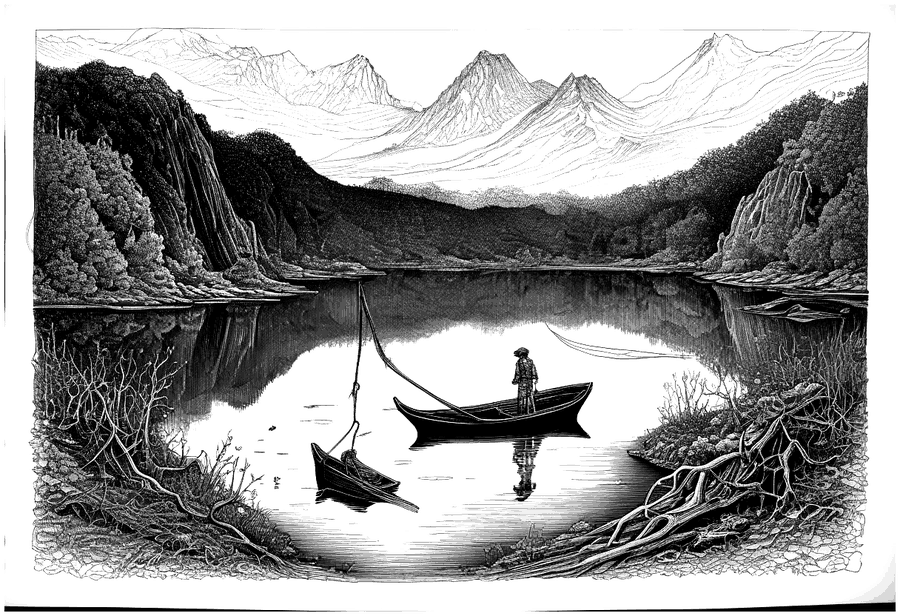
A deep, cold lake where fishermen will not cast their nets for fear of the creature said to live in it, eleven feet long by the most modest account. Its water is so clear that on still days you can see the ruins of a drowned Elder town on the bottom.
Life & lore
Feasts
On Floodwake, 1 Ondaria, the people of Raluna set candle-boats on the lake for the drowned, and for the town on the bottom, whose dead have no one else. On Breakice in Thaw the first crack is watched closely, because the creature is said to break the ice from below. No fishing festival is kept, because no fishing is done.
Daily life
Raluna, a stone-cutting and leather town of about four and a half thousand, lives beside the lake but not on it. People draw water from it with long-handled buckets and keep out of the shallows. Boatmen take visitors out on still days to look down at the drowned town. The taverns serve river fish carried in from elsewhere.
Customs
Raluna brides throw a shoe into the lake so the creature will take that rather than a child. A child who falls in and is pulled out is given a second name. The drowned are mourned on the shore, but bodies taken by the lake are never searched for. Nobody throws a net into the water, even to recover something lost.
Folklore
The creature is eleven feet long by the most modest account and as long as a church by the least modest. Raluna mothers sing The Lake Has a Long Arm to keep children from the water: "The lake has a long arm, and a longer memory." A shoe washed back to shore means the creature has refused the bride.
History
The Elder town on the bottom has no name, though its streets can be counted from a boat on a still day. In 691 a Balsozhian prince had divers sent down, and they brought up a bronze lamp and a cup before one did not come back. The lamp hangs in Raluna's church, and nobody remembers what happened to the cup.
People
Ticsády Zhence is the oldest boatman and takes people out for a look, never further than the third street. Szenc Gyötta, an armourer, buys anything that comes up from the bottom. Lugely Zonzhona says she has seen the creature five times and sells drawings of it at the tavern for 1 d.
This year
A boat with two Ucillamope scholars on it went out in Hofjor and came back with one scholar, who will not speak of it. The drowned town has been unusually clear this summer, and people have counted a street they have never seen before. Some say the creature has grown.
The war
Raluna's armourers work for the imperial army, and the town's young men have gone to the war. The press-gangs now take boatmen, so there are fewer boats on the lake and people say the creature is bolder. The arms-masters sell lake-water to soldiers to quench blades, for luck.
Market & law
A boat out to the drowned town costs 3 d, or 1 sh for a still day. Things raised from the bottom must be shown to the town reeve, who takes a third. It is forbidden by town law to cast a net in the lake, on pain of a fine of 2 horse-dinars and a day in the stocks.
Healing
Cold-water cramp kills swimmers, and Raluna people do not swim. The lake's water is said to cure warts if they are dipped at dawn. Tanners at the leather-yards suffer from lime-burns and cough, and the barber-surgeon by the church treats both for 6 d.
Adventure seed. The boatmen have counted a new street on the bottom of the lake, and a door on it standing open. A scholar from the Library wants to hire a diver.
The longest river on the Flokburgh Continent (only the Arjan of Qabahrah, at 2,390 miles, is longer in all the world), winding from the Hoarspine glaciers across the taiga to the northern sea. Fur-traders float down it on rafts in spring; the Emperor's barges carry the Hoarfolk cannon on it this year.
Life & lore
Feasts
Breakice on 1 Thaw is felt all along the river, but the raftsmen keep their own feast, the Floating, when the ice clears and the first fur-rafts leave the taiga for the sea. On Floodwake, 1 Ondaria, river towns set candle-boats on the water. On Last Sheaf the downriver farms throw the Worm's Bride into the river.
Daily life
The river is a road. Fur-traders build rafts of taiga logs in spring and float them a thousand miles to the northern sea, and break them up for timber at the mouth. Barge-haulers walk the towpaths, and every landing has an inn that sells smoked sturgeon, rye and birch beer. In winter the river freezes and sledges use it.
Customs
Raftsmen tie a lock of their hair to the first log of a new raft. A drowning is never named on the water. A raftsman's widow throws his cap into the river, and if it sinks she may remarry at once. A stranger who asks for a ride on a raft must work an oar.
Folklore
The Kjelheimers say the Witfordge is the Worm's great vein, and that it runs warm when the Worm stirs. Raftsmen sing Down the Long Water through the night, and they say a raft that runs aground at Vecsatorvasza will never reach the sea. A white sturgeon is lucky. A black one means the river wants someone.
History
The Witfordge has carried furs since before the Empire. In 525, the Long Winter, it froze to the bed for the first time in memory, and it was used as a road from the Hoarspine to the sea for nine months. The fur-guilds of the lower river kept a tally-stick on the frozen river, which now hangs in Varcag's guildhall.
People
Pozh Mos is the Barge-Master who has been given the cannon convoy and will not sleep until it reaches the steppe. Nely Toszád runs the biggest landing inn above Varcag and sells news to anyone. Brynna Taldottir is a Kovavikian fur-trader who runs rafts down the river every spring and wants to know who will buy her furs this year.
This year
The Emperor's barges are carrying the Hoarfolk cannon down the river this year, and every landing turns out to watch them pass. Several barges have sprung their seams, and the Rusted Brethren are blamed. The river ran high in Rocadones, and the fur-rafts were late.
The war
The cannon must go by the Witfordge and then the steppe to Erencszasz, and the whole river is watched by Hajhian scouts. The towpaths are full of press-gangs, and fur-traders are fined for blocking the barges. The landing inns are making a fortune from soldiers.
Market & law
A raft of furs is worth about 300 cr at the mouth. River tolls are 1 d a log at each imperial landing, and a pilot costs 1 sh a day. Blocking an imperial barge is punished by flogging. Sturgeon roe sells at 1 sh a pot. Steppe groats are now accepted at every landing.
Healing
Raftsmen suffer from rope-burn and hernias, and the landing inns keep a barber-surgeon who charges 6 d. River-ague hits the lower reaches in Ondaria, when the floods come. Winter-black takes the toes of the sledge-drivers. Willow-bark grows on every bank and is chewed for everything.
Adventure seed. One cannon-barge carries a crate the Hoarfolk gunners will let nobody open, heavier than any gun. Find out what it is before it reaches the steppe.
A sacred rainforest of trees so old that their roots form caves. The High Huntress is chosen by a hunt in its depths, and it is death for anyone else to hunt there. The Mistwood Bretborn say it is the last forest the Elder Crowns planted.
Life & lore
Feasts
At the Shedding on 10 Hofjor the holy hunts are drawn, and in a selection year the sacred hunt for the High Huntress goes into the Bliksberg. Utstad keeps Cave-Bread Night in Isgard, when villagers leave bread at the mouths of the root-caves for the forest. The Penner's Gate sends the year's prisoners towards the forest to be hunted.
Daily life
Utstad, a village of about eleven hundred at the forest's edge, lives on the pilgrims and the priests. Its people gather moss, mushrooms and fallen wood but never hunt, and they eat barley, mushrooms and pigeon bought from outside. Forest-wardens in green walk the edge with longbows. The forest drips all year, and the air smells of leaf-rot.
Customs
Utstad children are taken to the forest edge at seven and told to listen for a whole night. Weddings are held under the first great tree on the Utstad path. Anyone who dies in the forest is left there, and the family plants a sapling at the edge. Carrying a drawn bow past the boundary stones is forbidden to all but the hunt.
Folklore
The Mistwood Bretborn say the Elder Crowns planted the Bliksberg, and that the trees are still waiting for them. Utstad grandmothers say Fikisin ratråm ul gohørnin, "The hunter does not fear the night", and add that the forest does not fear the hunter. A white owl over the village means a priest will die.
History
In 214 the first High Huntress was chosen by a hunt in the Bliksberg, and the Raugarians count their holy years from it. In 618 a hunt lost thirty priests in the root-caves when giant spiders came up from below, and since then the hunts have stayed above ground. The Bretborn mapped the root-caves in 690 and burned the map.
People
Velk Trandsson is Chief Forest-Warden and has turned out more poachers than anyone alive. Brekk Ulvårsson runs the only inn at Utstad, the Bowstring, and keeps a book of everyone who has walked into the forest and not come out. Thehowy ith Vor, a Mistwood Bretborn mapmaker, is said to know the root-caves.
This year
The insurgents have promised to free the prisoners at the Penner's Gate this year, and the forest-wardens fear that the freed will hide in the root-caves. Hunters claim the giant spiders have been seen at the forest edge for the first time in living memory. A great stag was found dead without a wound.
The war
The longbow regiments have taken half the forest-wardens, and poachers from the wetlands are bolder for it. The wetland villages say the Huntress takes their sons while the Kjelheim rebels feed their daughters, and some of those daughters bring food to rebels hiding in the forest's edge.
Market & law
Nothing may be hunted or sold from the Bliksberg, and it is death to hunt there unless you are the hunt. Moss and mushrooms may be gathered by Utstad folk with a warden's tally. The Bowstring sells beds at 5 d and maps of the paths for 1 sh, which the wardens say are wrong on purpose.
Healing
Root-cave fever, a fungus-cough caught in the caves, kills slowly and is treated with smoke of juniper. Spider-bite causes swelling and fever, and Utstad herb-wives draw it out with bread and milk poultices. Marsh ague comes with wetland pilgrims, and the hunters chew willow-bark for wounds.
Adventure seed. The Bowstring's book lists a name that walked into the forest last month: Sigrun Kvaldottir. The High Huntress was in Fagervik that day, and the innkeeper is frightened.
A gash in the land a mile deep in places, its walls banded red, ochre and black. Locals say it is a good place to hide treasure, and three centuries of thieves have taken their advice. Nobody has found most of it.
Life & lore
Feasts
Nobody holds a feast at the ravine itself. In Kilho, a hundred and fifty miles away, treasure-seekers set out after the Long Silence on 20 Thaw, once the glacier roads are passable. Kilho's Soumi keep the Silent Days on the 10th, 20th and 30th of each month, and no guide will lead a party on one.
Daily life
The ravine stands on unclaimed glacier, and nobody lives there except treasure-hunters and the guides who feed off them. Hunters' camps of oiled canvas cling to the rim in summer. Guides from Kilho bring dried fish, barley and lamp-oil up by sledge. The walls are banded red, ochre and black, and the wind howls down them.
Customs
Treasure-hunters leave a pebble painted with their mark at the head of the descent path, and a guide breaks the pebbles of those who do not return. Soumi guides will not speak on the descent. A party that finds something shares a cup of spirits at the rim before anyone opens it.
Folklore
Locals say the ravine is a good place to hide treasure, and three centuries of thieves have taken their advice. Kilho guides say Nehu je maka tule luktos aipo, "Wait, and the river will bring the fish": wait, and the ravine gives up its gold. Black bands in the walls are said to hide the best caches.
History
The first famous cache was hidden about 530 by the Kovavikian brigand Stavn Hrolksson, after the Long Winter. In 712 a Merlish counterfeiter hid forty pounds of false crowns there, which are still turning up. Every century or so a big find starts a rush. The last, in 786, drew two thousand people.
People
Haaku Soinila is the oldest guide in Kilho and has made sixty descents, none to the bottom. Gaml Stervsson is a Norse treasure-hunter who has spent twenty years on the ravine and found a sword and a boot. Kozzit Zrum-Dop-Zak-Dop, a Kettlekin, is building a basket-lift to lower people into the deepest part.
This year
A party found a chest of Raugarian hacksilver in Rocadones, and Kilho is full of strangers. Some say the Quiet Hands hid the Counting-Towers' gold here, and three Merlish roof-runners have been seen in Kilho asking questions. A rockfall has opened a new cave in the red band.
The war
Deserters from every army hide in the ravine, and the guides sometimes find them frozen. Valsiaria's refusal to fight keeps Kilho calm, but Manttamite crusaders came through in Hofjor looking for a gun-cache. With smugglers busy on the glacier, there are new tracks in the snow.
Market & law
A guide from Kilho to the rim costs 2 elephant marks a day, and a rope-man for the descent costs a mark more. Finds on unclaimed land belong to the finder, but Kilho's reeve charges a tenth on anything brought back through the town. Claim-jumping is settled with knives on the rim.
Healing
Falls kill most treasure-hunters, and Kilho's bone-setter has the busiest practice in Valsiaria. Sky-sickness and winter-black come with the height and the glacier. Kilho's Soumi physician treats frostbite with warm water and silence, and charges 2 sh, which is better than the Norse snow-rub.
Adventure seed. A painted pebble at the head of the descent path bears the mark of a treasure-hunter who died in 786. Someone has used his mark, and recently.
A sea of sand fused to glass in great swirls, as if something burned here hotter than any fire. Mirages walk across it in daylight. Caravans skirt its edge, and the Glassborn live at its heart. Under it, people say, lies Bretbury.
Life & lore
Feasts
On the Unspoken Night in Haymonth, caravans camped on the Waste's edge sing without words, so that they speak no name the mirages can steal. Wellwater in Longnight is the one time the Successor's caravans go near the Waste. In the dry months the Glassborn's Choir can be heard at night from the edge, and the caravan-men call it the Long Song.
Daily life
Caravans skirt the edge, and the oasis towns of Zalfamaq, Jizayd and Soraidah live by watering and guiding them. Caravan-men wrap their faces in indigo veils and paint their eyes with kohl. By day the glass shimmers and mirages walk across it. At night the cold is bitter, and the Waste cracks and pings as it cools.
Customs
A caravan-man ties a bell to the last camel so the caravan can always hear it. No one points at a mirage, and nobody calls out a name across the Waste. When someone vanishes, the caravan waits one day, pours water on the sand, and goes on. Qashari bury the dead with their faces turned away from the Waste.
Folklore
Under the Waste, people say, lies Bretbury, and Tugan trampled the Worm's head there. Caravan-men say Thaloosh hurk meerikhal kil zadhooloo qulaagh adoh, "The wind hides the road; the stars show it", and travel by night. A mirage that walks towards you is a mirage-lure. If you follow it, it has a mouth.
History
The sand was fused to glass in great swirls in year 0, as if something burned hotter than any fire. In 622 the Glassborn woke at the heart of the Waste, and caravans began to hear chiming at night. Since then the Chiming City has risen on the horizon, and nobody can say whether it has grown.
People
Sudhaadah al-Rafeebi is caravan-master of the Zalfamaq road and has crossed the Waste's edge two hundred times. Sasheed al-Raraqi sells veils, kohl and "Bretbury glass" at Soraidah. Nudhaarah al-Rufakhahi, a Successor's Eye, watches the Glassborn from a camp on the edge and sends her reports to Qaqah.
This year
Two Glassborn Strays were seen walking north through Orcosia this year, and the caravan-men say the Choir has changed its song. A caravan of thirty camels vanished between Zalfamaq and Jizayd in Mieles, and its bells were heard for three nights after. The Comet of Thaw was seen reflected in the glass.
The war
The Asraha–Mashian War has taken camels and riders, so caravans are smaller and the mirage-lures take more stragglers. Company spies try to cross the edge to reach Qaqah unseen. The Successor's riders patrol the edge, and they turn back anyone without his seal.
Market & law
A guide along the edge costs 2 siglos a day. Water is sold at the oases at 1 d a skin, and refusing it to a traveller is a capital crime. Glass from the Waste is sold everywhere, mostly fake. Crossing the line of the Last Cairn near the Gates without the Successor's seal is punished by death.
Healing
Glass-eye is the scourge of the Waste: Qashari kohl and veils prevent it, and leopard-priests treat it with a salve. Glass-cuts on hands and feet fester, and caravan-men wash them with salt water. Thirst and the mirage-madness kill the rest. The cure for the madness is to tie the patient to a camel and keep going.
Adventure seed. A caravan's lost bells were found, all of them, laid in a perfect circle a mile into the Waste. Someone wants the caravan-master to come and look.
The highest peak on Qabahrah, a red mountain that catches the first sun of the day and holds it until long after dark. The Hoarfolk of Sunhold mine its roots, and the sun-dragon Ankhorra coils near its summit.
Life & lore
Feasts
At the Kneeling of the Elephants on 1 Thaw, the Kavarri of the foothills light fires facing the Crown, in honour of Ankhorra, who is said to have crowned the first Shah. The Hoarfolk of Sunhold keep Wormwake Eve. On the first dawn of every month the foothill villages climb the ridges to see the Crown catch the sun.
Daily life
The foothill villages above Mar Shahr herd goats and sell food to the Hoarfolk of Sunhold, who mine the Crown's roots. Hoarfolk steel-traders drive mule-trains down to Shahpabad. The Crown glows red at dawn and long after dark, and the villages light no lamps until it fades. Wyrmwatch men keep a hut on the north ridge.
Customs
Kavarri foothill families marry at dawn, facing the Crown. Sunhold Hoarfolk bury their dead in the deepest halls, where they turn to stone. Oaths sworn in sight of the Crown are thought binding even on Ankhorra, so oaths are sworn there and never broken. Nobody climbs above the snow-line.
Folklore
The Kavarri say Ankhorra holds the sun in the Crown's peak at night, so that the dragon can see. They say Semesh izantomvin venta nirde birikvin jedar san, "The shah has sweet words and sharp swords", when they talk of the dragon. A red glow lasting until midnight is a sign of a coming crown.
History
Sunhold was cut into the Crown's roots long before the calendar. In 700 Ankhorra was seen over Shahpabad, and the Long Sleep began. Ember Deep, the second Sunward hold, dug deeper than any hold should, and last winter its Marrow-Delvers sealed it from the inside. Traders hear hammering through the rock.
People
Stîrdis of Sunhold is the hold's trade-mistress and sells steel to Shahpabad. Dilvar Koshani is a Kavarri goatherd who says he spoke to Ankhorra as a boy and sells the story to visitors. Sarrdur of Sunhold was at Ember Deep's gate the night it was sealed, and tells anyone who will listen about the Lit.
This year
A light shows in the vents of Ember Deep at night, and the Last Shift are tapping messages through the walls. The Wyrmwatch say Ankhorra moved on the summit during the Comet of Thaw. Sunhold has doubled its guard and sold more steel than ever to Shahpabad.
The war
Kahpia's war with Jowshia means that every Hoarfolk steel blade from Sunhold sells for a third more. The elephant-priests want the dragon appeased and send offerings to the foothills. The Grey Walls who guard the Shah would rather fight Lit Hoarfolk than unpaid. Mule-trains are taxed for the war.
Market & law
Sunhold steel sells at the foot of the Crown for 3 siglos a pound, and a guide to the snow-line costs 1 siglos a day. Ember Deep is sealed, and anyone caught breaking its seals faces Hoarfolk banishment and Kahpian law. Hoarfolk ingot-marks are accepted everywhere in the foothills.
Healing
Grey lung afflicts Sunhold's miners, who retire to the surface at sixty. Marrow-burn comes out of Ember Deep with escaped miners, and the Sunhold physicians treat it with cold iron. Sun-blindness on the snow is treated with kohl and dark cloth. The foothill herb-wives use goat-milk for everything.
Adventure seed. A tapped message from Ember Deep reaches Sunhold in old Hoarspeech: "We have found the bottom, and it is looking up." The Wyrmwatch want volunteers.
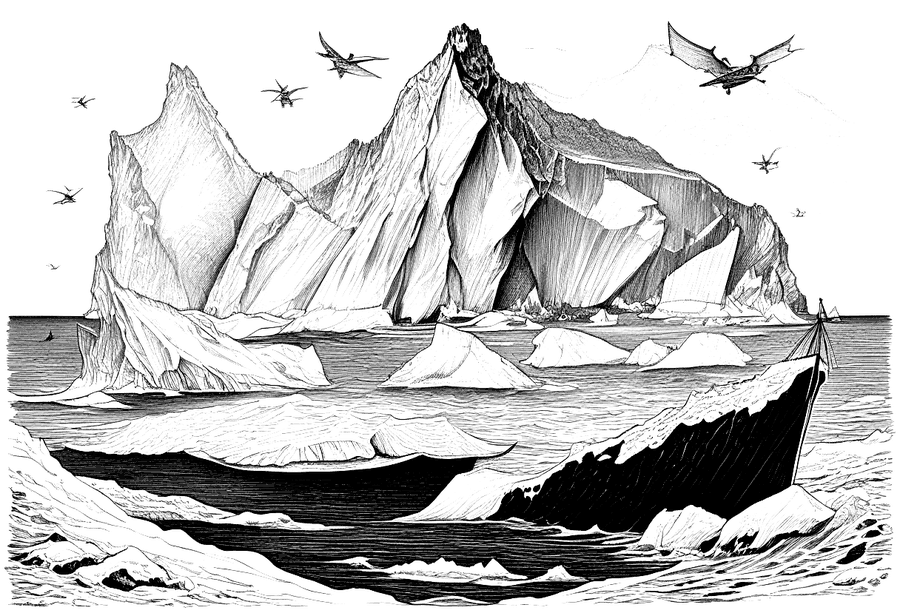
An ice-cap covering an entire island, its edge calving bergs the size of towns into the northern sea. On its north coast, frozen into the ice like flies in amber, lie the ships Skjoldis the Drift-Queen has collected.
Life & lore
Feasts
Nobody keeps a feast on the Ice. Seal-hunters from Kovavikia and Raugaria hold the Bergwake in Haymonth, when they row out to watch the first big berg calve, and they drink to it. Breakice in Thaw marks the opening of the hunting season. On Ashnight the hunters' camps on the south shore put out their fires like everyone else.
Daily life
Nobody lives on the Ice. In summer seal-hunters camp on the south shore in sod huts and skin tents, and eat seal, cod and berries. The ice groans and cracks all day, and every so often a berg falls into the sea with a noise like cannon. Raiders from Malocsermat and Felderoy hunt the hunters.
Customs
Hunters carve a mark into the shore rock before the season, and they chip it out before they go home. A hunter who dies on the Ice is left on a berg to drift. Never call Skjoldis by name on the north coast. Hunters leave a gift on the ice for her: a knife, a ring, a ship carved in bone.
Folklore
The Drift-Queen keeps ships frozen in her bay like flies in amber, and hunters say you can see the masts on a clear day. They tell of a ship that bargained its way out with a gift Skjoldis did not own. The hunters' song is The Queen's Collection, and every verse is a ship. The ice bear is her dog.
History
The ships in the ice have gathered for centuries. The oldest that can be seen is a Tsuruma junk, and the newest a Raugarian longship lost in 819. In 704 a Merlish whaler, the Margery, went in to salvage the bay and came out frozen solid, her crew still at the oars. She drifted ashore on Vopeid, and her figurehead stands in Gogur's Fur Market.
People
Kolv Ermsson is the head of the south-shore seal-hunters and has hunted the Ice for thirty summers. Skerra Valkdottir is a Kovavikian bear-hunter who sells pelts in Gogur. A Wyrmwatch man, Corporal Buk of Gravdalla, keeps a hut on the south shore, and has started to talk to the ice.
This year
A Raugarian longship that sailed for the Ice in Hofjor has been seen frozen into the bay, with its sail still set. The Comet of Thaw was seen reflected in the ice cap. The hunters say a new berg has a ship inside it, and nobody wants to row out to look.
The war
Raugarian longships have gone east, so fewer hunters come, and raiders from Malocsermat and Felderoy are bolder. Fur and seal-oil prices have risen in Gogur, so those who come make money. Some say Raugarian deserters are hiding in the hunters' camps.
Market & law
A white ice bear pelt sells for 40 cr in Gogur, and seal-oil for 1 sh a gallon. Hunting on the Ice is free, as the land belongs to nobody, but the raiders take a cut. Stealing from another's cache is punished by marooning on the Ice, which is the only law the hunters agree on.
Healing
Winter-black is the hunters' curse, and the Norse treat it with elk-fat and snow-rub, which they know is wrong. Bear-maulings are sewn up with gut. Snow-blindness is treated by binding the eyes. Scurvy takes the long-stayers, and the hunters chew cloudberries against it.
Adventure seed. A frozen ship in the bay bears a flag nobody recognises. A Gogur merchant will pay for the flag, and Skjoldis may want a gift in exchange.
Places of note
Beyond the wonders, these are the places adventurers end up: towns, forts, holds, ruins and stranger things.
Litta
Principality of Ortonzania · market town · c. 2,000
A market town of timber and stone on the Midmanch road, with a fair on every quarter-day and a coaching inn, the Crooked Spire, named for the view. On the hill to the east stand the black spires of the Winedihul Crypt. Children have gone missing this year, and nobody in Litta walks the east road after dark.
Why go
The starting point for the Spires of Winedihul. Hire guides, buy rope and hear the rumours at the Crooked Spire.
Life & lore
Feasts
Litta keeps Gatefair on 1–3 Haymonth, beating its boundary stones with hazel rods, but since spring nobody beats the eastern stone, which stands on the crypt road. On the Ferrying (1–9 Tunarejo) Litta lays a honeycomb on every grave, and this year Father Pell has told the town to keep its doors shut, against custom everywhere else. Quarter-day fairs fall on 1 Thaw, 1 Hofjor, 1 Ondaria and 1 Uxbridmanch.
Daily life
Breakfast is barley porridge with a spoon of dark Ortonzanian honey; supper is mutton pie at the Crooked Spire, 3 d with ale. Most families keep bees, cut timber or rett hemp in the ponds below Mill Lane, so the town smells of wet rope in summer. Houses are timber on stone footings, with iron nails driven into every east-facing sill.
Customs
A Litta bride walks the boundary on her wedding morning and touches each stone, saying Gabingdon's words. The dead are buried with their boots unlaced and their hands tied with hemp cord, a custom that is older than the Hollow Legion and is now done twice as tightly. Guests are given bread at the door and must eat it before the sun leaves the spires.
Folklore
Mothers sing The Bells of the Hill: "Seven spires and a door of bone, / Count them twice and you'll walk home." Children who cannot count the spires are said to be the ones the hill wants. Old folk say a crow on the eastern road means a burial within the week, and that the spires lengthen in winter.
History
Litta grew up around a hemp market chartered by the first Prince Ashworth, and the coaching inn was rebuilt after the Mill Lane Fire of 761, when the new owner named it for the only view nobody could burn. In 790 the churchyard was extended twice in one year after a fever, and the sexton of that year swore the new graves were already dug when he came to them.
People
Martha Crane keeps the Crooked Spire, sells rope at 1 sh for fifty feet, and wants her son Tobias back; he went east in Mieles. Father Osric Pell of the Anvil chapel keeps a list of the missing children and sends it to the Rust-Watch every Smithsday. Hal Fenner, a hemp-dealer, guides strangers to the spires at night for 2 cr and does not ask why.
This year
Eleven children have gone since Thaw, the last on the eve of Gatefair. Fresh graves are found empty in the morning, and the sexton has begun filling them with stones before the bodies go in. The Prince's soldiers keep the east road closed but drink at the Spire and refuse to talk about what they have seen march past at night.
The war
Litta's young men have gone to the fleet at Shifract or to the Prince's border forts, so women run the hemp ponds and the timber gangs. Merlish recruiting sergeants offer 2 sh a day and have stopped coming here. The Hollow Legion marching on the Midmanch road makes it hard to say which columns at night belong to which war.
Market & law
Ortonzania reckons in crowns: rope 1 sh for fifty feet, a lantern 3 sh, a night at the Spire 4 d with supper. Honey sells at 2 d a pound, half the Shifton price. By the Prince's decree the penalties climb: trespass on the Winedihul hill is punished with branding on the cheek, entering the crypt itself adds a 50 cr fine, and anyone digging in the churchyard without the sexton, or carrying anything out of the crypt, is hanged.
Healing
Granny Wren, a herb-wife on Mill Lane, treats hill-chill, a cold fever the children of Litta catch after walking near the spires, with honey, mustard plasters and a cord of red hemp about the wrist. Bites from things that dig are washed in salt water and seared; the barber-surgeon charges 6 d and wants paying first.
Adventure seed. Martha Crane will give a guest free lodging for life if they bring back her son Tobias, who walked east in Mieles singing The Bells of the Hill.
The Winedihul Crypt
Near Litta, Ortonzania · necropolis
A hill of crypts and mausoleums crowned with spires like the bones of a hand, older than Ortonzania and rumoured to be a school of necromancy. The Prince forbids anyone to go in. His enemies whisper that he has bargained with what sleeps there.
Why go
Tier V: the necromancer. Grave-goods from kingdoms older than any on the map.
Life & lore
Feasts
The crypt keeps no feast, but the people of the hill's edge do: on Ashnight they put out their fires an hour early so the hill "has no light to follow". During the Ferrying the Penitents are said to hold their own nine nights in the lower galleries. Shepherds swear the spires ring on the first Lampless night of Tunarejo.
Daily life
Nobody lives on the hill, but grave-robbers called spire-men camp in the beechwood below it, eating cold food because smoke draws the Wardens' attention. They wear felt-soled boots and wrap their lanterns in black hemp. The hill smells of wet stone and old honey, from the offerings left at the lowest mausoleum, which nobody admits to leaving.
Customs
Spire-men swear never to take a grave-good from a skull's own hand. Before going in they each leave a copper penny on the threshold stone, and coming out they walk backwards past it. Anyone who dies inside is left there, because a body carried out has always walked back in within a week.
Folklore
Litta children say the spires are the fingers of a buried hand, and that when the hand closes the world ends. The spire-men's saying is "Take the gold, leave the name": read no inscription aloud. The crypt is said to hold a teacher's chair carved from one Elder thighbone, and a register of pupils that is still being written in.
History
The crypt is older than Ortonzania. The first Ashworth princes walled the lower gates in 611 and paid a family of Litta masons to keep the walls patched; the last of that family, the Brandes, died out in 780 and the walls were never checked again. In 744 a Shifton broadsheet printed a map of the galleries, and the printer was found dead in his own press.
People
Agnes Rook, a spire-man of twenty years, has mapped three levels and sells copies at 5 cr. Brother Cedric Vane claims to be a Penitent and wants hirelings to carry marrow-salt into the deepest hall. Captain Wat Holloway commands the Prince's cordon at the foot of the hill, and has orders he will not show anyone.
This year
Since spring the Diggers have been tunnelling from Litta's churchyard toward the hill, and their spoil-heaps appear overnight. The Marshal's Hundred has ridden out from the crypt road three times this summer. Spire-men report that the lowest mausoleum, sealed since 611, now stands open, and that its floor has been swept.
The war
Prince Godric's enemies say he wants the dead as soldiers before the living war reaches him. Whatever the truth, his cordon at the hill draws soldiers away from the border forts, and spire-men say some of the guards are not there to keep people out but to watch what comes out.
Market & law
Grave-goods from Winedihul are illegal to sell in Ortonzania; Shifton fences pay 20 cr for an Elder armlet and ask no questions. A crypt-warden's armour plate fetches 100 cr and more from Hoarfolk smiths who want to study it. Being caught on the hill means branding on the cheek; being caught inside the crypt adds a 50 cr fine; being caught carrying a bone out means hanging.
Healing
A ghoul's paralysing scratch is treated by the spire-men with a poultice of mustard and honey and by keeping the wounded man talking. The sickness they fear most is the grave-sleep, a sleep from which the sleeper wakes speaking an older tongue; cold iron on the chest and Father Pell's prayers are the only known cures.
Adventure seed. Brother Cedric Vane pays 10 cr a head to carry three sealed jars of marrow-salt to the deepest hall. He will not say who sealed them.
Chuejon
Diocese of Ilbarescia · capital · cathedral-castle
A cathedral that is also a castle, on a crag above the river, with three rings of walls added one invasion at a time. Ilbarescia has more soldiers for its size than anywhere in Kidaneland, and most of them drill in Chuejon's courtyards. Prelate Inés rules from the cathedral, claims to speak for the Lion of Light better than the Pontiff does, and pays tribute to Raugaria through gritted teeth.
Why go
Hire hardened soldiers. Carry messages between three churches that hate each other.
Life & lore
Feasts
Chuejon keeps Hiving and Lionsday a day before Orcos, on 30 Thaw and 20 Rocadones, and on Lionsday the Prelate blesses the sun from the cathedral roof a full day before the Pontiff does in Orcos, to make the point. Its own feast is the Three Walls on 8 Reaping, when the town walks all three rings of the walls with candles, one for each invasion that built them.
Daily life
Soldiers outnumber every other trade, so mornings start with drums in the courtyards and bread with goat's cheese eaten on the march. Townsfolk sell cattle, honey and Ilbarescian emeralds, and live in tall stone houses wedged between the walls. The bells ring the hours, the forges ring the rest, and the river below smells of tanneries.
Customs
An Ilbarescian proposal is made with a drawn sword laid across a honey-cake. Brides wear yellow at Hiving; grooms wear their levy sashes. Every child is entered on the muster roll at its naming, so the priest who baptises is also the clerk who counts. The dead are buried in the walls, one niche to a family.
Folklore
The town's saying, in Astellian, is Solano dovar nicuze pozilo, "the sun sees the hidden road", which Chuejonese use to mean that the Prelate sees everything. Legend says Rocadones himself laid the first stone of the cathedral on a crag no army could climb, and every army since has climbed it anyway.
History
Ilbarescia broke from Orcosia in 511, the first split in the Fuempild faith, and Chuejon's cathedral was raised as a rival to Lion Hill. The second ring of walls went up after the Battle of Valsaz in 588; the third after 739, when Raugaria crushed the Ilbarescian Rebellion. During the Honey Years of the 470s Chuejon's beekeepers were the best paid in the world.
People
Captain Fuendo of Masales drills the cathedral guard and hires out veterans for 2 sh a day. Canon Pitada of Lonies keeps the hostage-roll from the Igyoszavan raids and wants her nephew back from Tabradozar. Tobiejo of Ranzales sells emeralds below the third wall and, it is said, Raugarian secrets to Orcosia.
This year
The Prelate has refused to send the Orcosian envoy home and refused to receive him, so he has been sitting in the second courtyard since Mieles. Hostages are still being exchanged with Igyoszavas a few at a time. The Comet of Thaw was read in Chuejon as the Lion's sword, and the Prelate preached on it for six hours.
The war
Raugaria has called for Ilbarescian levies to march east, and Chuejon has sent half of them, slowly. Tribute is due to Fagervik in hacksilver, and the Prelate pays it a week late every quarter on principle. Grain is dear with the Dearth in the south, and soldiers' bread has gone from wheat to barley.
Market & law
Chuejon takes sun-reals, crowns and hacksilver, and changers charge 10%. An emerald of the fine grade fetches 100 cr; a precious one 500 cr. A veteran pikeman costs 2 sh a day. A deserter has his name read out from the cathedral steps and cut from the muster roll before he is hanged from the church tower, and Ilbarescians fear the first more than the rope.
Healing
The cathedral's Sisters of the Hive dress wounds with honey and linen, charge 5 sh for temple healing, and are better at it than anyone outside the Sun Temple. Soldiers in the courtyards suffer the drill-cough from dust and cold stone. The cure is a Hiving honey-and-brandy at 2 d, which works because it is mostly brandy.
Adventure seed. Canon Pitada will pay 30 cr to anyone who can carry her nephew home from Tabradozar without either realm noticing that a hostage has gone missing.
Vasvár, the Iron Fort
Kingdom of Hajhia · star-fort on the Cannon Road
A star-shaped fort on the open steppe, the last strongpoint on the road to Erencszasz. It was built against arrows and horsemen. Now the Balsozhian siege guns are coming down the Witfordge, and the garrison is throwing up new earth banks in front of the old walls day and night, with every pair of hands it can find.
Why go
The front line of the war of two houses. Join the defence, or scout the Cannon Road for the Queen.
Life & lore
Feasts
The garrison keeps the Sitting of Snow on 15 Longnight on the open ground outside the walls, telling the horse-ancestor stories for three nights. Its own day is Vasvár's Ride on 1 Thaw, when every rider circles the five points of the star at a gallop; the last one back cleans the stables until Mieles.
Daily life
Soldiers and steppe families eat mutton broth, millet and mare's-milk curd, standing. Felt tents crowd the ditch-side of the walls. Everyone in the fort shovels earth from dawn to dark, and at night the sound is picks, sheep and the horse-lines. Pay comes in steppe groats, and the soldiers wear them sewn into their sleeves.
Customs
A Vasvár marriage is sworn under the open sky, never in a house, and the couple share a cup of fermented mare's milk on horseback. A newborn's first gift is a pinch of earth from the walls. The dead are laid on the steppe facing the Witfordge, and their horse's tail is cut and hung on the gate.
Folklore
The fort's proverb is Tólócs ígyer muka csodor, "a broken oath is a dead horse", carved over the north gate. Legend says the fort was laid out by a shaman who walked a star in the grass, and that as long as its five points face the five winds no enemy will take it. The new earth banks have spoilt the shape, and the old soldiers have noticed.
History
Vasvár was built in 702 by Hajhian kings to watch the Cannon Road, then a trade road for salt and wool. In 764 its garrison survived a winter of wolves by eating its own winter fodder and then its own boots. The great well in the central yard, dug in 730, is the deepest on the steppe and the reason the fort was put here.
People
Castellan Mivár Vence holds the fort for Queen Dorottya and wants Hoarfolk engineers more than he wants reinforcements. Mona Givevár, the fort's quartermistress, feeds four thousand people on stores meant for nine hundred. Kolt Legivár, a horse-trader, sells remounts at twice the price and spies, people say, for both sides.
This year
The Balsozhian siege guns are coming down the Witfordge by barge, and scouts count the days. Every refugee who stops at Vasvár is handed a shovel before bread. A Hoarfolk deserter from the Open Forge arrived in Rocadones and is teaching the garrison how to build earth against cannon, for a price nobody will name.
The war
The war is the whole of life here: the fort is the last strongpoint on the road to Erencszasz. Refugees heading south pass through daily, and some stay to dig. Horses cost twice the peacetime price, and the garrison has started eating the old ones. Montaso Shark bandits sell information to both armies outside the walls.
Market & law
Steppe groats pass here at 0.08 cr; horse-dinars are refused at the gate on principle. A remount costs 24 cr, double the peacetime 12. The fort's law is the Queen's: oath-breakers are given to the wind, horse-thieves are dragged behind their stolen horse, and anyone caught selling the fort's stores outside the walls is hanged from the north gate.
Healing
The fort's shaman, Pöka Mevár, treats camp flux by boiling water and smoking the tents, and it works. Sword cuts are stitched with horsehair and packed with yarrow. Lung-fever from the wet earthworks is treated with mare's-milk vodka and a felt blanket, and kills the old soldiers first.
Adventure seed. Castellan Mivár Vence will pay 50 cr for proof of the day the siege guns leave Tuvartoszoma, and 200 cr if one never arrives.
Top of the Hoarspine Stair · the highest of the seven Hoarfolk holds
Cut into the peak where the Hoarspine Stair crosses the range at 8,872 feet, its gate is the only door through the mountains in winter, and the Hoarfolk charge for it. The seven holds, in the Hoarspine and the Sunward Range, are the only places to buy thunder-salt at its source.
Why go
Cross the Hoarspine in winter. Buy powder at the source. Hire Hoarfolk guides for the deep roads.
Life & lore
Feasts
The hold keeps Wormwake Eve on 6 Rostovund, sealing one disused cut of the Stair and pouring ale into a crack in the summit rock. Its own feast is the Last Toll on 30 Isgard, when the gate-keepers waive the toll for the final traveller of the year, who is given a seat at the hold's table and a pinch of thunder-salt as a gift.
Daily life
The Hoarfolk eat cave-mushroom stew, smoked goat and salted barley bread, and brew a black mushroom ale. Inside, the hold smells of coal, sulphur and wet wool. Steam pipes heat the halls. Hoarfolk tend the toll-gates, the powder-stores and the furnaces; human porters carry baggage up the Stair for 1 sh a day.
Customs
Hoarfolk courtship is a contract cut into stone, witnessed by the hold-line; love is not mentioned. A child's first tooth is set into the hall's record wall. The dead are walled into the rock of the Stair itself, so every traveller climbs over the hold's ancestors, which the Hoarfolk think is a compliment.
Folklore
The hold's saying is Brak thaz thrûn khol bodrôrm thaz kûthorg: "the mountain is old, and the king is young". Porters say the steps count themselves at night and that anyone who counts eleven thousand and one will not come down. Travellers believe Rostovund's Crown watches the Stair, and so cover their faces at the summit.
History
The Stair is the oldest Hoarfolk road; the hold at its top claims to have tolled travellers for two thousand years. In 525, during the Long Winter, the hold kept the Stair open when every other pass froze and took in four hundred Kovavikian refugees, whose descendants still serve as its porters. The toll-house's ledgers go back further than the Ucillamope Library's.
People
Gate-Warden Hordith Khûmhalul commands the gates, over the Toll-Warden who takes the money, and keeps the list of everyone refused passage. Shâk Marzâlul runs the powder-store and sells to licensed buyers only, he says. Arne Halvdan, a Kovavikian-descended porter, leads travellers up the old cuts for 5 cr and knows where the frost-wyrm lairs.
This year
The hold has closed the Stair to all Balsozhian and Hajhian soldiers, and both sides say this favours the other. A frost-wyrm has taken two porters above the twentieth landing since Hofjor. Merchants complain that the hold has quietly doubled its salt price, and the Gate-Warden refuses to discuss Gravdalla's sealed gates with anyone, human or Hoarfolk.
The war
The war has to go round the Hoarspine because the hold refuses armies. Smugglers charge 5 cr to take someone over the glacier, avoiding the toll, and the hold's wardens hunt them. The Open Forge's sale to Balsozhia has split the hold: the Gate-Warden is an Old Anvil, the powder-store master is not.
Market & law
The toll is 2 sh a walker, 1 sh a mule and an ingot-mark a wagon, and Hoarfolk pay nothing. Thunder-salt at the source costs 1 cr a pound, but only with a Powder Moot licence; without one, 3 cr from the porters. Salt is 10 d a pound. Those who break a toll contract are cut into the shame-wall, and repeat offenders are sent down the Stair without boots.
Healing
Hold healers treat sky-sickness with climber's leaf and a night in the lowest hall. Winter-black is common among porters and is cured by amputation; the hold's bone-saw surgeon charges 1 cr and has a reputation for speed. Grey lung is treated by retiring the miner to the toll-gates, where he complains about the air.
Adventure seed. Arne Halvdan has found a smuggler's path that passes a frost-wyrm's lair. He needs two travellers to carry the porters' bones back down the Stair.
Raugarian Theocracy, in the Hoarspine · Hoarfolk hold
Where thunder-salt was first mixed, in 612. In winter the valley disappears under snow and the hold lives on its furnaces: steam pipes run under the streets to keep them clear, and the great forge-towers have not gone out in two hundred years. Raugaria's priests rule the valley. The Hoarfolk rule everything beneath it.
Why go
The finest powder and guns in the world, a winter refuge, and the deepest seams, with the marrow-salt in them.
Life & lore
Feasts
Gravdalla keeps Wormwake Eve on 6 Rostovund more seriously than any hold, sealing its oldest tunnel with a wall of iron. On 14 Hofjor, the hold's own Day of the First Thunder marks the explosion of 612, and every forge-tower fires one blank charge at noon. The Raugarian priests above keep the Shedding on 10 Hofjor and complain about the noise.
Daily life
Hoarfolk families live under the streets of the valley town, heated by steam pipes; humans live above. Meals are smoked trout, mushroom stew and black bread baked on forge-heat. Everyone smells of sulphur, and everyone coughs. Work is powder-mixing, iron-casting and delving, and the forge-towers' hammer-beat sets the time in place of bells.
Customs
A Gravdalla apprentice is given his first pinch of thunder-salt to burn on the anvil, and must not flinch. Marriages are sealed with a matchlock fired into the air. The dead are cremated in the forge-towers, and their ash is mixed into the hold's gunpowder, so every Gravdalla gun fires a little of its ancestors.
Folklore
The hold's oldest saying is Ûrgrakê rîtazd khoz, "do not dig without a prayer". Miners believe the deepest seams sing when marrow-salt is near and that a miner who hears the singing must go up at once. They also tell of the first powder-maker, who survived the blast of 612 and is still, some say, down in the lowest gallery.
History
Thunder-salt was first mixed here in 612, when alchemists blew the roof off a gallery. The forge-towers were lit in 634 and have not gone out since. In 731 a firedamp blast killed sixty delvers, and the hold built the first steam-pumps to clear the air. The hold's record wall was re-cut in 800 and lists eleven delvings.
People
Grand Fusewarden Brannoc leads the Powder Moot from here and has said nothing about the gates. Dumdis Gravdallul, a delver's widow, petitions daily to know whether her husband was behind the gates when they closed. Watch-Captain Hroth of the Wyrmwatch has been seen going down and coming back up, which no one else has.
This year
On 15 Hofjor, the morning after the Day of the First Thunder, the lower gates were sealed with iron and no explanation. Forty delvers of the deep shift have not been seen since; their families were paid the full shift-price and told to stop asking. The forge-towers still burn, but the hold now buys marrow-salt from Silverhold. Tapping has been heard behind the gates at night.
The war
Raugaria's priests rule the valley and want Gravdalla's guns for their regiments, but the Old Anvils refuse to sell until the Open Forge is expelled. Raugarian collectors have doubled the iron levy. Since the sealing, rumour in the Hunt of Hofjor says the Hoarfolk are hiding a weapon below; the Hoarfolk say nothing.
Market & law
Gravdalla powder sells at 1 cr a pound to licensed buyers and is reckoned the finest in the world; a Gravdalla hand-gonne costs 20 cr. The hold takes ingot-marks and hacksilver. Selling powder without a Moot licence means being sent up for life. Anyone caught at the sealed gates is cut into the shame-wall by name.
Healing
Grey lung kills most delvers before sixty; the hold's cure is a steam-tent of pine resin, which eases it. Powder burns are treated with goose-fat and snow. Marrow-burn among the deep miners is treated with cold iron bands worn on both wrists, and the hold smiths make them for 2 sh a pair.
Adventure seed. Dumdis Gravdallul will pay her husband's whole shift-price, 40 ingot-marks, to anyone who opens the lower gates and tells her what is tapping.
The Foleleyme gas-works
Igyoszavas · Lanternwright works on a waking volcano
Tanks, pipes and scaffolds clamped to the flank of Foleleyme, where marrow-gas seeps from the vents, and sky-ships hang overhead on tethers to be filled. Since the sky-ships began drawing gas here, the volcano has begun to smoke. The Hoarfolk say the gas-works woke the dragon Vyrnax beneath it.
Why go
Adventure: Marrow and Smoke. Or simply buy passage on a sky-ship.
Life & lore
Feasts
The gas-works crews keep Forgefire on 1 Uxbridmanch by relighting every flare on the scaffolds; Kettlemoot on 12 Haymonth is celebrated by sending up every empty gas-bag at once. The Vengrian herders of the lower slopes leave honey and blood at the roots of the oldest pines on Root Night, 12 Hofjor, for the Soumi forest-god, and ask him to keep the mountain asleep.
Daily life
Kettlekin and hired Vengrians work twelve-hour shifts in leather masks soaked in vinegar. They eat mutton dumplings and drink sour mare's milk, and sleep in shacks bolted to the rock. The place hisses, clangs and smells of rotten eggs. Every tool is brass, because iron sparks, and smoking within half a mile is forbidden.
Customs
A new gas-hand's first shift ends with his mask being thrown into a vent; if it burns blue, he stays. Kettlekin who die here are buried in the sky, sealed in an old gas-bag and let go. The herders' taboo is never to name the dragon on the mountain; they call it the Neighbour.
Folklore
Gas-hands say Ske ek stel vel, ek gipli vel, "if you fix the ship, you own the ship", and argue about it over every repair. Herders say the vents breathe in and out like a sleeper, and that the night Foleleyme breathes twice as fast, everyone should run downhill and cross the river, because the Neighbour will not cross running water.
History
Kettlekin scavengers found marrow-gas in Foleleyme's vents in 798, and the Lanternwrights built the first tanks two years later. In 812 a tank exploded and the flash was seen in Tabradozar; the crater it left is now the reservoir. The works first drew gas for a sky-ship in 804, and Foleleyme began to smoke this year.
People
Works-Master Tokka Gaugewright runs the gas-works for the Lanternwrights and denies everything. Sozzik Ventwalker is a Boiler Purist who works here only to collect proof that the gas-works are waking the mountain. Vence Ticsády, a Vengrian herder, sells mutton to the crews and says his sheep refuse to graze above the third vent.
This year
Foleleyme is smoking. The vents near the summit have begun to glow at night, and two shifts of gas-hands have quit. Marrow-wraiths have been seen in the deep pipe-galleries since Thaw. The Wyrmwatch has set up a post on the ridge and is recruiting gas-hands, and the Lanternwrights have forbidden their crews to talk to it.
The war
Every sky-ship in the war is filled here, so both Balsozhia and Merland want the gas-works safe and their enemies unable to use it. Igyoszavas, a Valsiarian vassal, is supposed to be neutral, and Protector Ilona Tabrady taxes the barrels instead. Gas prices have risen by half since Rocadones.
Market & law
Marrow-gas is sold by the barrel at the Drift above, not here; at the works a filled envelope costs 30 cr for a small sky-ship. Gas-hands earn 2 sh a day, wartime rates. Lighting a flame without leave is punished by being sent down the mountain with no pay; stealing gas by being hung from a tether for a day.
Healing
Gas-hands suffer the rotten cough and gas-blindness; the camp healer treats both with a vinegar wash and fresh air. Marrow-burn is common and treated with cold iron rings. Burns from flash-fires are packed with goose-fat. Herders say a drink of the river water below the mountain cures anything the gas has done.
Adventure seed. Sozzik Ventwalker needs someone to carry a thermometer to the glowing summit vents and back. The Lanternwrights will pay more to stop it.
Brasswhistle's Drift
Above the Foleleyme gas-works · Kettlekin sky-town · about 900
A town that has never touched the ground: thirty years of hulks, gas-bags, platforms and rope bridges lashed together and moored by four chains above the gas-works, where marrow-gas is cheapest. Pibbet Brasswhistle tied the first two hulls together, and every sky-ship in the world now refits here. The Lanternwrights say the Drift is safe for as long as Foleleyme only smokes.
Why go
Sky-ship berths and repairs, the only market where marrow-gas is sold by the barrel, and Kettlekin who will build anything once.
Life & lore
Feasts
Kettlemoot on 12 Haymonth is the Drift's great day: every balloon goes up, the platforms swing, and the best idea of the year is voted from the Bell Deck. The Drift also keeps Pibbet's Day on 9 Ondaria, the anniversary of his first flight, when the town drinks to its founder and lights a lantern in the first two hulls he tied together.
Daily life
The Drift eats what can be winched up: dried mutton, flatbread, pickled cabbage and strong tea. Kettlekin live in old hulls and gondolas, sleep in hammocks, and work in workshops hung from rope bridges. The whole town creaks, whistles and sways. Everything is tied down, and visitors are told to tie themselves down too.
Customs
Drift weddings are held on the highest platform, and the couple jump together on a rope. A newborn is weighed against brass cogs and the cogs given as its first gift. The dead are wrapped in an old envelope, given a final pinch of gas and let go to drift. Cutting a rope that is not yours is the gravest insult.
Folklore
The Drift's song is Four Chains Hold Her: "One for the boiler and one for the bag, / One for the fixer and one for the brag." Kettlekin say if any chain breaks the Drift will fly away to the sky's edge. Children are told that Pibbet Brasswhistle is still up there, steering a balloon too high to see.
History
Pibbet Brasswhistle tied the first two hulls together over the gas-works in 804, the year he died. Within ten years the Drift had three hundred people. In 819 the north chain parted in a storm and the town swung for a night on three; the Chain Guild was founded the next morning. The Drift has refitted every sky-ship in the world since.
People
Bubbo Chainwarden heads the Chain Guild and checks every chain each morning. Tazzit Patchmother runs the biggest refit yard and will build anything once, for a price. Vád Csavár, a Vengrian smuggler, ferries goods up from the ground and down again, avoiding the Protector's tax.
This year
The Drift is debating whether to cut its chains and move away from Foleleyme; the vote is set for Kettlemoot. Two sky-pirates of the Free Balloonists were caught stealing gas in Rocadones and are still hanging in cages from the Bell Deck. A Kettlekin inventor has promised a balloon that will reach the moon.
The war
The war has made the Drift rich: every warring sky-ship refits here, and the yards are booked until Isgard. Balsozhian and Merlish captains drink in the same tavern, the Dripping Kettle, under a rule that no fight may break a rope. Spies from both sides pay well for refit records.
Market & law
The Drift is the only market where marrow-gas is sold by the barrel, at 4 cr a barrel this summer. Payment is in cogs or crowns; six cogs make a boiler. A berth costs a boiler a night. Theft is punished by hanging in a cage for a week; cutting a chain is punished by cutting the thief's rope.
Healing
Sky-sickness is treated with climber's leaf and a cup of ginger tea. Falls are the commonest injury, and the Drift's bone-setter, Matta Splintwise, sets bones for 6 d. Burns from gas-flashes are treated with a paste of honey and ash. Kettlekin age fast, and the Drift's elders at forty are treated with respect and soup.
Adventure seed. Bubbo Chainwarden has found a file mark on the east chain. Someone wants the Drift to fall before the Kettlemoot vote. He will pay 20 cr for a name.
The ruined cities
Near Lefka, Aroksparombek, Sugarvines and Habibifi · Elder Crown ruins
Elder Crown cities, abandoned when Bretbury burned. The greatest lies inland from Lefka, swallowed by the Kaporesian rainforest: stepped temples split by roots, and a guardian of bronze and glass that still walks its avenues as it did eight hundred years ago. Only weapons of tier 4 or 5 can harm it. The Green Sleeper lies somewhere in the same forest.
Why go
Elder treasure and inscriptions, and tier V guardians (see the monster tiers).
Life & lore
Feasts
At Lefka, the fishing village beside the greatest ruin, Floodwake on 1 Ondaria is kept with candle-boats pushed upriver towards the stepped temples, not down to the sea. The village's own feast is Lampwalk on 30 Thaw, before the monsoon closes the tracks, when lamps are left burning along the ruin's edge so the guardian can see that nobody is coming in.
Daily life
Lefka lives on grilled river-fish, plantain and sugarcane, with fermented fish sauce on everything. Houses stand on stilts under palm thatch, and everyone sleeps under hemp nets against the mosquitoes. Villagers fish, cut cane, and rent hammocks and rope to treasure-hunters. On still nights the whole village hears the guardian's tread on the avenues, slow and regular as a clock.
Customs
Lefkan couples exchange obols at their wedding, the same coins each will one day lay on the other's eyes. A newborn is shown the sea first and the ruin never. The dead are buried facing the sea, and nobody may be buried within sight of the stepped temples, for fear that the guardian will count them among its own.
Folklore
Lefkans say Keteidea gespanein tha rephe, "the sea hears every captain", and add that the ruin hears every thief. Children are told the guardian is looking for the master who left it and takes anyone who walks like him. Treasure-hunters throw a coin into the great cistern for safe passage, and the cistern is now knee-deep in coins nobody dares fish out.
History
The cities were abandoned when Bretbury burned. Elladan fishermen founded Lefka about 300 and built their first wharf from ruin stone, until in 412 the guardian walked down to the river and took the wharf apart, stone by stone, and carried it back. The smaller ruins near Aroksparombek, Sugarvines and Habibifi each have a guardian too; nobody has ever seen two meet.
People
Phesasys Lyminpidou guides expeditions for 2 sh a day and claims to know the guardian's rounds to the minute. Xenthos Pelorides buys whatever comes out of the ruin and sells it in Myrnamon for three times the price. Liin Mides, Lefka's headwoman, wants the treasure-hunters gone and the Rot Communion with them, and cannot have either.
This year
The monsoon has just ended and the season's first expeditions are gathering in Lefka. The Rot has reached the village: two fishermen have lichen on their hands. In Rocadones a Bloomed plague-walker walked straight down the main avenue of the ruin, and the guardian stood aside to let it pass, which it has never done for anyone.
The war
Kaporesia is far from the northern war, but Manttamite cells use Lefka's creek to land hand-gonnes for the north, and the Despot's marines now search every boat. With the Dearth, grain costs four times what it did, so Lefka eats fish, plantain and sugarcane and sells its rice to the marines.
Market & law
Lefka takes obols, crowns and, grudgingly, Company notes. Rope is 1 sh, a hammock-berth 2 d a night, a guide 2 sh a day. A glowing Elder gem fetches 5,000 cr in Shifton and a tenth of that in Myrnamon. The Despot takes one part in five of all treasure at Myrnamon; anyone caught hiding a find loses it and an ear.
Healing
Marsh ague is everywhere, and Utturi bark costs 1 sh a dose. Swamp-leech bites are washed in cane spirit. The Bloom is burned off early with a hot knife, and Lefkans now check each other's hands every morning. A guardian's blow crushes rather than cuts; the village bone-setter sets what can be set and Liin Mides says the prayers.
Adventure seed. The Bloomed walker the guardian let pass is still inside the ruin, digging. Liin Mides will pay 15 cr to learn what it is looking for.
Meybid
Principality of Sag · capital · savanna town
A red town of mud-brick towers among the baobabs, on the road out of every ruin in Sag: the ruined city near Habibifi, the temple near Shahjatama, the fortress near Yeremran. Treasure-hunters from every realm pass through. The Prince taxes them on the way out at the toll-house by the only gate, and he is very good at guessing what is in a pack.
Why go
Outfit an expedition into the ruins of Sag, then sell what you find, minus the Prince's share.
Life & lore
Feasts
Meybid keeps Mahrang's Drum on 1 Isgard with rain-drumming on the roofs and a poetry contest in the Prince's courtyard; the winner's verses are painted on the toll-house wall. Its own feast is Gatefeast on 15 Hofjor, when every treasure-hunter who came back alive that year drinks free millet beer at the Prince's expense, and the dead are named.
Daily life
Breakfast is millet porridge with sour milk; supper is goat grilled over dung fires with baobab-pulp sauce. Townsfolk live in tall red mud-brick towers, replastered after every rains. Most work the caravan trade: outfitting, guiding, carrying, and selling waterskins and shovels. At dusk the Prince's one magenta elephant is walked down to the river, and traffic stops for it.
Customs
A Kavarri suitor brings a gift before he says a word, and the bride's mother judges the gift. Children are named under the oldest baobab. The dead are buried beneath the floor of the family tower, and when a floor is full the family builds another storey, so the oldest families live highest.
Folklore
The town's proverb, Bazamdun leshar siro, "a gift opens the gate", is painted over the toll-house door, and the Prince's men read it as a price list. Treasure-hunters touch the oldest baobab before leaving for the ruins; those who forget are said to come back lighter than they went, one way or another.
History
Meybid was a cattle market until the ruins made it rich. The toll-house by the only gate was built in 621, after the Battle of Sazinaw, when the Caliphate meddled in Sag and the Prince needed money quickly. In 790 a thatch fire burned half the town, and the Prince of the day ordered it rebuilt entirely in mud brick.
People
Khoresh Taldani, the toll-master, can guess a pack's contents by lifting it, and is rarely wrong. Pirzan Moshtari outfits expeditions for 10 cr a head, water and shovels included. Gadawa Counts-the-Odds, a savanna Rhunari, guards caravans to the ruin near Habibifi and tells every client exactly how likely they are to die.
This year
Since Sag tore up its pact with Masha, Company families have fled north through Meybid, carrying paper notes nobody here will take. In Rocadones an expedition came back from Habibifi with a gem that glows in the dark; the Prince taxed it at half, not a fifth, and the treasure-hunters' quarter is talking about the gate.
The war
Sag stays out of the Asraha–Mashian War, but Caliphate patrols ride close to the Habibifi ruin and Prince Farrokh keeps most of his three thousand soldiers on the border. Expeditions to the fortress near Yeremran have stopped, because the patrols treat anyone digging as a spy.
Market & law
Meybid takes siglos (0.12 cr), crowns and mithqals; Company notes fetch a third of face value from the one changer who will touch them. A camel costs 15 cr, a licensed guide a siglos a day. The Prince's share of treasure is one part in five. Anyone caught smuggling past the toll-house loses the whole find and is flogged at the gate.
Healing
Snakebite is the commonest death on the ruin roads; Mehrun Taskari, the town's healer, sells a black-mamba antivenom at 5 sh a dose. Glass-eye from the desert edge is prevented with kohl. Savanna fever is treated with Utturi bark when it can be had, and with prayers to Mahrang when it cannot.
Adventure seed. Khoresh Taldani guessed a pack wrong for the first time in twenty years. Its owner has vanished, and the Prince will pay 20 cr to find them.
The Shifract Necropolis
Near Mar Shahr, Asraha · desert necropolis
Stepped pyramids and obelisks half-buried in the dunes, an avenue of armoured statues, and skeletal sentinels who still keep watch. Nobody knows why a necropolis on Qabahrah bears the name of Prince Godric's capital. Shifracters find it either thrilling or obscene.
Why go
Undead sentinels, sealed tombs, and the question of the name.
Life & lore
Feasts
The people of Mar Shahr keep the Unspoken Night in Haymonth, at the dark of the Lamp, and on that night they bar their gates on the necropolis side, because the dead are said to walk where no name protects them. At Wellwater they pour one cup of the first rain onto the dunes facing the pyramids, so the dead will not come looking for water.
Daily life
Mar Shahr eats dates, camel's-milk curd and flatbread baked on hot stones. Its people wear indigo veils and live in mud-brick houses with wind-towers. They work the caravans, the date groves and the salt pans. At night, when the wind comes off the necropolis, the dunes give out a low drumming that locals call the sentinels' march.
Customs
The town's dead are buried in unmarked graves with their names whispered only once, so nothing can call them. A wedding is sealed by pouring water into sand. Guests are given water before a word is spoken, as Qashari law demands. Saying the necropolis's name inside a house is taboo; locals call it "the Other Place".
Folklore
Mar Shahr's saying is Tham thaloosh taghad shaqahesh, "the sand will hide your name", said of anyone who goes to the pyramids. Legend says the armoured statues on the avenue were the necropolis's builders, struck still for speaking a name they should have kept. Children are told the sentinels count footprints and come for any that do not match.
History
Nobody knows who built the necropolis. Asrahan records first mention it in 388, when a caliph's surveyor measured the avenue of statues and was found next morning sitting among them, dead and armoured. In 799 the Order of the Unread Script sent an expedition that came back with rubbings of the name Shifract cut in Elder script, and nothing else.
People
Datih al-Nanaki guides caravans past the necropolis and knows exactly where the sentinels turn back. Ladheeqah al-Shushafahi, one of the Successor's Scribes, copies inscriptions from the outer obelisks and shows them to nobody. Qatir al-Jazani sells water to treasure-hunters and writes down their names, "so someone remembers".
This year
An Ortonzanian ship has been seen off the coast, and Mar Shahr has heard about Prince Godric's sealed orders. The skeletal sentinels have been seen further out on the dunes than ever before, standing and facing north. A stranger who is almost certainly a Successor's Eye has taken a room in Mar Shahr and asks about Angshire names.
The war
The Asraha–Mashian War has filled the coast roads with soldiers, and caravans now hire guards. The Caliphate has posted a camel troop at Mar Shahr, supposedly to watch the coast but really to watch the necropolis. Locals say the Caliph wants to know what is buried there before the Ortonzanians do.
Market & law
Mar Shahr takes mithqals (1.3 cr) and crowns; Company notes are refused since the war. Water is 1 d a skin, 3 d to foreigners. A guide to the avenue costs 3 sh a day and twice that after dark. Fouling a well is a capital crime. A grave-robber caught with goods is left in the dunes without water, as the Hidden Ones see fit.
Healing
Glass-eye is prevented with kohl and veils. Heatstroke is treated with wet cloths, shade and salted water. A sentinel's wound turns cold and grey; Mar Shahr's healers pack it with hot sand and say the Hidden Ones' prayer, Thuloosh, qawoon adool, "Hidden Ones, hear us", without naming the wounded man.
Adventure seed. Datih al-Nanaki saw the sentinels walk to the shore and stand looking out to sea, towards Ortonzania. He will guide you there for 5 cr.
The Chiming City
The heart of the Glass Waste, Asraha · home of the Glassborn
Towers of clouded glass and bronze rise out of the fused sand and ring in the wind like struck bells. The Asrahans call it Qasr al-Ajras, the Palace of Bells, and steer their caravans wide of it. Here the Glassborn gather in the Choir. Nobody knows whether the Elder Crowns built it, or whether the Glassborn have been raising it from the glass beneath them since they woke in 622. Some say Bretbury lies underneath.
Why go
Nobody has gone and come back. The Glassborn may answer questions about the Elder script, for a price that is never money.
Life & lore
Feasts
The caravan towns on the edge of the Glass Waste, Zalfamaq, Jizayd and Soraidah, keep the Unspoken Night in Haymonth, and say that on that night the Chiming City falls silent. Their own day is the Hearing on 4 Reaping, the anniversary of the first chiming in 622, when no bell, gong or cymbal may be struck anywhere in the three towns.
Daily life
The caravan towns live on dates, camel milk and water sold to travellers. Everyone wears kohl and a veil against glass-eye. Houses are mud brick with wind-towers, their windows shuttered on the Waste side. When the wind blows from the heart of the Waste the chiming carries for forty miles, and townsfolk sleep with beeswax in their ears.
Customs
Caravan folk teach children the Glassborn courtesy before they can walk: one precise question, asked once. A child born while the chiming is loud is called bell-born and is thought lucky with strangers. The dead are buried facing away from the Waste. It is taboo to bring Waste glass into a house.
Folklore
The Glassborn proverb, written as pitches, is the glass does not forget: what a Glassborn has heard, it keeps. Caravan folk say the city is Bretbury calling for its masters. Legend says that a man who hears his own name in the chiming will walk into the Waste, and that the Glass Dragon Qalisar sleeps beneath the city's tallest tower.
History
The chiming was first heard in 622, when the Glassborn woke. In 700 a Qashari scholar, Maheed al-Kumahahi, walked into the Waste to reach the city and was found a month later at the edge, blind from glass-eye, saying only that the towers were singing in a key that hurt. The caravan towns have made a living from listeners ever since.
People
Rumaathah al-Shajami keeps a caravanserai in Zalfamaq and once asked a Stray a question, which it answered. Gharin al-Kuhawahi guides travellers to the edge of the Waste and no further, for 5 cr. Magheeqah al-Fahaqi, an Orcosian Reader of the Unread Script, writes the chiming down as notes and believes she has found a repeated phrase.
This year
The chiming has grown louder this year. Two Strays were seen walking north through Orcosia in Rocadones, the first ever north of the sea, and another walked into the Successor's Scriptorium in Qaqah and is reading the stones in chimes. Glassborn sentinels have been seen at the Waste's edge, looking, people say, for it.
The war
The Asraha–Mashian War has drawn the Caliphate's soldiers south, and bandits have come into the gap. The Successor-Caliph wants the Glassborn's knowledge of the Elder script to prove his claim to the Crowns, and the Successor's Eyes pay well in Zalfamaq for any word the Glassborn have spoken.
Market & law
The caravan towns take mithqals and crowns. Water costs 1 d a skin, a guide to the edge 5 cr, a camel 15 cr. A Glassborn answer cannot be bought with money; Rumaathah says the Stray asked her for a memory. Selling Waste glass is forbidden by the Caliph's law, on pain of having the seller's hands bound in glass-cloth for a month.
Healing
Glass-eye is the curse of the Waste: kohl and veils prevent it, and Leopard Warden salve, at 3 sh a pot, treats it if it is caught early. Glass-scorpion stings bring visions, which are slept off. Those who follow a mirage-lure are mourned rather than treated.
Adventure seed. Magheeqah al-Fahaqi has heard her own name in the chiming. She will pay 30 cr for an escort to the city, and says she will not come back.
Other places of note
Place
Where
Why go
The Salinty Idol
Nakatontorpe, Orcosia
The longest Elder inscription on the Flokburgh Continent
The inscribed stones
Across Qabahrah
Eight standing stones in Elder script, from the Tulaisli Runestone to the Naqshahrke Monolith