Peoples & races
Humans fill most of the map, but they were not the first to live in it and they do not own the sky. Six other peoples share Kidaneland with them, and every one has its own account of what the world is for.
Most realms are human-ruled, and most of their subjects are human. The other peoples live in homelands of their own (switch on Peoples on the map), in quarters of the great cities, and in the mercenary companies, workshops and ships' crews of every nation. In the gamebooks a hero may be of any people except the Glassborn and the dragons. Each people adjusts the starting scores and adds one gift.
| People | Homelands | Numbers | Lifespan | Score changes | Gift |
|---|---|---|---|---|---|
| Humans | Everywhere | c. 58M | 60 | None | +1 LUCK: humans are lucky, or think they are |
| Hoarfolk | The Hoarspine; the Sunward Range | c. 1.1M | 200 | STAMINA +2, LUCK −1 | No darkness penalty underground; −1 to swim |
| Bretborn | The Mistwood; the Leopard Highlands | c. 240,000 | 600 | SKILL +1, STAMINA −2 | Spells cost 1 STAMINA less (minimum 1) |
| Rhunari | The Hornlands; the Woolly Steppe | c. 900,000 | 90 | STAMINA +4, SKILL −1 | Charge: +2 Attack Strength in the first round; cannot fire pistols or hand-gonnes |
| Kettlekin | The Kettle Coast; Tebek | c. 1.6M | 40 | STAMINA −3, LUCK +1 | +1 to every thief's roll and every repair |
| Glassborn | The Glassborn Waste | c. 3,000 | ageless | Not playable | Natural armour rating 4; immune to poison and hunger |
| Dragons | Seven lairs | 7 | older than the calendar | Not playable | See below |
Humans
Eleven human cultures share the two continents. On the Flokburgh Continent they are the seafaring Angshire, the hunting Norse, the horse-riding Vengrians, the patient Soumi, the river-farming Astellians, the coastal Elladans and the wandering Tallians. On Qabahrah they are the desert Qashari and the savanna Kavarri. On the isles they are the seafaring Tsuruma and the Halmi fisher-clans. Humans are short-lived, quarrelsome and everywhere: about 58 million of the world's 61 million people. Every one of the twenty-one realms on the map has a human ruler. The other peoples govern themselves in holds, forests, clan-moots and deserts, inside or beside human borders. Humans borrow everyone else's inventions and improve on half of them.
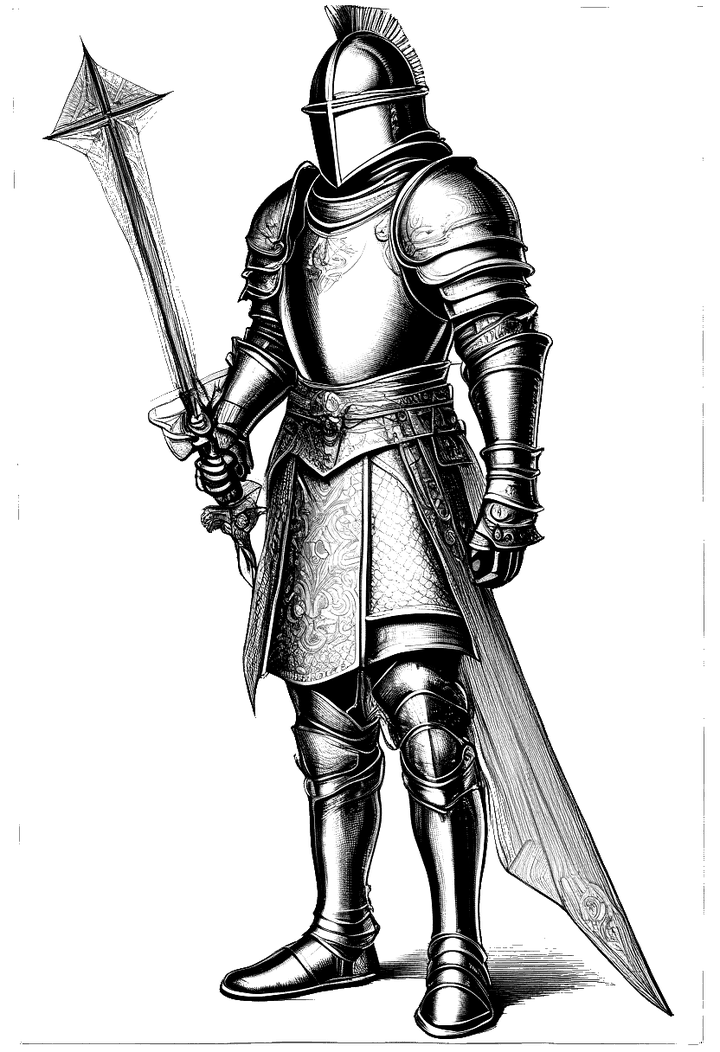
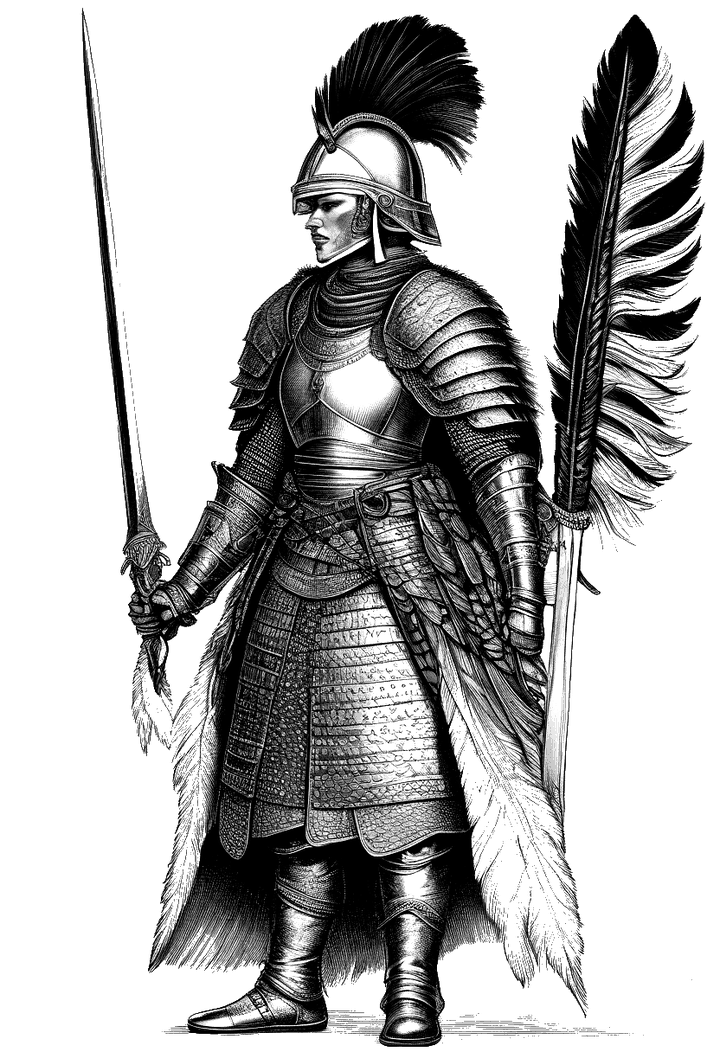
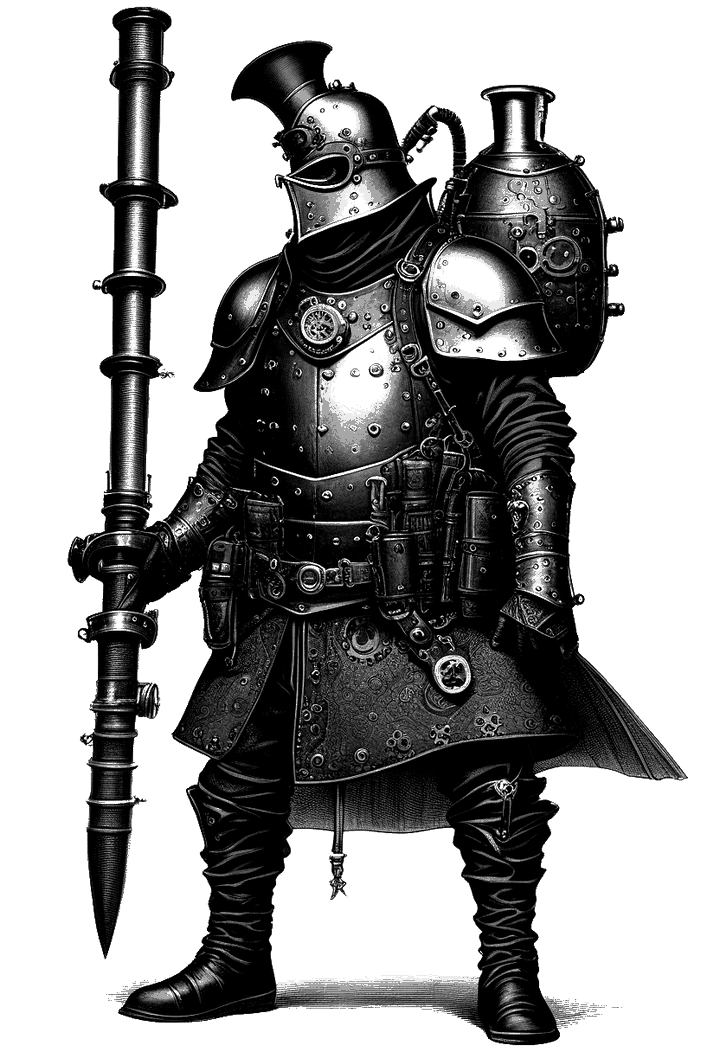
Knights. Every realm fields armoured riders, but three orders are famous. The Sunlancers of Orcosia are the Lion-Pontiff's knights: plate burnished like the sun, the Lion of Light on every shield, and a vow never to strike in darkness, where the Lion cannot see. The Queen's Wings of Hajhia are lancers who wear frames of eagle feathers on their backs, which rattle in the charge like a storm coming. Since 833 they have ridden wherever Queen Dorottya rides, and a third of them are women. The Boilerguard of Kushi wear steam harness: plate built round a coal boiler, with brass pistons at elbow and knee that let a knight swing a hammer no unaided human could lift. Kettlekin build the boilers, and the Hoarfolk deny they sold the plate. A harness runs for an hour on a sack of coal, then must stop and vent. There are thirty of them, and the Ridge Court will not sell one at any price.
The eleven cultures
Open a culture for its food, feasts, rites, tales, notable folk, news, trade and medicine.
Angshire · life & lore
- Festivals
- Gatefair (1–3 Haymonth) is the Angshire festival: boundary stones are walked and beaten, gates hung with ribbon, and tolls waived for three days. Forgefire (1 Uxbridmanch) renews every contract and binds every apprentice. Merland gambles through the Ash Days, while Ortonzania adds Keel Day (12 Thaw), when the Admiralty Yards at Shifract lay the year's first keel and the whole town eats on the slipway.
- Daily life
- Breakfast is small beer, a heel of rye and a bloater; dinner is a mutton pie at noon, a 4 d meal in any inn. Burgesses wear black broadcloth with ink-stained cuffs. Ortonzanian sailors wear tarred blue canvas and a gold ring to pay for their burial. Houses are tall and narrow, with the counting-room downstairs. Children are indentured at twelve, and every child can do sums.
- Rites of life
- A marriage is a contract, read aloud, signed by both families and blessed on the anvil by a Thetletown priest (1 sh to 1 cr). A newborn's name goes into the parish ledger with a penny pressed beside it. At sixteen comes Signing Day, the first time you put your name to paper. Coffins are nailed with nails drawn from the dead's own tools. Ortonzanian sailors are buried at sea.
- Folklore
- Gabingdon the Mule of Gates stars in a hundred tales in which the stubborn mule outlasts a king, a dragon and a lawyer. Everyone touches a gatepost and says 'Gabingdon, see me through.' The favourite proverb is A struck coin and an unstruck tale. Their humour is flat understatement: a man who loses his ship has had 'a disappointing season'. Never sign anything on a Lampless night.
- History
- The Angshire ports banded into Merland after the Burning. The Counting-Towers of Shifton went up between 640 and 702, Josiah Calloway founded his bank in 701, and the Shifton Standard was declared in 712. The Shifton Weathervane was first printed on a Kettlekin press in 744. Every Merlish schoolchild learns these four dates, and no battle dates.
- Notable folk
- Agnes Pellbury edits The Shifton Weathervane and wants the casualty lists printed with names, not numbers. Tobias Wrenford, chart-master of the Shifract Admiralty, drew the charts for the Prince's sealed ship and has taken to drinking alone. Old Hester Coleby of Macham's Coal Gate has sued the Moot of Fifty eleven times, won four, and is suing it again.
- This year
- Gatefair is running as this book goes out, and the Torkburgh beating of the bounds has turned up a moved boundary stone on Calloway land. The Moot is arguing over seizing the Powder Moot's warehouses. In Shifract the talk is of the Prince's ship for Qabahrah, and the old rumour that the Angshire came from there.
- The war
- Merland's taxes are up to one part in fifteen, and the casualty lists come out every Smithsday. Macham's hiring halls sign anyone at 2 sh a day, and apprentices run away to take it. Ortonzania's fleet is pressing fishermen. In the alehouses old Ortonzanian and Merlish sailors drink together and complain that they have never fought on the same side before.
- Trade & law
- They sell timber, grain, coal, wine, honey and above all credit; letters of credit at 12–20% a year. Law is written down and fines scale with wealth: a burgess pays ten times a carter. Debtors go to the Ledger House, thieves are branded with a T for a second offence, and murderers and coiners hang. Haggling over an agreed price is the one true Angshire insult.
- Medicine
- The Thetletown Church runs hospitals in Merland, where everything is boiled and the patients pray to the Smith. A physician costs 2 sh, a barber-surgeon 6 d for a bone. Macham coughs with grey lung from the Mavehambe coal, and the ports fear pox. The folk cure for a cold is a hot iron nail dropped in ale.
Adventure seed. At Gatefair, a Torkburgh boundary stone is found moved overnight. Beneath its old socket lies a lead box sealed with an Elder Crown glyph.
Norse · life & lore
- Festivals
- Breakice (1 Thaw) marks the first crack on the lakes. The Shedding (10 Hofjor) is the great Raugarian day, when antlers are gathered and the year's holy hunts drawn by lot. Kjelheimers keep Wormwake Eve (6 Rostovund), pouring beer into cracks in the earth. On Ashnight every Norse family holds the Grudge-Telling, reciting its inherited feuds aloud so no child forgets one.
- Daily life
- They eat smoked elk, salmon cured in juniper, flatbread, cloudberries and lingonberries, and drink birch beer. Raugarians wear oiled wool and elk-hide boots, with a bowstring guard on the left wrist from childhood; Kovavikians wear furs eight months a year. Homes are cedar longhouses in the rainforest and turf-and-log halls in the taiga. Every child has a bow by six.
- Rites of life
- Courting couples hunt together, and a marriage is sealed when the pair share their first kill. The bride-price is paid in hacksilver. Coming of age is the first kill of a deer, after which the youngster inherits the family's oaths. Fagervik dead are laid on forest platforms to join the eternal hunt. Kjelheim dead are buried deep, 'back to the bones'.
- Folklore
- The favourite proverb is Røfan hvo ul vahas kræson, 'The oath does not die with the man.' Tales tell of Hofjor freeing the stag from the Penner's fence, and Kjelheim mothers sing their children to sleep with the Father-Corpse turning in his sleep. Norse humour is deadpan and grim: a man frozen to his saddle is said to be 'resting'.
- History
- The first High Huntress was chosen by sacred hunt in 214, and the first Antler was raised at Fagervik in 402. The Long Winter of 525 killed a third of Kovavikia and is still sung as a dirge. The Year of Two Winters in 817 sent Kovavikian families south over the Hoarspine, and many never returned.
- Notable folk
- Jødørn Stekrodottir, a longship skipper of Kogenda, ignores Fagervik's orders and runs furs to Kushi ships. Dånu Brusson, a blind Kjelheim cantor in Gogur, sings the archaic liturgy that the insurgents chant in the streets. Liva Tetsdottir is the Wild Hunt's best tracker; she has been asked to hunt insurgents and has not said yes.
- This year
- The Raugarian Insurrection is spreading from Kogenda through the wetlands. The insurgents have sworn to free this year's prisoners at the Penner's Gate themselves. In Kovavikia the wolverines are moving near Hofjor, and the Rib Temple's bone in Gogur grows frost on hot days. The Comet of Thaw was read in both temples as a sign for their own side.
- The war
- Raugaria has sent its longbow regiments east, and the wetland villages say the Huntress takes their sons while the rebels feed their daughters. Thunder-salt has doubled in price, so hunters use the bow (they prefer it anyway). Kovavikians, conquered last year, are now being conscripted to fight for their conquerors.
- Trade & law
- They trade furs, timber, hemp, honey and game, and Gravdalla iron, paid in hacksilver weighed on a hunter's scale. Old buried hoards are everywhere. There are no prisons: the guilty are turned out into the Bliksberg with a day's start and hunted. Slavery is the worst crime in Raugaria. Kovavikians mutter that Raugarian law is a wall dressed as a forest.
- Medicine
- Winter-black is treated with an elk-fat and snow rub, which everyone knows is wrong, and then the saw. Marsh ague shakes the Raugarian wetlands every third day; willow-bark helps. Kjelheim bone-setters in Kovavikia hum the liturgy while they work. Temple healers at Fagervik heal hunters first.
Adventure seed. A Kjelheim cantor's new verse names the hidden cave where the insurgents keep the Penner's Gate keys. The Wild Hunt will pay well to learn it.
Vengrian · life & lore
- Festivals
- Vengrians count by the Lamp, not by weeks. The Sitting of Snow (15 Longnight) camps the clans together for three nights of horse-ancestor stories. At midsummer, in Rocadones, a hundred thousand riders camp around Balsozha. Every family keeps Foal-Naming on the first full Lamp of Mieles. Igyoszavas, which worships the Soumi forest-god, also leaves honey for Utturi at the roots of great trees.
- Daily life
- They eat mare's-milk curd and millet for breakfast, standing up, and dried horse-meat softened under the saddle. Fermented mare's milk is their drink. Everyone wears a felt coat, quilted trousers and riding boots, women included. They live in round felt tents, which they pitch even outside stone houses. A child sits a horse before it walks, and a family's wealth is counted in horses.
- Rites of life
- Every vow is made under the open sky, because a vow sworn indoors does not bind. At a wedding the bride is given a horse's length start and the groom must catch her. A newborn is carried three times round the tent. The dead ride to the Sky-Mother's tent: their horse is not killed but freed onto the steppe, and nobody may ever ride it again.
- Folklore
- Every child learns Tólócs ígyer muka csodor, 'A broken oath is a dead horse.' The Wind Brothers steal hats from liars. A rider who dreams of a white mare will die or marry within the year. Vengrian humour is loud teasing among kin, and they despise threats, which are answered with steel. Praising a man's horse is better than praising the man.
- History
- The horse-clans became the Empire and the Kingdom after the Burning. The Kecelcatorvas Monument has stood on the Balsozhian plain since before the clans arrived. In the Grey Foal year of 693 a sickness took half the steppe's horses, and families married to share herds. Many Vengrian bloodlines date from that winter.
- Notable folk
- Tetely Tíkela, a famous horse-singer, sings the clans' genealogies to the refugees of the Tent Sea at Erencszasz. Kász Laszolt, a clerk at the Dinar Mint in Balsozha, knows exactly how much gold is missing from the coin. Rimász Gyeszona, a gem-cutter of Tabradozar, cuts Igyoszavas stones for Valsiarian buyers and wants her own shop.
- This year
- Kinsmen are fighting each other. Families on both sides of the border have sons in opposite armies, and some clans have split their herds by oath. In Igyoszavas, Foleleyme's smoke has the herders moving cattle off the slopes. Balsozha had bread riots in Rocadones over the debased dinar.
- The war
- Balsozhia holds northern Hajhia, and about 200,000 Hajhians have fled south and east with their groats. The Tent Sea at Erencszasz holds a hundred thousand of them. Horses cost double in Hajhia. Press-gangs work the Balsozhian river towns. Old horse-lords refuse to guard the Hoarfolk cannon and call guns 'roof-weapons'.
- Trade & law
- They sell horses, cattle, dyes, honey, coal and silver. A riding horse is worth 12 crowns, and the debased horse-dinar 0.7. Debts are oaths. Oath-breakers are given to the wind, which means outlawed, and anyone may kill them. A horse-thief is dragged behind the horse, because stealing a horse is kidnapping a companion. Threatening a Vengrian costs +3 on any intimidation roll.
- Medicine
- Shamans ride in trance to the Sky-Mother's tent and ask her to heal the sick. Saddle-gall, broken collarbones and camp flux are the common complaints, and camp flux is raging in the Tent Sea, where Thetletown field hospitals boil everything. Mare's-milk curd is put on burns. In Igyoszavas the herders trust Soumi druids.
Adventure seed. A dead lord's horse, freed on the steppe, has walked into the Tent Sea. Whoever rides it breaks a taboo, and whoever rides it will be followed.
Soumi · life & lore
- Festivals
- Silent Days fall on the 10th, 20th and 30th of every month, and on them a shout in Valsiari earns a fine. The Long Silence (20 Thaw) closes whole towns from dawn to dusk, with staring contests at sunset. Druid households keep the Tusking on 5 Mieles, when the elephants are scrubbed in the lakes and rivers and honey is left for Utturi.
- Daily life
- Food is lake fish smoked over alder, rye porridge, forest mushrooms and birch-sap. Mahouts eat with their elephants. Clothes are undyed linen and grey felt, worn long, because bright colour counts as boasting. Log houses stand on the lake shores beside timber elephant sheds, and every farm has a steam-hut. Children are taught to sit still and silent before they are taught to read.
- Rites of life
- A couple is betrothed after a Day of Sitting: they spend a whole day together in silence, and if neither has spoken by sunset, the match is good. A child is named only when it first sleeps through a storm. Mourners keep silence for thirty days after a death. The dead are buried at the roots of a great tree with honey, for Utturi.
- Folklore
- Sululo jashe on puhai, 'The silent man is strong', is carved over half the doors in Valsiari. In the tales Utturi tests travellers with a riddle and eats the ones who answer too quickly. Soumi humour lives in the pause: a joke may take a day to finish, and the listener's raised eyebrow counts as a roar of laughter. Never step over a sleeping elephant.
- History
- Utturi is the oldest Soumi god, and the Church of the Silent War grew from his worship. The Saski silver seam was opened with the Hoarfolk of Saski Hold, and the very pure elephant mark has been struck from it ever since. The Royal Stables' Tusk Roll lists every war elephant for three centuries, with its temper.
- Notable folk
- Selsa Tenyslonen is master of the Royal Stables in Valsiari, with two hundred elephants, and has not spoken in public for nine years. Jasku Naanjaponen, a silent judge, has lost only one staring contest, to a Rhunari. Hehailla Syvela is a Manttamite street-preacher who was once a temple novice and now shouts every night under the Quiet Temples.
- This year
- Manttamite crusaders are marching through Valsiaria and preaching loud, and families are split between the old church and the new heresy. Princess Emese has not opened her brother's letter, and the market wagers on what it says. Soumi traders in the Quiet Quarter of Shifract are suddenly popular with spies.
- The war
- Valsiaria refuses to fight, and Soumi are quietly proud of it. The Manttamite crusade is their war: villages lock their temples against marching zealots, and elephant drovers guard the roads. Ortonzanian buyers want war elephants, and the Stables will not sell.
- Trade & law
- They sell timber, war elephants, clay and Saski silver (the elephant mark, a shilling and a half). Lending at interest is forbidden, so they trade through silent partnerships that share the profit. A dispute goes to a staring contest before a silent judge. Fines are paid in silence, and the worst sentence is exile. Rushing a Soumi costs +2 on every roll.
- Medicine
- Druids heal with Utturi bark, which costs 1 sh a dose and cures marsh ague. Mahouts suffer crushed feet and broken ribs, and bone-setters bind them in birch splints. The Silent Church treats rage as a sickness, with fasting and silence. Patients who scream are thought to heal more slowly.
Adventure seed. A silent judge has been found dead in the Quiet Temples, his mouth sewn shut. The Manttamites are blamed, and they loudly deny it.
Astellian · life & lore
- Festivals
- Hiving (1 Mieles) brings honey-cakes, swarm-catching and betrothals, with brides in yellow. On Lionsday (21 Rocadones) the Lion-Pontiff blesses the sun, and nobody may keep a secret. Floodwake (1 Ondaria) floats candle-boats, the Ferrying (1–9 Tunarejo) is kept with masks and open doors, and Orcosia fasts on the Ash Days. Ilbarescia keeps Lionsday a day early at Chuejon, to annoy Orcos.
- Daily life
- Honey goes in everything: honey-bread, honeyed river-fish and spiced honey wine. Men and women wear white linen and broad straw hats, and shutters are left open all day, because closing them by daylight looks like hiding. Houses are whitewashed and built round courtyards that face east. Children are taught to argue in public before they are taught to keep quiet.
- Rites of life
- Weddings are held at noon in the plaza, never indoors. A newborn is lifted to the sun at midday and named aloud before the whole street. At fifteen comes the First Confession, made at noon in public. Funerals are held at dawn, and the dead are laid facing east so that Tunarejo can ferry them to the sun.
- Folklore
- Solano dovar nicuze pozilo, 'The sun sees the hidden road.' The bronze lions of the Lion Gate in Orcos are said to roar when a liar passes. Astellians love argument and satire: rhyming broadsides about priests are sold at every fair, and people say 'sun-honest' sarcastically. A shadow falling across a cradle is the worst omen.
- History
- The Grey Sweat (344–349) killed one Orcosian in five and gave the Ferrying its present form. The Honey Years of the 470s brought forty years of peace, poets and lens-grinders. In 674 came the Year Without Bees, when Hiving was kept without honey, and in 772 the Great Fire of Bustogollo, after which every guild hung a new bell.
- Notable folk
- Orsejo of Fotenga, a master lens-grinder in the Glassworks of Orcos, claims his new lens can make Elder glyphs legible. Tuechada of Llire is a Bell Guild wool merchant in Bustogollo who wants a charter and has no patience with the Pontiff. Pitada of Lonies is an Ilbarescian hostage-broker who has negotiated the return of sixty captives from Igyoszavas.
- This year
- The Teracleanian Dearth has emptied the southern granaries and a bushel costs 2 sh. Mantena and the River Steps of Orcos are still half under water. A reader and one rubbing have vanished from the Ucillamope Library. In Rocadones two Glassborn Strays walked through Orcosia, and villagers set out bread for them.
- The war
- Orcosia is still deciding, and every envoy is in Orcos buying dinners. Hajhian refugees crowd the southern river towns, and the Astellians, bound to be generous in public, feed them grudgingly in private. Ilbarescia's levies march in Raugaria's war, which Ilbarescians resent less than serving Orcos.
- Trade & law
- They sell timber, honey, coal, white sand and Ilbarescian gems and cattle. The sun-real is worth 1.1 crowns, and refusing one insults Rocadones. The Sun Treasury keeps gold for a tenth. Offenders confess and do penance at noon and pay fines to the Sun Treasury, and necromancers are burned at noon 'so the Lion sees'.
- Medicine
- The Sun Temple's healers are among the best in the world (5 sh a wound) and work only by daylight. Marsh fever haunts the deltas, and the old fear of the Grey Sweat returns with every flood. Any cure that 'borrows from the dead' is treated as necromancy, so grave-moss poultices are sold secretly.
Adventure seed. Orsejo's new lens makes one line of the Salinty Idol readable. That night the Lion Gate roars, though nobody passed it.
Elladan · life & lore
- Festivals
- The monsoon closes the jungle tracks in Hofjor and Rocadones, and the Opening of the Bays (10 Haymonth) reopens the sea: every captain pours wine to every harbour from Hubros to Histhos. The Ferrying (1–9 Tunarejo) is kept with obols on graves. Each village also keeps its own Bay Night, when the local spirit is asked whether it is content.
- Daily life
- They eat octopus stewed with sugarcane vinegar, fish grilled on palm-ribs and flatbread, and drink palm wine. Men and women wear short undyed tunics and wide rush hats, and go barefoot on deck. Rowers' calluses are shown off like scars. Houses stand on stilts above the tideline. Children swim before they walk and take an oar at ten.
- Rites of life
- A couple marries at the tideline, and each pours wine to the bay in the courtesy form. A newborn's name is first whispered to the sea. At thirteen comes the First Bench, a day's rowing without rest. The dead are burned on the beach with an obol on each eye, and their ashes are buried inland, because nothing dead may foul the water.
- Folklore
- Keteidea gespanein tha rephe, 'The sea hears every captain.' Speaking to a bay with the ordinary 'you' is like slapping a priest. Elladan humour is bawdy, with insult-songs traded between rowing benches, and they joke even to the spirits. A captain who sneezes as he boards must wait a tide. Spitting in water is the one thing no Elladan finds funny.
- History
- Elladan pearl-divers first worked the Kaporesian reefs for Valsiarian buyers after the Igyoszavas War. In 791 the whole of Myrnamon watched Pibbet Brasswhistle's kettle-balloon rise, and the Elladan harbour-pourers held a council over whether the sky needed wine too. They decided that it did.
- Notable folk
- Kadorle Tonlidou is harbour-pourer of Myrnamon, and no ship leaves until she has spoken to the bay. Zechos Latilonides, a pearl buyer of Lampsaratis, pays honest prices and keeps the black pearls for himself. Rhimeun Mamaridou is a Manttamite oar-captain who runs muskets north under sugar sacks.
- This year
- The Dearth has quadrupled grain prices on the coast, and villages are eating sugarcane pith. Treasure-seekers are flocking to Lefka and the Elder town beside it. Some villagers say the Green Sleeper turned over in Rocadones, because a stretch of jungle inland from Lefka grew a yard in a week.
- The war
- Kaporesia is a vassal of a realm that refuses to fight, so the war arrives as smuggling. Manttamite cells move weapons north, and the Despot pretends not to see. The Chain disruptions have left Elladan rowers idle in port, and many have signed on with pirates.
- Trade & law
- They sell clay, hemp, timber, sugar and pearls, and are paid in obols (half a penny). The Despot taxes the pirates who shelter in his coves. Spitting in the sea or fouling a well is flogged, and drowning a captive is a hanging crime. A 'pour for the harbour' bribe is expected by every harbour master.
- Medicine
- Marsh ague is cured with Utturi bark from Valsiaria. Pox comes with every foreign ship. Reef-cuts fester in the heat and are washed in palm spirit. Divers go deaf in middle age. Elladan healers ask the local spirit before they treat a patient, and refuse if the answer is no.
Adventure seed. Kadorle refuses to pour for a ship bound for Lefka because the bay is not content. The owner offers 10 cr to whoever can change the bay's mind.
Tallian · life & lore
- Festivals
- The Owing (20 Reaping) gathers the caravans at the Lake Shore of Erencszasz to settle debts with a song each, and nobody may 'pay flat'. Tallians keep New Fire and Ashnight like everyone else, but on Ashnight they each tell one new story, which leaves every teller owing Poglianolino a song. Caravans also feast on the day their lead camel was born.
- Daily life
- On the road they eat flatbread baked in hot sand, dried apricots and salted camel-cheese, washed down with salt tea and butter. Coats are patchwork, and each patch records a story or a debt paid. Camels, children and coat-hems all wear bells. They live in long low tents. A child learns one story for every year of its age.
- Rites of life
- A groom owes his bride's caravan one song for every camel it owns, and rich brides are hard to win. A newborn is given a debt-name, a story it must one day finish. A dead Tallian is buried with an unfinished tale whispered into the grave, so the camel will come and ask for the ending.
- Folklore
- Tofino mosi zinlo banosi, 'The camel remembers every debt.' Every story ends with the teller owing the camel a song. To Tallians humour is holy: practical jokes are prayers, and a humourless man is suspected of theft. Poglianolino hides lost things in sandstorms and returns them to the person who laughs first.
- History
- The Tallians were crossing the cold desert before the Hajhian kings. In the Long Debt of 744 the caravans lent half their camels to Hajhia during a drought, and they were repaid with interest and the right to water at any royal well. Every caravan still carries a copy of that charter.
- Notable folk
- Pibu Lucky-Song is the most famous storyteller in Hajhia, and he owes the camel three hundred songs. Zitede Loud-Debt runs a caravan that smuggles refugees around the Balsozhian lines for a story each. Nardesa Long-Camel, a caravan-mother in Bustogollo, wants the Bell Guild to give Tallians a bell of their own.
- This year
- Caravans that winter in northern Hajhia have been cut off by the occupation. Camels have doubled in price, and Balsozhian quartermasters are seizing them. The cold desert routes are full of refugees who do not know the wells. Pibu Lucky-Song has announced that he will tell a new story at Erencszasz on 20 Reaping.
- The war
- The Tallians have no side, but the war has sides for them. Balsozhian requisitioning has taken camels from three caravans, and Hajhia's Queen has asked Tallian drovers to carry her messages. Many caravans now walk by night, singing quietly. Tallian guides charge refugees 1 sh a day across the cold desert.
- Trade & law
- They trade salt, dyes, felt, stories and news, and carry goods between Hajhia and the southern cities. A debt must be repaid with a little more than was lent, plus a song. Stealing from a caravan is the worst crime: the thief is left in the desert with one camel that has been taught to go home.
- Medicine
- Herb-wives treat sand-burn with camel butter, and frostbite and cracked lips are common in the cold desert. Salt tea is given for everything. A sick child is told a funny story, and if it laughs, it will live. Tallians trust Thetletown hospitals only if they are allowed to pay in songs.
Adventure seed. Pibu Lucky-Song's new story names a hidden Elder well in the cold desert. Three caravans and a Balsozhian scout set out to find it first.
Qashari · life & lore
- Festivals
- The water-year begins with Wellwater, at the first rain on Qaqah (usually Longnight), when every well is blessed and the Successor-Caliph descends the Well of the Successors. The Unspoken Night falls at the dark of the Lamp this Haymonth, and no name may be spoken. In Haruwayha, Groving (18 Hofjor) sees every family plant a tree on the desert's edge.
- Daily life
- They eat dates, flatbread, goat's-milk yoghurt and lentils, and drink bitter sage tea three times. Clothes are indigo robes with veils, and everyone wears kohl against glass-eye. In Masha, Company clerks wear Merlish coats over their robes. Oasis towns are white houses with wind-towers, and the desert clans live in black goat-hair tents. Every child can find north by the stars.
- Rites of life
- Guest-right lasts three days and is never refused, and a guest is spoken about, not to, until it ends. At a wedding the bride's family cleans a well together, and the groom's family brings the rope. A newborn's lips are wet with water from the family well. The dead become spirits of well or wind and are buried facing the nearest well.
- Folklore
- Duhoor dahar dun rathar, 'A guest is water in the desert.' Qashari humour is wordplay: poets who pun on the three-letter roots win purses at court. The Hidden Ones live in wells, stars and the threshold of every tent, and stepping on a threshold insults them. A mirage that shows you a city is the Glass Waste calling you home.
- History
- The First Wells Compact of 41 made guest-right law. The Glassborn woke in 622, and the desert clans moved their roads away from the chiming. Masha's merchant ports broke from Kahpia between 738 and 750, and the Trade Company printed the first paper money in 760, which old Qashari still call 'water written on sand'.
- Notable folk
- Bishnah al-Shutatahi is keeper of a well at Sainah who has refused water to nobody for forty years and has twice sheltered both sides of a feud. Hajeed al-Ghaleehi, a clerk at the Sea Exchange in Meedihar, knows the Board is moving its gold. Haqeezah al-Tusayahi, a poet at the Court of Shade, is mocking the war in verse that nobody can quite prove is mockery.
- This year
- Asraha is at war with Masha, and Qashari are fighting Qashari. A Glassborn Stray is chiming at the inscriptions in the Scriptorium of Qaqah. Masha fears its notes will fail. Haruwayha's leopard-priests say the Mirqah Cavern is breathing cold. The Unspoken Night is coming, and soldiers on both sides have promised to observe it.
- The war
- The Asraha–Mashian War cuts the caravan roads, and the Chain convoys are disrupted, so Company notes are worth only 7 crowns in the north. Al Tubar's riders fight for Jowshia, and Haruwayha's leopard-priests fight for Kahpia. Guest-right still holds in the war: a soldier who reaches an enemy's tent is fed for three days.
- Trade & law
- They trade salt, dates, incense, horses and caravan carriage, and their money is the mithqal (1.3 cr) and the Company note. Water lent returns with a cup more. Refusing guest-right or fouling a well is a capital crime. Refusing offered food or water insults a Qashari, and returning guest-right pleases them.
- Medicine
- Glass-eye is prevented with kohl and veils and treated with the leopard-priests' salve. Pilgrims bathe in the hot springs of Nafhadawa in Al Tubar for joint-ache and skin sickness. Sunstroke is treated by burying the patient to the neck in cool sand. Haruwayha's leopard-priests are the finest healers on Qabahrah.
Adventure seed. On the Unspoken Night, a stranger asks for water at Bishnah's well. He gives his name aloud, which is forbidden. It is the name of the Successor-Caliph.
Kavarri · life & lore
- Festivals
- The Kavarri name their twelve months after Tugan's family. At the Kneeling of the Elephants (1 Thaw), magenta elephants are paraded in Shahpabad and the Shah is re-crowned when the great elephant kneels. Mahrang's Drum (1 Isgard) brings rain-drumming and poetry contests at court. Jowshia this year has held its own Kneeling at Nastan, which Kahpia calls treason.
- Daily life
- They eat millet porridge, goat stewed with peppers and mango, and flatbread, and drink sorghum beer. Magenta is reserved for the temple elephants and their priests. Courtiers wear sashes embroidered with their own poem-names, and commoners wear ochre wraps. Families live in round thatched compounds around a shared cattle pen. Children learn verse before they learn sums.
- Rites of life
- Business and marriage alike begin with a gift. A groom's family gives a bronze elephant-bell, and wealthier families give a real calf. Coming of age is reciting a poem of your own composition to the eldest of the household. The dead are 'carried on Tugan's back' to burial mounds on an elephant-drawn litter, and the elephant is fed sugarcane at the graveside.
- Folklore
- Bazamdun leshar siro, 'A gift opens the gate.' Kavarri humour is courtly and double-edged: insult-poems in the Poets' Garden are written so each line can be read as praise. Ankhorra the Sun-Coil appeared over Shahpabad in 700, and grandmothers tell children the dragon is still waiting for a worthy shah. Tugan's name is never used in a curse.
- History
- The Magenta Colossus has stood in Shahpabad longer than any shah. In 700 Ankhorra was seen over the city and vanished, and court poets have dated everything since then from 'the Last Wing'. In the 790s a famine was broken when the Shah opened the Elephant Lines' granaries, a feat still sung at Mahrang's Drum.
- Notable folk
- Seikar Tashani, court poet in Shahpabad, has written a verse that seems to praise the Shah and may in fact call on his nephew to seize the howdah. Tichek Khekozdari, an Elephant Priest, keeps the great kneeling elephant and is the only person it obeys. Zhiriz Chuni farms the Prince of Sag's exit tax on treasure-hunters at Meybid, and is richer than the Prince.
- This year
- The elephant migration near Chudeshk has trampled villages, and the priests read it as Tugan's displeasure. The Grey Wall Rhunari in Shahpabad are owed six months' pay. Sag trusts nobody. Treasure-hunters crowd the ruins near Habibifi, Shahjatama and Yeremran. Jowshian siglos are struck light, and Kahpian markets refuse them.
- The war
- The Jowshia–Kahpian War splits families along the border. In Jowshia every man who can draw a bow has been called up, and women are running the markets. Kahpian villages lose their elephants to the war-lines. Sag has stayed out of the war and spends its time spying on everyone.
- Trade & law
- They trade ivory, but never from a killed elephant, plus cattle, peppers, poetry and steel bought from Sunhold. Their money is the siglos (0.12 cr). Gifts come before business, and starting business without one insults a Kavarri. Oath-breakers who swore on Tugan's tusk are executed by elephants, and killing an elephant is the worst crime.
- Medicine
- Elephant Priests heal by the gift of Tugan, and a patient pays with a gift to the temple elephant. Marsh ague is common in the Jowshian wetlands. Elephant-crush injuries fill the hospitals in the war-lines. Families keep a jar of honey and ash for burns. A healer who brings no gift on a visit is not trusted.
Adventure seed. The great kneeling elephant refuses to rise after the Shah's crowning. Tichek Khekozdari quietly says it is waiting for someone else.
Tsuruma · life & lore
- Festivals
- At Sail-Dipping in Rocadones every ship dips sail to every shrine, the ancestors are fed and new hulls are named. On Shrine-Sweeping (1 Thaw) every household cleans its threshold and the harbour-mouth shrine. On Lantern Return (15 Tunarejo) paper lanterns are floated out of harbour for the dead, who are always at sea. Ritata keeps the same feasts, with a Balsozhian envoy now in the front row.
- Daily life
- They eat rice and millet with fish broth, pickled seaweed and salted plums, and drink rice wine warmed in winter. Layered jackets bear a house crest, and sailors wear indigo jackets marked with their ship. Houses are wooden, raised, and swept twice a day. Children are taught to bow, to tie forty knots and to say -ka and -mi before they can read.
- Rites of life
- Introductions come first, with a gift on arrival. A marriage is sworn on the shore with land verbs, because a sea-promise does not bind. A newborn is named at the hearth shrine on its seventh day. The dead are said to have gone to sea; their ashes go into the harbour-mouth shrine, and their names are spoken thereafter only with -mi.
- Folklore
- Niko ri munasa chi sema iami, 'An oath at sea is a wave.' Tsuruma humour is wordplay on the -ka/-mi verbs: a husband who promises fidelity 'with a sea verb' gets a laugh. Embarrassing someone in public is never funny. Ships are alive and counted like people, and a ship left unnamed overnight takes a name of its own, usually a bad one.
- History
- In 604 Tsuruma shipwrights launched the Ichi-maru, the first three-masted ocean ship, and made the Chain route routine. In the Pox Year of 631 Tsuruma physicians developed variolation, and they still charge for it. The Sky-Docks of Kamiechia, built with Kettlekin crews, gave the capital a harbour in the air.
- Notable folk
- Tokami ke Sae is a Kamiechia surgeon who variolates the children of envoys from both alliances for 2 cr a child. Toteya ke Hogoro is a master shipwright at Yeongdong, building hulls for the Admiralty and dreaming of a sky-hull. Nakaechia ke Gayasu keeps the Distant Deer inn near Tonan, where everyone in Ritata brings their gossip.
- This year
- The Prince has kept envoys from both alliances waiting in the same week, and Kamiechia's teahouses wager on which he will receive first. Ritata's Tsuruma castle at Ninakashi now flies a Balsozhian horse-banner, and Ritatans are learning embarrassment. The Admiral's term at Lantern Cove ends next month, and Kushi's Admiralty is watching.
- The war
- Kushi is allied to the Compact, so the Shifton League fears a second front at sea, and Merlish ships are searched at the Chain. Convoys to Qabahrah have slowed and sailors are idle. Ritata's two regiments may be called to serve a steppe emperor they have never seen.
- Trade & law
- They sell ships, convoy passage and Chain tolls, and pay in strings of cash (1.5 cr), cutting off what they owe. The Toll of the Chain is paid on every ship. Embarrassing a Tsuruma in front of others costs +2 on every later roll. A broken land-oath is punished by the loss of the house crest. Smugglers on the Chain are hanged from the shrines' gates.
- Medicine
- Tsuruma surgeons are the best in the world and set bones, remove stones and sew wounds with silk. Variolation protects against pox, at a price. Scurvy is prevented with pickled plums on every voyage. Shrine-priests treat ill luck. A sick person's hearth is swept three times a day.
Adventure seed. A ship arrives at Yeongdong with no crew and its name scraped off. Shipwrights say an unnamed ship will choose its own captain, and it has chosen you.
Halmi · life & lore
- Festivals
- The isles lie south of the line, so their seasons run backwards to a northerner. On Grandmothers' Climb (Mieles, after the long rains) every clan carries fish and pearls up its own peak. The Feud-Count (dark of the Lamp in Isgard) has the elders recite every clan feud. Tebek's Halmi add the Lantern Tally at Lantern Cove, when the year's prizes are counted on the harbour wall.
- Daily life
- Food is grilled fish, seaweed rice, taro and shellfish, with palm toddy to drink. Divers wear little but oiled skin and a clan tattoo along the spine, and elders wear woven bark cloaks. Villages stand on stilts below the peaks. Children dive for shells at five and for pearls at twelve, and learn to name their ancestors back nine generations.
- Rites of life
- The eldest speaks first, and a reply begins by naming the eldest present. A marriage needs a shaman's omen, spoken in the omen mood, and a bride's clan must forgive one old feud. A newborn's first sea-bath is given by its grandmother. The dead are buried on the slope of their grandmother peak, facing it.
- Folklore
- Meolgo ma monutmu seon reon ma tahammu, 'The sea forgets, but the clan remembers.' Halmi humour is elders' teasing: an elder may mock anyone younger, and the young may only laugh. The Grandmothers opposed the Kushi conquest and are patient. Nobody sails without an omen, and a circling frigate-bird means 'turn back'.
- History
- The clans held the southwestern isles long before Kushi conquered most of them and taxed the pearls. Jinsan fell to the pirates in 821 and became Lantern Cove, and many Halmi stayed. The Geocheon Tomb near Seongju is older than any clan memory, and the shamans will not say whose it is.
- Notable folk
- Cheon Wopyol is the eldest shaman on Hawon, and his omens decide which boats sail from both the Kushi and the Tebek side of the island. Gikse Euha is the best pearl diver on Hwasun and dives deeper than anyone, for black pearls. Dae Sanweung, a clan elder in Lantern Cove, sits in the Ledger Hall and hates every captain equally.
- This year
- A travelling circus nobody can explain is touring the isles, and shamans have forbidden their clans to watch. Lantern Cove's Admiral's term ends next month, and Halmi crews are being bribed to vote. The Kushi Admiralty at Yeongdong is pressing Halmi sailors into the fleet.
- The war
- The northern war seems far away, but Kushi's alliance with the Compact means more ships, more press-gangs and higher pearl taxes to pay for them. The Free Captaincy's raids on Kushi convoys put Halmi crews on both sides. Old feuds are being settled at sea under the cover of the war.
- Trade & law
- They trade pearls (100 cr for a fine one, 500 cr for a black), dried fish, shell and rope. Kushi law takes a tenth of every pearl, and the Tebek Articles take a share by vote. Ignoring a shaman's omen insults a Halmi, and abandoning kin is the worst crime: the offender's name is cut from the ancestor chant.
- Medicine
- Divers suffer from deep-sickness: joint pain, dizziness and sometimes death after coming up too fast. Shamans treat it by putting the diver back underwater slowly and chanting. Coral-poison is drawn with hot stones, and reef-cuts are washed with lime. Elders are always treated first.
Adventure seed. Cheon Wopyol has foretold, in the omen mood, that a black pearl from the Geocheon Tomb will end Kushi's rule. Every captain wants it.
The Hoarfolk
Broad, slate-skinned people about four and a half feet tall, with hair frost-white from birth and pale, almost colourless eyes. The Hoarfolk say they were carved from the bones of the Dead Worm, and that their holds are rooms in its skeleton. Nobody has found a time before they were in the Hoarspine.
Each hold is ruled by a hold-line, a family descended from its founder, and the holds together send representatives to the Moot of Anvils. The Hoarfolk invented thunder-salt (gunpowder) at Gravdalla Deep in 612, and with it the cannon and the matchlock hand-gonne. They pump their mines with steam and light them with marrow-lamps. Their greatest trade, and their greatest fear, is marrow-salt: crystallised magic dug from the deepest seams.
Holds: Gravdalla Deep (Raugaria), Silverhold (under Babadszalkado, Hajhia), Lenhalas Under, Saski Hold (Valsiaria), the Thousand-Step Hold on the Hoarspine Stair, and on Qabahrah, Sunhold and Ember Deep in the Sunward Range.
Belief: the Worm is dead and must stay dead. Every Hoarfolk child learns that deep digging feeds the dragons' dreams. Every hold digs deeper anyway.
Now: a faction of the Powder Moot, the Open Forge, has sold siege cannon to Balsozhia, and the guns are on their way to Erencszasz. The other holds are furious, because Hoarfolk law forbids taking sides in human wars.
Language: Hoarspeech. Names: among outsiders and in trade-speech, hold-name first, then given name, as in Gravdal Ottrin; in Hoarspeech the same dwarf is Ottrin Gravdallul, given name then hold with -ul, 'of the hold'. The old and the formal use the Hoarspeech form, so both are heard.
Life & lore
- Festivals
- Wormwake Eve (6 Rostovund) is the holiest night: every hold pours ale into a crack in the rock and seals one old tunnel with mortar mixed from the dregs. On Surfacing (21 Rocadones) children under thirty are taken up to see the longest day, and most of them hate it. Hoarfolk light New Fire from their own forge-towers, never from a temple.
- Daily life
- Breakfast is stone-bread baked on the steam pipes, blind cave-fish and a mug of grey ale brewed from lichen. Salt is dear at 10 d a pound in the Hoarspine. Families live in galleries off a hold's great hall, with doors cut to the owner's height. Children are apprenticed at thirty and learn to tell the time by the shift-bell, to the minute.
- Rites of life
- A marriage is a contract cut in stone and witnessed by both hold-lines; a bride or groom who arrives a minute late pays to have the date re-cut. A child's name is cut on the record wall beside a blank space for its deeds. The dead are laid in the slow halls, the deepest galleries, where lime-water drips on them until they turn to stone.
- Folklore
- Every child learns Grêrn drokholk thaz grêrn brozârg, 'A dead father is a good father', which is said of the Worm and now and then of real fathers. Miners never whistle below ground and never name a dragon there: the dragons are 'the sleepers upstairs'. The tale of the Miner Who Heard Breathing ends the same way in every hold. He dug towards it.
- History
- Around 120 the holds opened to human trade and struck the first ingot-mark, which has never been debased. In 612 the alchemists of Gravdalla Deep mixed thunder-salt and blew the roof off a gallery. In 739 black damp killed ninety miners at Lenhalas Under, and within ten years every hold had replaced open flame with marrow-lamps.
- Notable folk
- Gravdal Khêzdis keeps the record wall of Gravdalla Deep. She has been refused entry to the lower galleries since Hofjor, and has cut the refusal into the wall as an insult. Stair Gekhith, aged 171, was a girl on the Hoarspine Stair when Hrimgard came down in 671. Sunhal Thurn sells Sunhold steel in Shahpabad and is quietly buying up Open Forge debts.
- This year
- Gravdalla Deep sealed its lower gates in Hofjor and will not say why; traders at the gate hear nothing through it, not even hammering. Ember Deep is still sealed from the inside. The Moot of Anvils meets at the Thousand-Step Hold in Reaping to vote on expelling the Open Forge, and every hold-line is counting votes.
- The war
- Hold law forbids taking sides in human wars. The Open Forge of Silverhold broke it in 833 by selling siege cannon to Balsozhia, and Hoarfolk gunners now ride the barges towards Erencszasz. Hoarfolk factors are spat at in Merlish towns, and thunder-salt has doubled to 2 cr a pound. The Thousand-Step Hold still closes the Stair to armies, so both sides go round.
- Trade & law
- Hoarfolk sell thunder-salt, cannon, steel and marrow-salt, and they pay in ingot-marks, fingers of stamped silver worth a crown each. They lend only to other holds. A broken contract is cut into the hold's shame-wall under the breaker's name. The worst sentence is banishment to the surface, 'sent up'. The Stair toll is 2 sh a walker, 1 sh a mule and an ingot-mark a wagon.
- Medicine
- Grey lung takes most miners, so the holds retire them to the surface at sixty, where they sit in the sun and complain. Bone-setters called knitters work by marrow-lamp and mend crushed hands better than any human surgeon. The Bone-Rite forbids healing with marrow-salt, so a marrow-burned Delver gets cold iron bound to the wrists and nothing more.
Adventure seed. A Gravdalla miner sent up for theft swears the lower gates were sealed to keep something in, and offers his shame-wall pardon money to whoever proves it.
The Bretborn
Tall, slender and long-lived, with skin from copper to ash and faint freckles that glow when marrow is near. The Bretborn are the descendants of the courtiers, scribes and mages of the Elder Crowns who escaped the burning of Bretbury in year 0. They crossed the sea in the first years of the calendar, and the oldest of them alive today knew people who remembered the fire.
They split into two peoples. The Mistwood Bretborn live in the fogbound coastal rainforest of Raugaria. They are mapmakers, riflemen and recluses, tolerated by the Theocracy because their rifles have never been pointed at it. The Leopard Bretborn stayed on Qabahrah and settled the green highlands of Haruwayha, where they founded the faith of Asheena the High Leopard. The Emir's Wardens are still mostly Bretborn.
Magic and powder: the Bretborn perfected the sparklock in 803, a firearm whose charge is lit by a pinch of marrow-salt rather than flint or match. It never misfires in rain. A Bretborn rifle is the finest weapon a mortal can buy, if a Bretborn will sell it.
Belief: the Bretborn call their history the Memory. They teach that Bretbury burned because its rulers read something in the Elder script that should never have been read. They can no longer read the script themselves, and most of them want it kept that way.
Language: Lanthe, which descends from High Bret, the lost tongue of the inscriptions. Names: a given name and a "memory-name" taken from an ancestor, as in Ilvaren of the Ninth Lamp.
Life & lore
- Festivals
- On Ashnight (30 Isgard) each family sings its verse of the Memory in turn, so the whole history is sung through by dawn. A family that misses its place is shamed for a century. The Mistwood keeps Landing (14 Mieles) for the exodus that reached the Raugarian coast in year 3. The Leopard Bretborn plant trees with everyone else at Groving (18 Hofjor).
- Daily life
- Mistwood houses are built inside the hollow roots of old trees, roofed with moss and lit by marrow-lamps that make the freckles glow. They eat smoked salmon, fern-tips, sorrel and hard cheese, and drink pine-needle tea. Everyone wears grey-green oilcloth against the fog. Childhood lasts forty years, most of it spent learning the family verse and the rifle.
- Rites of life
- Bretborn marry for a century. At its end the contract is renewed, or quietly let lapse, at a feast where the couple sing each other's family verses. A child is given its memory-name at seven, from an ancestor whose verse it must one day keep. The dead are buried beneath a sapling in the Mistwood or a grove in Haruwayha, and never burned.
- Folklore
- The commonest proverb is Nimir e mos ar nimir nos e lir, 'We remember, and we do not read.' A freckle that glows with no marrow near means someone, somewhere, is reading the Elder script aloud. Nobody sings the Hollow Verse, the gap where one family's lines were lost. Children are told that the lost lines are the ones that burned Bretbury.
- History
- In year 3 the exodus landed on the Raugarian coast and vanished into the Mistwood. In 288 the last singer of the House of the Sixth Bell drowned off that coast and took her family's verse with her; the gap is the Hollow Verse. In 803 Mistwood gunsmiths perfected the sparklock, then argued for ten years over whether selling one was a sin.
- Notable folk
- Saihia of the Fallen Bell, a Leopard Bretborn of 611, is the oldest of her people and knew a woman born in Bretbury. Ankhorra murmured her name in 690, and she will not say what it called her. Difis of the Seventh Door, a Mistwood gunsmith, sold eight sparklocks last year and has been asked to stop. Tharceth of the Grey Ferry sells Mistwood charts in Fagervik.
- This year
- The empty reading-room and missing rubbing at the Ucillamope Library are blamed on the Silent Scholars, and Bretborn are being searched at the Library gate. The two Strays walking north have set every Lamp-Keeper's teeth on edge. The Comet of Thaw is in no family's verse, which the elders say is either very good or very bad.
- The war
- The Raugarian Insurrection is fought round the edge of the Mistwood, and both sides have tried to hire its riflemen. The Mistwood has refused, which the Theocracy calls loyalty and the rebels call cowardice. Merland and Balsozhia are both bidding for sparklocks, at up to 1,200 cr. The Leopard Bretborn ride with the Wardens on Kahpia's side in the Jowshia–Kahpian War.
- Trade & law
- A sparklock rifle costs 800 cr when a Bretborn will sell one, and each shot burns a 2 cr pinch of marrow-salt. Mistwood maps sell for 1 cr a sheet in Fagervik and are never wrong. Leopard Bretborn give gifts, not loans. The gravest crime is reading the script aloud: the reader's memory-name is struck from the family verse and never spoken again.
- Medicine
- The Bretborn heal with marrow-salt in secret: a pinch on a wound closes it in an hour and makes the freckles burn for a day. Their mages suffer marrow-burn. After five centuries the old may fall into the Long Grey, a weariness no healer can treat; the family sits with the sufferer and sings their verse to them.
Adventure seed. Saihia of the Fallen Bell will sing the first line of the Hollow Verse to whoever brings her the stolen Ucillamope rubbing, unread.
The Rhunari
Rhino-folk seven or eight feet tall, grey-hided and heavy, with one great horn or two. The savanna clans of Sag and Kahpia, the Hornlands, are herders and the finest heavy infantry on Qabahrah. A woolly northern branch, red-brown and shaggy, lives on the cold steppe of Hajhia and Balsozhia. How the two branches came to be on different continents is a question each clan answers differently.
A Rhunari's horn is carved with their lineage and deeds in horn-script, the only writing they use. A broken horn is a disgrace; a shaved horn means exile. Their word for truth is "a straight horn", and Rhun has no word for a lie at all, only "a crooked horn". Clans meet at the Hornmoot on the savanna, where disputes are settled by pushing contests that can last a day.
At war: Rhunari companies fight for pay. The best known are the Grey Walls, who stand in Kahpia's battle-line and in the Shah's palace guard. The woolly clans have sworn to Queen Dorottya of Hajhia, while two Grey Wall companies fight in Balsozhian pay. This year, for the first time in a century, Rhunari will charge Rhunari.
Belief: the Grey Mother, the patient earth, and Tugan the elephant, whom they call the Elder Brother. They scorn firearms: a gun lets a coward kill.
Language: Rhun. Names: a clan name and a deed-name, as in Torrak Breaks-the-Gate.
Life & lore
- Festivals
- Hornday (20 Tunarejo) is the great day: every Rhunari carves the year's deeds into the horn, pays or forgives horn-debts and pushes in contests that run till dusk. The savanna clans kneel with Tugan's elephants at the Kneeling (1 Thaw) and drum at Mahrang's Drum (1 Isgard). The woolly clans soak their hides at the Satorbapios Springs every Mieles.
- Daily life
- Savanna clans live in thorn-walled kraals and herd humped cattle. They eat sorghum porridge with soured milk and blood, about three times what a human eats. Woolly clans live in felt tents on the steppe and eat millet, mutton and horse-fat. Calves are taught to push before they can talk, and carry water to the herd until they are ten.
- Rites of life
- A suitor carries a stone into the family's kraal; if the family push it back out, the answer is no. A birth is announced with a single long horn-call. At about twelve a calf's horn is carved with its lineage for the first time. The dead are buried sitting up, facing the herd's grazing, and their horn is sawn off and kept in the clan's horn-house.
- Folklore
- Every calf learns Ndagaaya daa hoghoo ndagaa, 'Stand, and the earth stands.' The savanna clans say the Grey Mother sent the woolly branch north to see whether the cold could be pushed. The woolly clans say the savanna is where the exiles went. To dream of a crooked horn means someone near you is lying, so a Rhunari asks everyone twice.
- History
- In 412 the first Hornmoot united the savanna clans after a pushing contest that lasted three days and killed nobody. In 563 the Dry Years killed half the herds of the Hornlands, and the clans still keep a horn-debt to the Kahpian shahs who opened the royal wells to them. In 810 the Hornmoot forbade firearms to all Rhunari for ever.
- Notable folk
- Gaakowa Cuts-Clean is the master horn-carver of the Hornmoot, and her carving is accepted as a Rhunari's sworn word in any court on Qabahrah. Kabaawa Holds-the-Ford, a woolly trader in Gogur, sells furs to the Norse and carries letters between the clans. Mbahowa Splits-the-Line is the best-known Grey Wall captain alive, and he is in Balsozhian pay.
- This year
- Everyone is talking about Rhunari charging Rhunari for the first time in a century, and about whose horn will be shaved when it is over. Moot-Mother Gruva Stands-Unmoved has called no Hornmoot this year, which is news in itself. Woolly Rhunari who carry Hoarfolk horn-guns are being turned away from the pools at the Satorbapios Springs.
- The war
- The woolly clans ride with Queen Dorottya, and two Grey Wall companies stand against them in Balsozhia's army, so families are split down the middle. At Hornday, mothers in the Hornlands will carve both sons' deeds and pray to Tugan for neither. Kahpia's Grey Walls are owed back pay, and their captains say so loudly in Shahpabad.
- Trade & law
- Rhunari sell cattle, hides, mercenary service and their word. Horn-scrip, a debt carved on a sliver of horn, passes as coin because no Rhunari has ever defaulted on one. There are no prisons: a liar's horn is notched, a thief repays three times over in cattle, and a shaved horn means exile. A Grey Wall soldier costs 3 sh a day.
- Medicine
- A broken horn never heals, and the shame is worse than the wound; horn-menders bind cracked horns with copper wire and resin. Shamans set Rhunari bones with ropes and three helpers. Woolly Rhunari get hide-rot in wet winters and cure it at the Satorbapios Springs. Savanna clans dose marsh ague with Kahpian bark at 1 sh a dose.
Adventure seed. Mbahowa Splits-the-Line wants proof that his woolly cousin's horn was shaved unjustly, before the two of them meet across the field at Erencszasz.
The Kettlekin
Small, quick, mottled green-brown people, about three feet tall, with long ears that can hear a boiler's pressure change through a bulkhead. Kettlekin live short lives, about forty years, and fill them with noise, children and invention. They came out of the Kaporesian jungle with nothing but scrap and curiosity, and they changed the world.
In 791 a Kettlekin tinker named Pibbet Brasswhistle rose above Myrnamon in a kettle-balloon: a silk envelope over a coal boiler, steered by stolen oars. Forty years later Kettlekin crews fly sky-ships for Kushi, for the Trade Company and for the pirate Free Captaincy of Tebek. Their guild, the Lanternwrights, holds the secret of marrow-gas, the lifting gas that seeps from the vents of Foleleyme.
Society: loud, democratic and argumentative. Every Kettlekin workshop is run by whoever shouts the best idea that day. They count in sixes and price everything in brass cogs.
Belief: the Whistle, the god of pressure and release, who is heard whenever steam escapes. A Kettlekin prayer is a held breath let out suddenly.
Kettlekin who work in human cities pray to the Whistle by its Angshire name, Uxbridmanch, and say the Whistle is the breath of the Smith's bellows. The Thetletown Church has never decided whether to be flattered.
Reputation: humans hire them, Hoarfolk resent them for "borrowing" boiler designs, and Kushi depends on them more than it admits.
Language: Kettletalk. Names: a given name and a work-name, as in Pibbet Brasswhistle or Nix Coilgrabber.
Life & lore
- Festivals
- Kettlemoot (12 Haymonth) is days away: every balloon goes up, the best idea of the year is shouted and voted on, and silence is a sin. Pibbet's Day (9 Ondaria) marks the first flight of 791, and children go up in tethered kettles. Kettle Coast families also carry oil to the Green Sleeper on Oil-Night, at the end of the monsoon.
- Daily life
- Kettlekin eat six small meals a day: fried jungle grubs, fish stewed on boiler tops and sugarcane, washed down with sweet tea from tins. They live in stacked shanties on the Kettle Coast or in hulls lashed into Brasswhistle's Drift. Children are apprenticed at six, earn a work-name for their first real repair, and can captain a ship by twenty.
- Rites of life
- Two Kettlekin marry by fixing something together. The machine is theirs jointly, and if it breaks the marriage is under review. Litters of three are common and are announced with three whistle-blasts. The dead are burned in a boiler, and the funeral is the loudest party of the year, because grief kept in is a sealed valve.
- Folklore
- The great proverb is Ske ketti fe, tsak, 'If the kettle is silent, run.' Nobody sinks a balloon, even in battle, because it is bad luck. The Whistle is heard in every escaping valve, and a child who holds its breath too long is told the Whistle will take it. There are a hundred stories about Pibbet Brasswhistle, all different and all true.
- History
- The Kettlekin came out of the Kaporesian jungle with scrap and curiosity. In 744 a Kettlekin-built press printed the first broadsheet in Shifton. In 791 Pibbet rose over Myrnamon, and in 798 scavengers found marrow-gas at Foleleyme. In 806 the Great Pop blew the roof off the first gas-shed, and since then the Lanternwrights store gas in sixes of small tanks.
- Notable folk
- Kekkap Patchsilk, 47, is the oldest Kettlekin alive; she flew with Pibbet and says the Drift is not safe, and nobody listens. Teggap Gearbiter is the foreman in Macham who built a cannon without the Hoarfolk design, and is now in hiding. Pozzek Ropewalker captains the Loud Cousin for the Free Balloonists and has never sunk a balloon.
- This year
- The Boiler Purists say the gas-works are waking Foleleyme, and if they win the vote at this year's Kettlemoot, half the sky-fleet could be grounded. The Powder Moot and the Quiet Hands both want Teggap Gearbiter's cannon. Brasswhistle's Drift has quietly added a fifth mooring chain.
- The war
- Kettlekin crew every sky-ship on every side. The Kamiechia–Balsozha sky-lane opened last year, and Merland wants it shut. Press-gangs take Kettlekin mechanics in the Balsozhian river towns, and a few have come home with Hajhian groats and fewer fingers. Kettle-rockets now sell at 10 cr, double last year's price.
- Trade & law
- They price everything in brass cogs counted in sixes: six cogs make a boiler, worth about a shilling. Their one law is 'who fixes it owns it', and the courts of the Kettle Coast enforce it. A thief in a workshop is fined in labour. A Kettlekin who seals another's valve, or hoards a design, is thrown out of the workshop moot.
- Medicine
- Scalds, lost fingers and boiler-deafness are the wounds of the trade, and every crew carries goose-fat and lint. Sky-sickness is cured with climber's leaf, or by coming down. Lives are short, about forty years, and the old get the Rattle, a cough from coal smoke. Pressure-charm healers can make a failing heart beat harder, but only once.
Adventure seed. Kekkap Patchsilk has Pibbet's log of the 798 descent into the Foleleyme vents, with a sketch of something warm and scaled. She will trade it for one last flight.
The Glassborn
Figures of bronze and clouded glass, human-sized or larger, built by the Elder Crowns as servants and guardians. When Bretbury burned they stopped. In 622, travellers in the Asrahan desert began to hear chiming in the night. The Glassborn had woken. Nobody knows why.
About three thousand of them live in the deep desert, the Glassborn Waste, which no caravan enters. They speak among themselves in harmonic chimes, the Chime, and to others hardly at all. They gather in a council of tones called the Choir.
What they want: to guard the Gates of Bretbury, which they will not let anyone pass, and to obey a last command that each of them remembers only a fragment of.
The secret: scholars believe the Glassborn can read the Elder script, and that the Universal Translator was made so the Crowns could speak to them.
Wanderers: a few dozen Glassborn have left the Waste and walk the world alone. They are called Strays and are said to be looking for something.
Life & lore
- Festivals
- The Choir rings without stopping except on the Ash Days, when all three thousand Glassborn fall silent for five days, the anniversary of the burning that stopped them. Qashari caravans on the edge of the Waste fast through the silence. Strays keep the same silence wherever they are, and in Qaqah people come out to watch Ab-Fifth stand mute.
- Daily life
- Glassborn do not eat, sleep or tire. They stand in the sun for days, scour their glass with sand and mend their bronze with metal dug from the dunes. Each keeps one fragment of the Last Command and rings it into the Choir at Qasr al-Ajras. Strays carry nothing, and a caravan can hear one coming a mile off.
- Rites of life
- They are not born. Two Glassborn with the same ground tone are kin and stand together. When one breaks beyond mending, the Choir rings its fragment back to it until the glass falls silent, then buries the pieces in the fused sand. A Glassborn who hears a stranger repeat a question stops listening to that stranger for ever.
- Folklore
- Qashari children are told never to answer a chime at night, because it is asking for your name. The Choir's saying is C·G | C~E♭~A♭~D♭, 'We do not sleep.' Strays ring one question at everyone they meet, C·B♭·D | C·G·A·C' | C~E | C·B♭, 'Where is the crown?', and wait one breath for the answer.
- History
- The Glassborn stopped when Bretbury burned, and stood in the sand for six centuries. In 622 travellers heard chiming in the Asrahan desert. Nobody knows whether the towers of Qasr al-Ajras are Elder work or have been raised since. The first Stray reached Qaqah in 688 and stood at the Caravan Gate for a year before it rang a word.
- Notable folk
- Ab-Fifth, a Stray with an A-flat ground tone and a motif of C·G, is the one chiming at the inscriptions in the Scriptorium at Qaqah. The E-Twins, two Strays with the same ground tone, were seen walking north through Orcosia in Rocadones. Shaghir al-Laheeshi, a Qashari caravan-master, has traded questions with the Glassborn for thirty years and has never repeated one.
- This year
- Ab-Fifth is reading the stones aloud in Qaqah, three factions want it, and sentinels are said to be on their way to bring it home. The E-Twins crossed the sea, which no Glassborn was known to do, and were last seen on the road to the Ucillamope Library. Shaghir says the Choir is ringing higher, which means faster.
- The war
- The Glassborn serve no side and ignore both Qabahran wars. The Asraha–Mashian War has pushed caravans closer to the Waste, and sentinels have killed six Mashan scouts at the Gates of Bretbury this year. Every faction would like a Glassborn to read the Elder script for it, and none has found one willing.
- Trade & law
- They take no money. A Glassborn may answer one question about the Elder script for a price: a true memory, a song never sung before, or a promise. Shards of broken Glassborn, called Choir-glass, sell for 10 cr in Meedihar and ring when touched. The Successor-Caliph punishes anyone caught buying one with the loss of a hand.
- Medicine
- Glassborn mend cracks by focusing sunlight through their own glass to fuse sand into the break, and they mend a damaged Stray before they speak to it. Strays crack in northern frost, and the E-Twins are said to be cracking already. The wound they give humans is glass-eye: anyone who stands near the Choir at noon without a veil and Qashari kohl goes blind.
Adventure seed. The E-Twins have stopped at a Fuempild ferry in Orcosia and ring 'Where is the crown?' at the ferryman. He will pay whoever answers them before Tunarejo.
The seven dragons
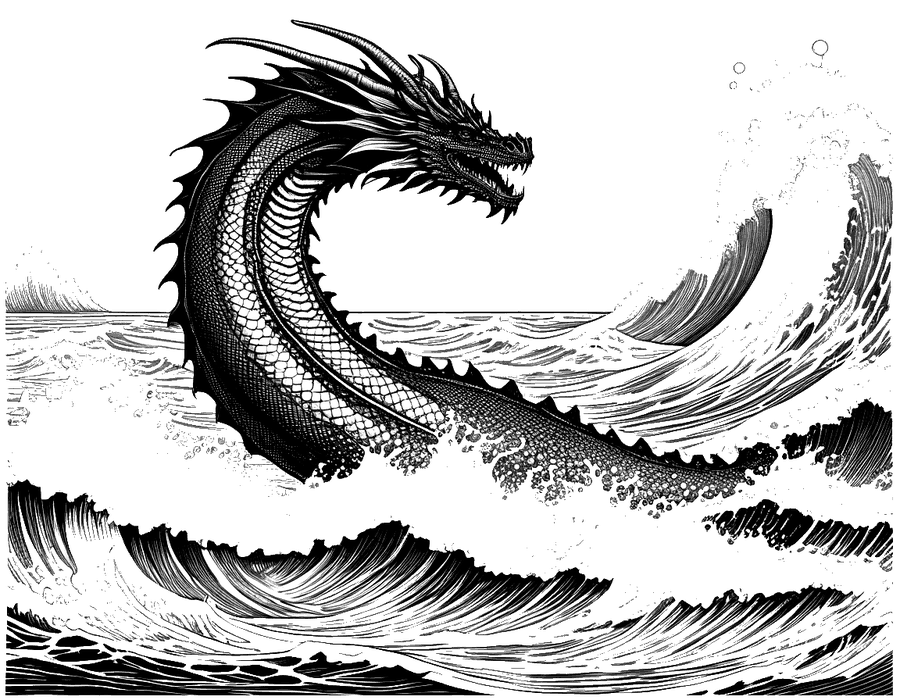
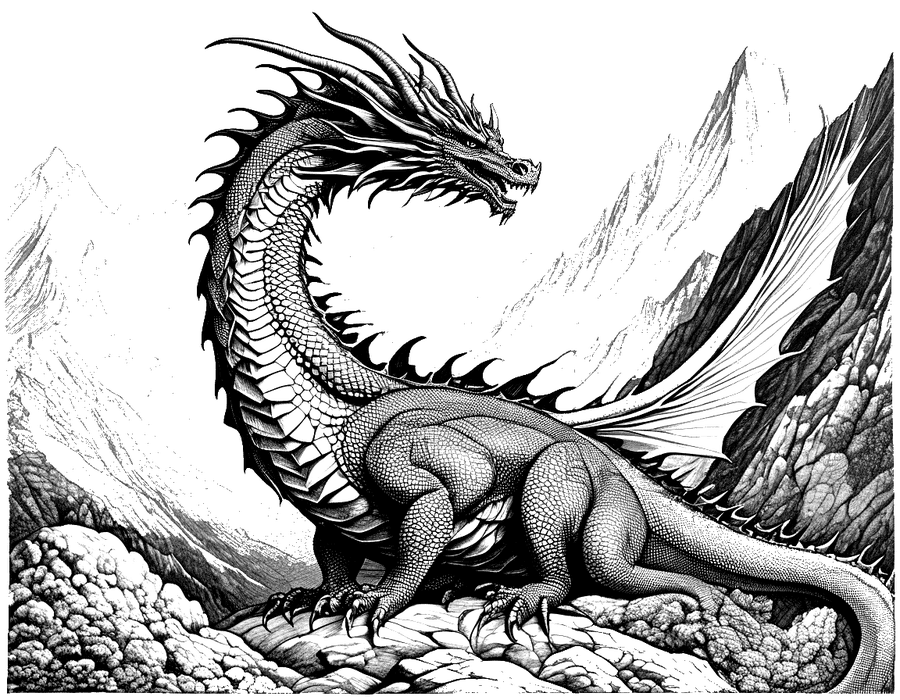
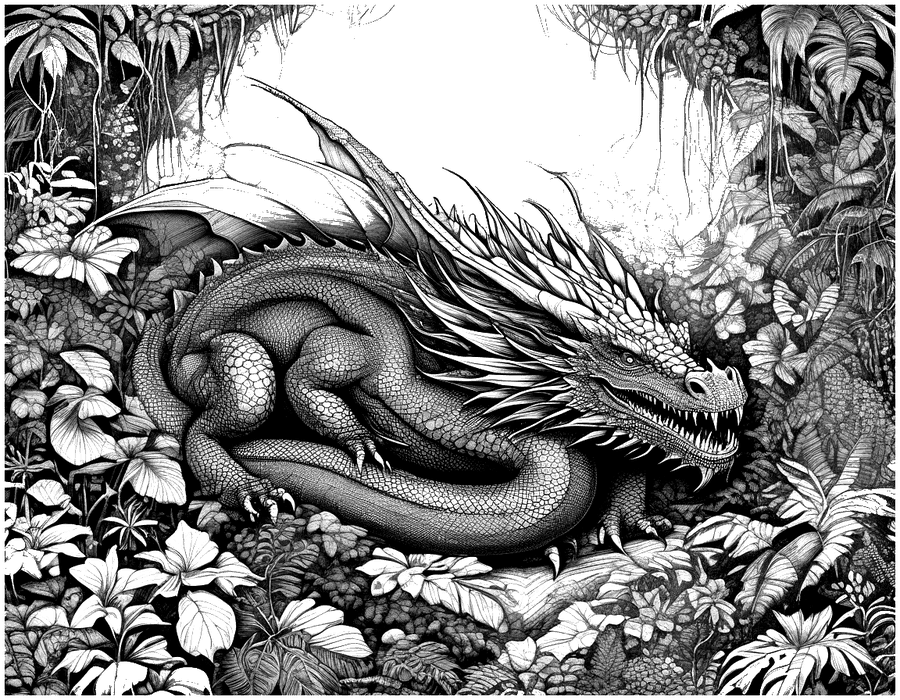
Every faith that tells of the Dead Worm agrees on one thing: the Worm dreamed as it died, and its dreams did not die with it. The seven great dragons are those dreams given flesh. Each embodies one part of the world. They are not beasts but sovereigns, each older than the calendar, each with its own hoard, its own wants and a lair marked on the map. All of them have slept since the Long Sleep began in 700, when Ankhorra was last seen over Shahpabad. Foleleyme has begun to smoke this year, and the Hoarfolk say they know what that means.
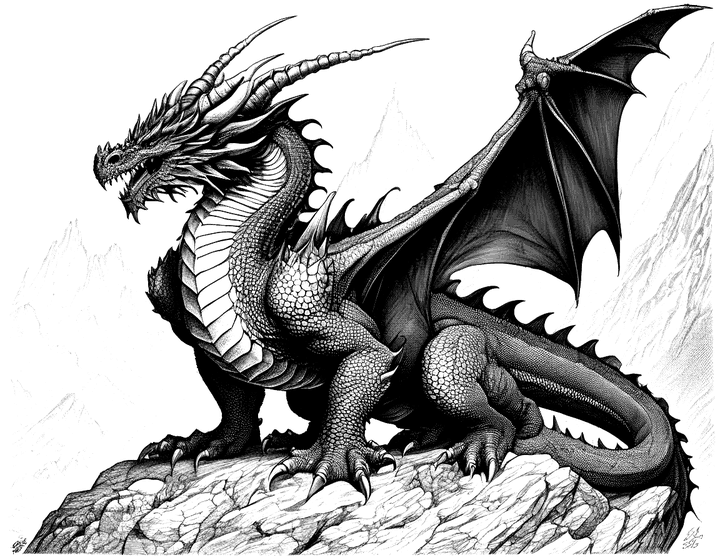
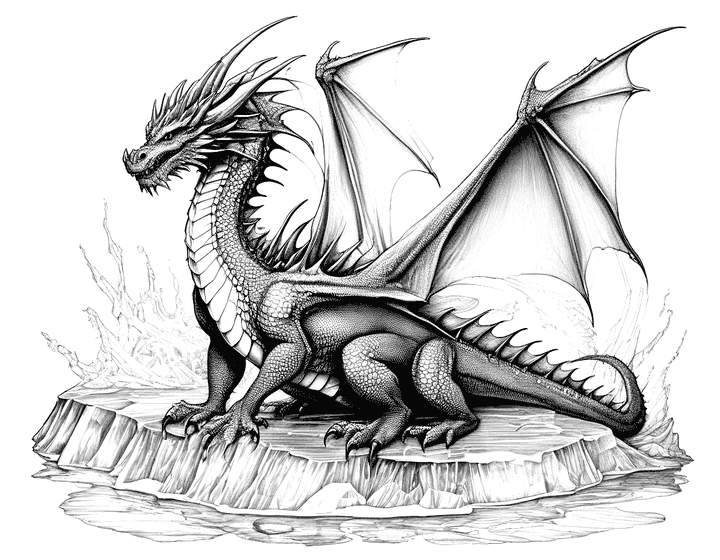
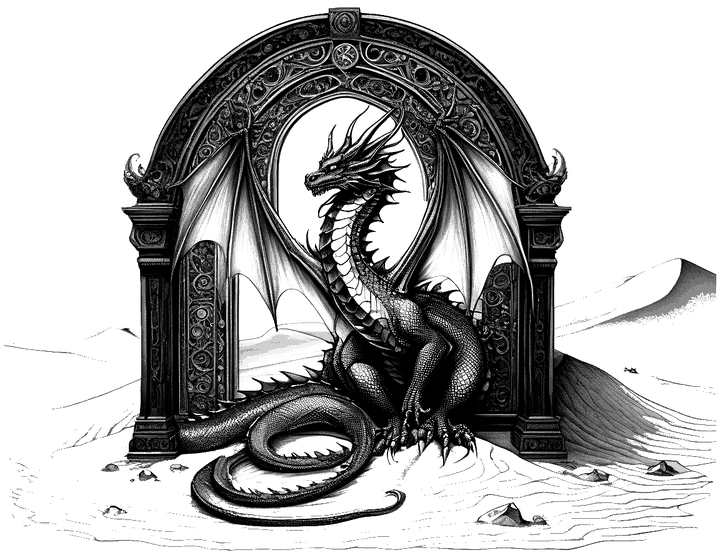
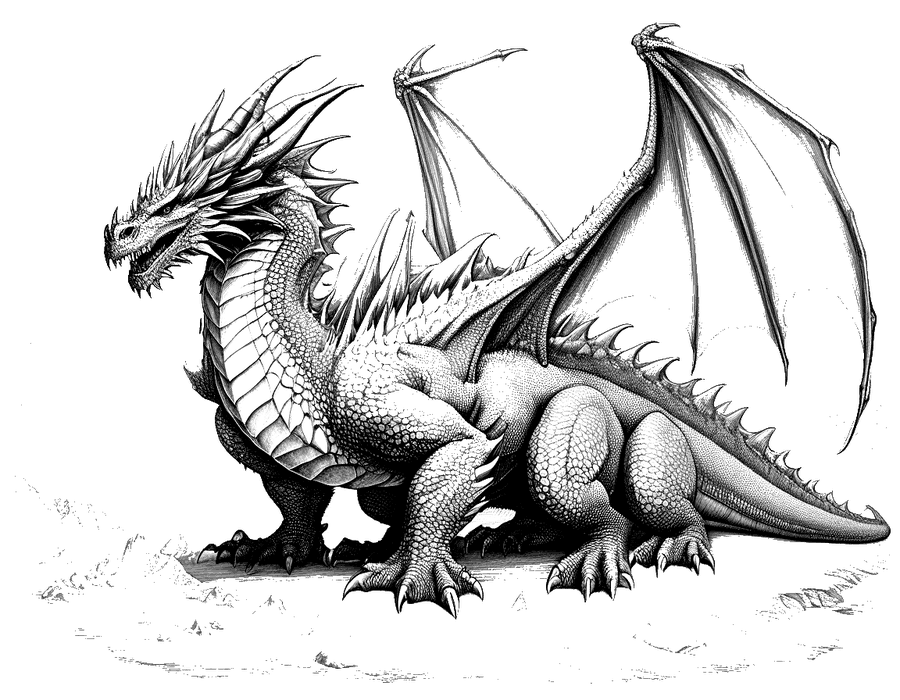
| Dragon | Embodies | Lair | SKILL / STAMINA | Wants | Weakness |
|---|---|---|---|---|---|
| Vyrnax the Ashen | Fire and ash | The flank of Foleleyme, Igyoszavas | 15 / 36 | To be the first to wake, and so the first to rule | Running water; it will not cross a river |
| Hrimgard the White | Frost and stillness | Near Rostovund's Crown, the Hoarspine | 14 / 40 | Silence; it kills anything that disturbs the glaciers | Fire and loud noise; cannon can drive it off |
| Skjoldis the Drift-Queen | Sea-ice and the cold north | The north coast of Hrafjor | 14 / 34 | Tribute of ships, which she keeps frozen in her bay like a collection | Vanity: she will bargain for a gift she does not own |
| Qalisar the Glass Dragon | Memory and the Elder Crowns | The deep Glass Waste | 16 / 32 | To keep Bretbury buried; the Glassborn are said to serve it | The Universal Translator; it fears being understood |
| Murrowmaw | The deep sea | Beneath the waters off Lantern Cove | 13 / 50 | To eat. The "Noskirk sea monster" sailors see is only the end of its tail. The pirates of Lantern Cove feed it, and it leaves them alone. | It cannot leave deep water |
| Ankhorra the Sun-Coil | The sun and kingship | The Sunward Range, near the Sunward Crown | 16 / 38 | To crown a mortal ruler of both continents, and then to rule through them | Oaths: it is bound by any promise it makes |
| The Green Sleeper | Growth and rot | The Kaporesian rainforest, inland from Lefka | 14 / 42 | Nothing; it has not woken in living memory, and the jungle grows over it | Unknown. The Kettlekin leave it offerings of oil. |
A dragon attacks twice each round, with jaws and claws (roll Attack Strength twice). A dragon's breath, once per fight, costs 6 STAMINA unless you test your LUCK successfully. Only weapons of tier 3 or higher can wound a dragon.
The dragons at home
What the people who live under each dragon believe, keep and fear.
Vyrnax the Ashen · life & lore
- Seasons
- Vyrnax has slept since 700, but its sleep has a pulse: the vents of Foleleyme breathe harder at midsummer and slacken in Isgard, and the gas-works price gas by them. The villages on the slopes keep Ashnight a day early (29 Isgard), putting out their hearths so the dragon smells no fire when the year turns.
- Living with it
- Herders below Foleleyme pasture their flocks on the far side of the streams, because Vyrnax will not cross running water. Every hut keeps a bucket of river-water by the door, and children sleep with a cup of it. Ash on the morning dew means the vents are breathing. Warm ash means leave.
- Charms & taboos
- A bride from the slopes washes her feet in a running stream before the wedding, so that the Ashen cannot follow her to her husband's house. The dead are buried on islands in the streams. Lighting a fire on the bare upper flank is taboo, and the Kettlekin, who must, pay the nearest herding family 1 sh a fire.
- Folklore
- Its own name is VŌRR, the Burning; it wants to wake first, and so rule first. Vengrian grandmothers say Rāt vōr tar shāllen, 'Fire does not go into the river', as a charm, without knowing what it means. Children sing that Vyrnax eats the stars that fall into Foleleyme, and the Comet of Thaw has made the rhyme popular again.
- History
- Vyrnax last flew in 698, when it burned the hill town of Tyazar to glass because its lord had dammed a stream across the dragon's path. Two years later the Long Sleep began. Herders say the dragon's breath has been in the mountain ever since, and that the Kettlekin found it in 798 and called it marrow-gas.
- Notable
- Watch-Sergeant Kozh Zhona keeps the Wyrmwatch post on the Foleleyme ridge with nine recruits, all hired since Thaw. Bokket Valvesong, gas-master of Brasswhistle's Drift, keeps a tally of the vents' breathing and has stopped showing it to anyone. A slope shaman who calls herself zemstavmin, 'little dream-stand', says the dragon has murmured her name in her sleep.
- This year
- Foleleyme has smoked since spring, and the Hoarfolk say they know what that means. The vents glow at night, the Drift has added a fifth chain, and the Wyrmwatch is recruiting at 3 sh a day. Hajhian refugees camped on the riverbanks have refused to move uphill, which locals call the first sensible thing anyone has done this year.
- The war
- Balsozhia buys marrow-gas from the works for its sky-ships, and the Open Forge cannon go to Erencszasz by barge. Hajhian refugees crowd the riverbanks, the only ground in Igyoszavas a dragon cannot cross. The Wyrmwatch's Slayers want the cannon turned on the volcano, and the Emperor has refused.
- Bounty & law
- Ash-glass from Vyrnax's old burns sells as a charm against fire at 1 sh a pebble, and does nothing. Marrow-gas at the Drift is sold by the barrel, cheaper than anywhere in the world. Igyoszavas law forbids damming any stream within a day's ride of Foleleyme: the dam is broken and the builder flogged, though nobody now remembers Tyazar.
- Wounds & cures
- Its breath costs a hero 6 STAMINA unless they test their LUCK successfully, and the burns weep for a month. Slope-folk dress burns with river-mud and Utturi honey, which works better than most physicians' grease. Since Thaw, ash-lung, a dry cough from the vents, has spread among the gas-works crews; the only cure is to leave.
Adventure seed. Kozh Zhona wants someone to climb the mountain stream by night and learn whether the vents now boil it. If they do, the river is no wall.
Hrimgard the White · life & lore
- Seasons
- Hrimgard sleeps near Rostovund's Crown and wakes, the Hoarfolk say, to noise on its glaciers. So the Hoarspine Stair keeps the Quiet Months from Isgard to Thaw: no bells, no horns and no singing above the treeline. In Rostovund, the month nobody marries, Kovavikian families leave a bowl of snow on the sill for the White.
- Living with it
- Guides on the high passes wrap mule-bells in felt, speak in whispers, and carry a fire-pot and a thunder-salt flash, because fire and loud noise drive Hrimgard off. Every caravan hires one shouter, whose only job is to make a terrible noise if needed. A glacier gone suddenly glassy means the dragon has breathed on it.
- Charms & taboos
- Couples in the Stair villages marry in a whisper. A child born in a snowstorm is called 'Hrimgard's' and given a bell to wear, so the dragon will know it is loud and leave it alone. Those lost on the glacier are mourned in silence for a day, and their names are never shouted again.
- Folklore
- Its own name is KŪLL, the Stillness. Guides murmur Sīl kūl, 'The ice is silent', before every crossing, and SĪLL, 'Be silent', is the one word of Wyrmtongue most Hoarfolk know; Kovavikian nurses use it to hush children. Many blame the Long Winter of 525, when the glaciers advanced in a single year, on Hrimgard turning over in its sleep.
- History
- In 671 a Hoarfolk survey party blasted a gallery below Rostovund's Crown. Hrimgard came down the glacier onto the Hoarspine Stair and froze a caravan of forty where they stood. The Thousand-Step Hold fired every cannon it had, and the dragon turned back. The frozen mules were cut out the next spring and still stand in the Hold's gatehouse.
- Notable
- Stair Gekhith, a Hoarfolk woman of 171, was a girl in that caravan and the only one dug out alive. Gimer Konsson, one of Watch-Sergeant Dukhdur's men at the Wyrmwatch post below the Crown, has heard the ice breathe twice this year. Stenna Gyrdottir guides smugglers over the glacier at 5 cr a head, and makes them wear felt boots.
- This year
- With the northern passes closed by imperial order, smugglers now cross the glacier near the Crown, exactly where nobody should go. The earthquakes along the Ulgan fault have cracked the ice, and the Wyrmwatch heard a long groan from the Crown in Hofjor. Gravdalla's silence has the Stair villages wondering what the Hoarfolk know.
- The war
- The Emperor's closure of the passes has pushed couriers and refugees up onto the glacier, where noise kills. A Balsozhian colonel has proposed waking Hrimgard with a cannonade and steering it onto the Raugarian rebels, which shows he has never read the Hoarfolk record. The Thousand-Step Hold keeps its guns pointing up the mountain, not out.
- Bounty & law
- Hrimgard ice, sold in Gogur as ice that never melts in a cellar, costs 2 sh a lump, and it melts. Glacier guides charge 5 cr a crossing and 1 cr more for felt boots. At the Thousand-Step Hold, firing a gun on the Stair in winter costs a 10 cr fine, and ringing a bell costs a month's labour.
- Wounds & cures
- Its breath is frost: the frozen go white and silent and must be warmed slowly by a fire, never rubbed, or the limb dies. Winter-black takes fingers on every crossing, and Norse elk-fat rubs make it worse. Snow-glare blinds, so guides wear slit eyeshades carved from bone.
Adventure seed. Stair Gekhith says one of the frozen forty carried a sealed Hoarfolk contract, still in the ice above the Crown. Its hold will pay to have it back unread.
Skjoldis the Drift-Queen · life & lore
- Seasons
- Skjoldis sleeps in her bay on the north coast of Hrafjor, and the Northern Isles count the year by her ice: the bergs start south after Breakice (1 Thaw). Norse and Kovavikian crews keep Ship-Gift on 29 Isgard, throwing a carved ship into the sea so that the Drift-Queen will take the toy and leave the hull.
- Living with it
- Islanders on Blikstur and Vopeid fish in small boats and never sail north of Hrafjor's headland. Every boat carries something beautiful it does not own, a borrowed brooch or a priest's silver cup, in case Skjoldis wakes and must be bargained with. Bergs in Haymonth are a bad sign.
- Charms & taboos
- A new hull is named after someone the crew has never met, so that Skjoldis will think it already belongs to someone. Sailors who die in the ice are left there, and the islanders say they have joined her collection and are not lonely. It is taboo to praise a ship's looks within sight of the ice.
- Folklore
- Her own name is SHĀLL, the Flowing, for the drifting sea-ice. The sagas give her only one sentence to mortals, YŪLL wēnhal tar ahn, 'Give me a ship', roared as a command. Island children who boast are sung Pretty ship, pretty ship, sail away north until they stop.
- History
- The sagas say Skjoldis took the Kovavikian whaling fleet of 611, forty-one ships, and that its captain bought back his own vessel with a gold torc he had stolen from the Rib Temple in Gogur. The other forty still lie in the Hrafjor Ice like flies in amber, and the torc has never been found.
- Notable
- Røskut Bjegåmsson, a Felderoy raider, claims to have walked among the frozen ships and come back with a sea-chest frozen shut; nobody has seen him open it. Teg Poldsson keeps the Wyrmwatch post on Vopeid, where Hrafjor shows on clear days. Bjørga Femsdottir, a scholar of Gogur, is cataloguing the frozen fleet by its figureheads.
- This year
- A Kushi trader, the Jun-maru, vanished north of Vopeid in Mieles, and sailors swear they have seen a new figurehead in the ice this summer. Raiders off Malocsermat and Felderoy have doubled since Kovavikia fell to Raugaria. Teg Poldsson has asked the Wyrmwatch for a second man and a bigger boat.
- The war
- Raugaria's conquest of Kovavikia sent fishermen out to the isles to escape the levies, and the Theocracy has no northern navy to stop the raiders who followed. Merlish privateers chasing Balsozhian fur ships have sailed too close to Hrafjor, and two have not come back. Skjoldis does not care whose ships they are.
- Bounty & law
- Salvage from the frozen fleet is worth a fortune: a figurehead from 611 fetched 300 cr in Shifton. Nobody rules the Northern Isles to forbid it. Ship-Gift carvings sell for 2 sh in Gogur. Island custom, the only law there, says a crew that takes from her collection owes her a ship in return.
- Wounds & cures
- Her breath is sea-cold: the touched turn blue and sleepy and can die in their beds a day later. Islanders warm them skin to skin under seal-furs, which works. Winter-black takes salvagers' fingers. The dead come out of the ice so well kept that grieving families sometimes try to wake them.
Adventure seed. Bjørga Femsdottir has matched a frozen figurehead to the Ichi-maru, the first ocean ship, lost on her northern voyage. Kushi wants what was in its hold.
Qalisar the Glass Dragon · life & lore
- Seasons
- Qalisar sleeps in the deep Glass Waste, and the Qashari say it hears names, which some give as the reason for the Unspoken Night (dark of the Lamp in Haymonth). Only the Glassborn track its sleep. Caravan-masters say the mirages walk furthest north when it dreams hardest, at the turn of the water-year.
- Living with it
- Caravans skirt the Waste by night, with veils and kohl against glass-eye. Guides rope each traveller to the next, because mirages lead people astray. Drivers whisper near the glass, and nobody says the name of Bretbury aloud, in any language, within sight of it.
- Charms & taboos
- A Qashari who must pass the Waste's edge leaves the written name of a dead ancestor at the last well, so that if the dragon takes a name, it takes that one. The Leopard Bretborn mourn anyone lost there with silence instead of a verse. It is taboo to carry Elder rubbings across the glass.
- Folklore
- Its own name is GLĀNN, the Gleaming. The Lamp-Keepers teach that its words to mortals were THĀNNvesh DRĀKK, 'Do not read the stones', and that its command RĪZZ, 'Forget', fused the Waste. Drivers say a traveller who comes out of a mirage without her own name has met the dragon, not the heat.
- History
- The Waste was fused in year 0 as if by something hotter than fire, and the Memory says Qalisar did it to keep Bretbury buried. In 455 the Asrahan scholar Qulaashah al-Radeeghi walked in to copy an inscription and walked out a year later unable to read or write. Her notebook, every page blank, is kept in the Scriptorium at Qaqah.
- Notable
- Low B, the Glassborn with the lowest ground tone, leads the Choir and is said to have been rung by Qalisar itself. Nisdah al-Naleeti, a Successor's Scribe, has asked the Caliph for a caravan to the Gates of Bretbury. Lis of the Pale Door, a Bretborn of the Silent Scholars, has burned three of Nisdah's notebooks this year.
- This year
- The rubbing stolen from the Ucillamope Library in Mieles is rumoured to say where the Speaking Lens was hidden, the one thing Qalisar fears. Ab-Fifth is reading the stones aloud in Qaqah. Mirages have been seen from the walls of Zalfamaq, and the old caravan-masters say the Glass Dragon is dreaming hard.
- The war
- The Asraha–Mashian War pushes caravans and columns closer to the Waste, and a Mashan column that cut across its edge lost a day in the mirages and a third of its men. Neither side will march near the Gates. The Successor's Eyes hunt the Speaking Lens as though it were a weapon, which it may be.
- Bounty & law
- Fused glass from the edge of the Waste sells in Meedihar for 5 sh a slab, for windows. Glass from its heart is never sold, because nobody comes back with any. Asrahan law makes it a crime to guide a stranger into the Waste: a flogging for the first offence, and loss of well-right for the second.
- Wounds & cures
- Glass-eye blinds anyone without kohl and veil, and the leopard-priests treat it with a salve. Qalisar's own wound is forgetting: its victims lose names, then words. The Memory says the only cure is to have your life sung back to you by someone who knows it, which is why Bretborn cross the desert in pairs.
Adventure seed. Nisdah al-Naleeti will pay 200 cr to anyone who carries a copy of the Speaking Lens's drawing to the Gates of Bretbury and reports whether anything there moves.
Murrowmaw · life & lore
- Seasons
- Murrowmaw sleeps beneath the deep water off Lantern Cove, but it eats in its sleep. The Brethren feed it on every Lampless night: a whale, or three oxen, tipped off the Feeding Barge at the Black Buoy, by the harbour mouth. At Sail-Dipping in Rocadones, every ship in the Cove dips sail to the deep as well as to the shrines.
- Living with it
- Lantern Cove fishermen work the shallows and leave the dark water to the dragon. Children swim before they walk, and never in the deep. The Noskirk sea monster, thirty-nine feet of tail, is a common sight from Gallows Wharf, and nobody there looks up from their beer.
- Charms & taboos
- A new Admiral of the Black Ledger is sworn on the Feeding Barge and pours the first bucket of blood into the water. Pirates who die in debt are given to the deep with the sum chalked on the shroud, so that Murrowmaw will settle it. Halmi exiles leave rice on the shore for the Mountain Grandmothers, and nothing at all for the dragon.
- Folklore
- Its own name is NŌKKH, the Deep. The pirates' toast before every vote is Gashhul WĒNN, 'The sea is hungry.' The Shore and Hearth faith says the deep anchors the islands and Murrowmaw is the anchor-chain. Sailors insist the tail is a separate beast, which saves them thinking about the rest.
- History
- When the town was still Jinsan, its people fed the deep with fish, as their grandparents had. The Kettlekin founders of 821 forgot the feeding for one month, and the tail took the brig Marigold and its prize together. The Brethren have kept the Lampless-night feeding ever since, and book the cost in the Ledger as 'harbour defence'.
- Notable
- Gimheon Wopyol, a Halmi exile, is Feeder of the Deep, the Brethren's oldest officer, and has outlived four admirals. Pozzek Ropewalker of the Loud Cousin swears she saw an eye the size of a sail open beneath her ship off Tebek. Ralil Darminides, an Elladan deserter, sells oxen to the Feeding Barge at 4 cr a head and is getting rich.
- This year
- Kushi's Admiralty wants Lantern Cove burned, and the Brethren hint that Murrowmaw guards their harbour; Kushi captains cannot tell whether it is a bluff. The Bingford tsunami set the tail thrashing for three days. Admiral Mae Corrin's term ends next month, and the Feeding Barge is the safest place in the Cove to be seen.
- The war
- The war that matters here is Kushi against the Free Captaincy. Kushi patrols keep well off Tebek since the tail sank two of them that chased pirates into deep water. The wars on Qabahrah have broken up the Chain convoys, and more prizes reach the Cove than ever, so the Brethren can afford more oxen.
- Bounty & law
- The Brethren spend about 400 cr a year on whales and oxen and call it the cheapest fleet in the world. Scales washed up from the tail fetch 20 cr each in the Drowned Market. Brethren law hangs anyone who harms the tail or skips a feeding on Gallows Wharf, and the culprit's share goes to the barge.
- Wounds & cures
- The tail breaks hulls and spines. Divers who go too deep after wrecks come up with the bends, and the Cove's surgeons treat it by lowering them back down on a rope. Salt-boils and drowning-lung are common, and the Halmi shamans' kelp poultice is the best cure in the Cove.
Adventure seed. Gimheon Wopyol is dying and wants a successor who can row the Feeding Barge out on a Lampless night without a lantern. She has a test in mind.
Ankhorra the Sun-Coil · life & lore
- Seasons
- Ankhorra coils near the summit of the Sunward Crown, the red peak that holds the sun long after dark. At the Kneeling of the Elephants (1 Thaw) the Shah is re-crowned under the Magenta Colossus, which faces the mountain on purpose. On the longest day the Hoarfolk of Sunhold keep Sun-Sealing, walling up any gallery that has run too close to the summit.
- Living with it
- Herders on the red slopes never make a promise out of doors, in case the sleeping dragon hears and holds them to it. Kavarri children are taught to say 'perhaps' instead of 'I swear'. When the mountain glows after midnight, the villages say the Sun-Coil has turned over, and they lock their gold away.
- Charms & taboos
- A shah of Kahpia is not crowned until the great elephant kneels, and the elephant-priests also bow towards the Sunward Crown, which they call appeasing the dragon. Kavarri couples make their vows indoors, under a roof, so the oath stays a mortal one. Dead kings are buried facing away from the mountain.
- Folklore
- Its own name is RŪGG, the Roar, because a command is spoken in the ROAR grade and Ankhorra is kingship. The courtiers' proverb is Kel vesh SĀRR, 'A word binds the king', and every Kahpian child knows that Ankhorra is bound by any promise it makes. The Poets' Garden holds a yearly contest for the best oath to trap a dragon.
- History
- In 700 Ankhorra was seen over Shahpabad, circled the palace three times and vanished, and the Long Sleep began. The Magenta Colossus was raised from 700 to 744 to show the dragon who rules here, and no gold leaf has been let fall from its tusks since. Legend says the dragon was looking for a mortal to crown and found nobody worth it.
- Notable
- Saihia of the Fallen Bell, the oldest Bretborn, was murmured by Ankhorra in 690 and is the only living person known to have been claimed by a dragon. Elephant-Priest Ghir Zhadari leads the elephant-priests who want the dragon appeased. Sunhal Thurn, the Sunhold steel-trader, says his miners have heard slow breathing through the roots of the Crown since Ember Deep went dark.
- This year
- Ember Deep, also in the Sunward Range, sealed itself from the inside last winter, and lights show in its vents. Shah Ardavan IV's war to retake Jowshia has the elephant-priests warning that a king who wants two crowns is exactly what Ankhorra is looking for. A Lantern Cove broadsheet has called him 'the dragon's candidate'.
- The war
- Kahpia and Haruwayha fight Jowshia and Al Tubar, and both camps have sent envoys up the mountain with promises; the Sunhold Hoarfolk have turned every one back. Grey Wall captains will not fight within sight of the peak. Merchants in Shahpabad are hoarding gold indoors, since it is said the dragon wakes to the smell of it.
- Bounty & law
- Sunhold steel sells well in Shahpabad, but Sunward gold is thought cursed and fetches a tenth less than lowland gold. Kahpian law holds any oath sworn within sight of the Sunward Crown binding for life. Breaking one is punished like breaking an oath on Tugan's tusk: by elephant.
- Wounds & cures
- Its breath is sun-fire, and survivors carry burns shaped like gold leaf. Shepherds get crown-blindness from staring at the glowing rock after dusk, and the elephant-priests treat it with tamarind poultices. Gold-fever, a refusal to leave the mountain, is cured by carrying the sufferer down in a basket.
Adventure seed. A Kahpian courtier wants a hero to climb the Sunward Crown with a promise so carefully worded that a waking Ankhorra would have to crown his master.
The Green Sleeper · life & lore
- Seasons
- The Green Sleeper has not woken in living memory, and its only cycle is growth: the jungle over its lair inland from Lefka grows fastest in the monsoon of Hofjor and Rocadones. The Kettlekin keep Oil-Night when the monsoon ends in early Haymonth, carrying jars of lamp-oil to the forest edge and pouring them over a flat stone.
- Living with it
- Villagers near Lefka cut back the vines round their huts every morning, because a vine left a week is thought to be the Sleeper's finger. Nobody eats a mushroom that grew overnight. Since the Bloom came down the rivers, every family keeps an oil-soaked torch by the door.
- Charms & taboos
- Elladans pour wine for the river spirits and a little lamp-oil for the Sleeper. The dead are never buried in jungle earth, but burned or sunk at sea, so the green cannot take them. The Leopard faith calls every dragon a servant of the Barren except this one, and its priests bless the jungle's edge but never the trees inside it.
- Folklore
- It is the only one of the Seven without a roared name. The seventh name, ZĒMM, the Dreamer, is the Worm's and claimed by none, and the Rot Communion says the Sleeper will claim it. Their chant is Īss ĪSS ul ōr DŌRRul, 'The forest grows, and the city dies.' Lefka children say the Elder guardian walks to keep the Sleeper company.
- History
- No record shows the Green Sleeper waking, even before 700. The Elder Crowns built their greatest jungle city beside its lair, and the Bretborn Memory says they did it on purpose. In 783 Kettlekin scavengers found an ancient oil-jar shrine in the ruins and began refilling it, and nobody since has dared to stop.
- Notable
- The Mother of Moulds, crowned with fungus, leads the Rot Communion and says she has heard the Sleeper turn over. Maggik Oilcan, a Kettlekin from the Kettle Coast, has carried oil to the Sleeper every year since she was six; she is thirty-one. Phesasys Lyminpidou, an Elladan guide in Lefka, takes treasure-hunters to the ruins for 2 sh a day, by day only.
- This year
- The Bloom is creeping out of the rainforest along the rivers, and Gardeners in beaked masks carry its spores from village to village. The monsoon closed the jungle tracks in Hofjor and has just let them open again, and Lefka is waiting to see what comes out. The Kettlekin say this year's Oil-Night will be the biggest ever.
- The war
- Manttamite cells smuggle hand-gonnes north through Kaporesia, and their boats carry the Bloom upriver with the guns. The Despot of Myrnamon cannot spare marines for the jungle, and the Leopard Wardens who hunt the Communion are busy in the Jowshia–Kahpian War.
- Bounty & law
- Oil for Oil-Night costs 2 d a jar and is the only thing anyone sells for the Sleeper. Marrow-salt for burning out the Bloom costs 5 cr a pinch and is climbing. Kaporesian law burns any Gardener caught with a censer, and the Despot pays 2 cr for every beaked mask brought in.
- Wounds & cures
- The Bloom starts as mould on the skin and a sweet smell, then numbness, then the last walk into the jungle. Burned early with fire or marrow-salt it can be stopped; later, nothing works. The Mercy, healers inside the Communion, are said to be close to a cure, and the Leopard Wardens hunt them anyway.
Adventure seed. Maggik Oilcan says the shrine's oil-jar was empty this year before she filled it, licked clean, and she wants a witness for Oil-Night.
The homelands at home
Daily life in the lands each people keeps for itself (switch on Peoples on the map).
The Hoarfolk Holds · life & lore
- Feasts
- Wormwake Eve (6 Rostovund) is kept in every hold, and in the glacier-edge villages, which pour beer into cracks to be on the safe side. At Surfacing (21 Rocadones) Hoarfolk children come blinking onto the high pastures. This Reaping the Moot of Anvils meets at the Thousand-Step Hold, and each hold-line will walk there in procession behind a rubbing of its record wall.
- Daily life
- Above the glacier edge the homeland is bare rock, snowfields and rows of smoking vent-chimneys. Human villages below send mutton, barley and wool up the hold roads and get steel, salt and hot water piped out of the mountain. Retired miners, the 'sun-sitters', live in stone cottages at the hold-mouths, and are the first faces a traveller sees and the last to stop talking.
- Customs
- A traveller who reaches a hold gate is given hot salt broth and a bench in the gate-hall, but is never let further in without a contract. The roads between holds are marked by an iron post every mile, each stamped with the smith who forged it. Hoarfolk who are sent up must live on the surface, and the human villages take them in as smiths and do not ask why.
- Folklore
- Grandmothers say Torg thaz ûkum khol gorrôld thaz zûlk thrimar, 'We are stone, and the others are flesh', which can be a boast or an apology depending on who says it. Glacier villages say the vent-chimneys are the Worm's breath. A road-post that rings when touched means a hold below is digging too close.
- History
- The holds keep a calendar 3,000 years old, which nobody else believes. Around 120 they opened to human trade and struck the first ingot-mark. In 525 the Long Winter pushed the glaciers forward in a single year, and the holds tunnelled under the ice rather than give up their roads. Since Hrimgard came down in 671, the high holds have kept the Quiet Months from Isgard to Thaw.
- People
- Grand Fusewarden Brannoc of Gravdalla leads the Powder Moot and has said nothing in public since Hofjor. Stair Hôldis, the Moot-clerk at the Thousand-Step Hold, will count the Reaping vote, and four holds have already tried to give her presents. Gravdal Thokgrim, a sun-sitter at Gravdalla's mouth, sells hold gossip for ale and is the only source anyone has on the sealed gates.
- This year
- Gravdalla Deep has sealed its lower gates and Ember Deep, across the sea, is sealed from the inside, so every hold is whispering that something deep has woken. The Ulgan Fault earthquakes have cracked the road between Lenhalas Under and the Stair. The Moot vote on the Open Forge in Reaping will decide whether the holds split.
- The war
- Hold law forbids taking sides in human wars, and Silverhold's Open Forge broke it in 833. The northern passes are closed by imperial order, so smugglers charge 5 cr to take people over the glacier, and the holds' wardens hunt them. The Thousand-Step Hold refuses the Stair to armies. Hoarfolk factors are spat at in Merland and jostled in Shifton.
- Market & law
- Hoarfolk sell thunder-salt, cannon, steel and marrow-salt, and pay in ingot-marks worth a crown. They lend only to other holds. Salt is 10 d a pound in the Hoarspine, and thunder-salt is sold only to buyers with a Powder Moot licence. A broken contract is cut into the shame-wall, and the worst sentence is to be sent up. The Stair toll is 2 sh a walker.
- Healing
- Grey lung takes most miners, so the holds retire them to the surface at sixty. Knitters mend crushed hands by marrow-lamp better than any human surgeon. Humans on the hold roads suffer sky-sickness and winter-black, cured with climber's leaf and the bone-saw. The Bone-Rite forbids marrow-salt healing, so marrow-burn gets cold iron and nothing more.
Adventure seed. Stair Hôldis has noticed that one hold's vote-rubbing was taken from freshly cut stone. Somebody has forged a hold-line's mark ahead of the Reaping Moot.
The Sunward Holds · life & lore
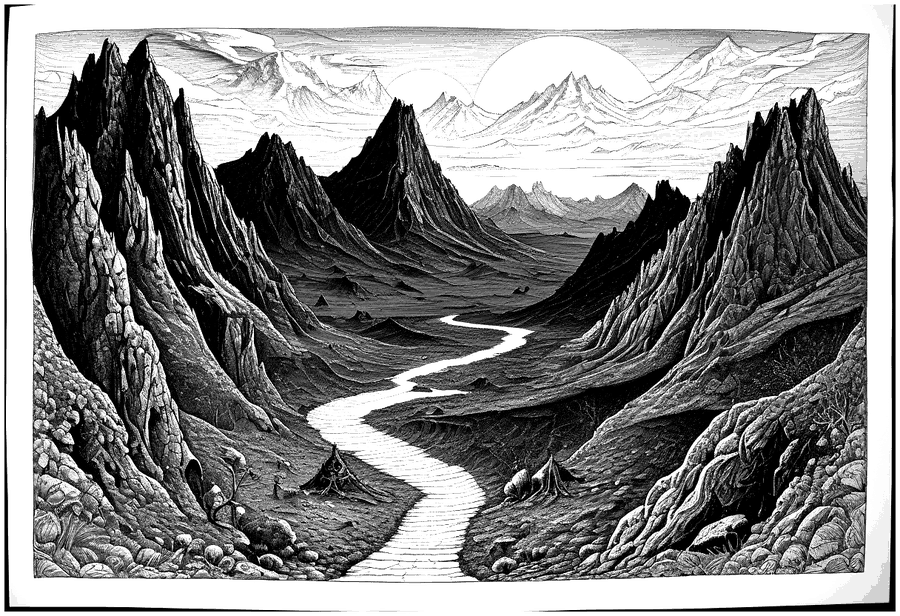
- Feasts
- The range keeps the Hoarfolk year with the Kavarri feasts on top of it. At the Kneeling (1 Thaw) and Mahrang's Drum (1 Isgard) the hold traders come down to the herders' fires and, by old custom, get the worst seats. Wormwake Eve (6 Rostovund) falls here at the end of the rains. On the longest day Sunhold keeps Sun-Sealing.
- Daily life
- Kavarri goatherds graze the red slopes above the forest line and trade cheese and kids at the hold gates for steel needles and salt. Mule-trains carry Sunhold steel down to Shahpabad and Takabukha. The Sunward Crown glows red at dawn and long after dark, and nobody lights a lamp until it fades. At night the light in Ember Deep's vents shows from ten miles off.
- Customs
- A herder who brings a gift to a hold gate is let into the gate-hall and given broth. Kavarri herders marry at dawn facing the Crown, and they bury their dead in cairns facing away from it, so the dragon will not count them. Herders never make a promise out of doors. The Sunward Hoarfolk lay their dead in the slow halls to turn to stone.
- Folklore
- The herders' rule is Bazamdun leshar siro, 'A gift opens the gate', and it works on Hoarfolk too. Children say 'perhaps' instead of 'I swear'. Underground the Hoarfolk never name Ankhorra, and call it 'the one upstairs with the lamp'. A goat that will not cross a ridge has smelt the Lit.
- History
- Sunhold was cut before the calendar, and Ember Deep was dug later for its marrow-salt. In 640 the two holds and the Shah agreed the Mule Road compact: Hoarfolk steel goes down, Kahpian grain comes up, and the tolls were fixed in siglos and never changed. In 700 Ankhorra was seen over Shahpabad, and the Long Sleep began.
- People
- Sunhal Ozdis, a sun-sitter, keeps the surface terraces above Sunhold where retired miners grow figs, and she sells them to the hold at shameless prices. Narzeh Dulvani, a Kavarri goatherd, sold cheese at both gates for thirty years and was the last outsider to trade at Ember Deep before it was sealed. Sarrdur Ghardunul, who left Ember Deep before the sealing, binds wraiths into blades at Sunhold and never takes off his gloves.
- This year
- Ember Deep is sealed from the inside, hammering comes through the rock, and the Last Shift taps for rescue. The Wyrmwatch say Ankhorra moved on the summit during the Comet of Thaw. Sunhold has doubled its guard, sold more steel than ever and bought up Kahpian dye-root, and the herders are moving their flocks off the eastern slopes.
- The war
- Kahpia and Haruwayha fight Jowshia and Al Tubar, and both camps have sent envoys up the mountain with promises for the dragon; the Hoarfolk turned all of them back. Grey Wall captains will not fight within sight of the peak. Mule-trains are taxed for the war, and a Sunhold blade now costs a third more in every market.
- Market & law
- Sunhold steel sells for 3 siglos a pound at the foot of the road, and a guide to the snow-line costs 1 siglos a day. Sunward gold fetches a tenth less than lowland gold, because it is thought cursed. Any oath sworn in sight of the Crown binds for life under Kahpian law, and breaking one is punished by elephant.
- Healing
- Grey lung and marrow-burn are the miners' illnesses, and the second one comes down the mountain with escaped Ember Deep miners. Sun-blindness on the snow is treated with kohl and dark cloth. Lowlanders get sky-sickness above the forest line, and the herb-wives treat it, like everything else, with goat's milk.
Adventure seed. Narzeh Dulvani's goats refuse the slope above Ember Deep, and the grass there has gone glassy. She will pay a kid a day to whoever finds out why.
The Mistwood · life & lore
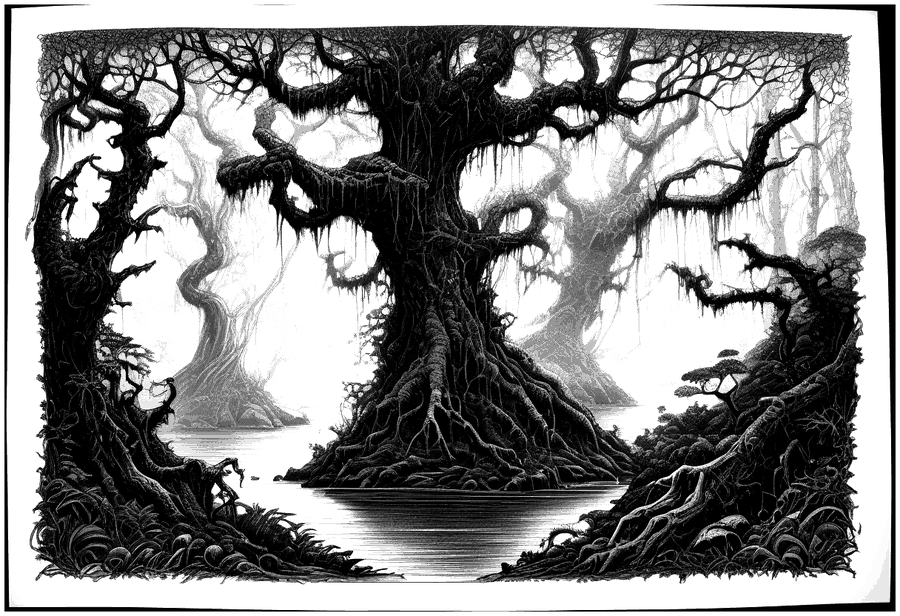
- Feasts
- Landing (14 Mieles) marks the year 3, when the exodus reached the Raugarian coast. Every family walks to the shore at dawn and back into the trees by noon. On Ashnight every family sings its verse of the Memory. The Mistwood's own small feast is Chart-Night, the last night of Ondaria, when mapmakers burn the year's rejected drafts so that no wrong map survives.
- Daily life
- The Mistwood is a band of fogbound rainforest along the Raugarian coast. Fog comes off the sea every afternoon, and paths of split cedar boards run between root-houses lit by marrow-lamps. People eat smoked salmon, fern-tips, sorrel and hard cheese, and drink pine-needle tea. The only loud sounds are dripping trees and the crack of sparklocks on the practice ranges.
- Customs
- Outsiders are walked in by one guide and out by another, so no single Bretborn can be blamed for what a visitor saw. The dead are buried under saplings, so every tree in the old stands is somebody's grandmother, and felling one is treated as desecrating a grave. A Mistwood marriage is made for a century, and renewed or quietly let lapse at a feast.
- Folklore
- The elders' answer to every envoy this year is Aessipan eilth nos e bin, 'The old tree does not run.' Raugarian fishermen say the afternoon fog is the Bretborn breathing out. A freckle that glows with no marrow near means someone somewhere is reading the Elder script aloud, and the whole family stops talking until it fades.
- History
- The exodus landed in year 3 and vanished into the trees. In 288 the last singer of the House of the Sixth Bell drowned off this coast, and her verse became the Hollow Verse. In 690 Mistwood mapmakers charted the Bliksberg root-caves and burned the map. In 799 they tried weaving giant-spider silk into rifle-cloth and gave it up after two weavers vanished. The sparklock followed in 803.
- People
- Dan ith Thothmun, a Mistwood elder of four hundred, has refused both the Theocracy's envoy and the rebels' and given them the same cup of tea. Vowy ith Hivor walks the forest's eastern edge with a sparklock and turns back anyone who brings a torch. Difis of the Seventh Door, the gunsmith who sold eight sparklocks last year, has been asked by the elders to stop, and has not said yes.
- This year
- The Raugarian Insurrection is fought round the forest's edge, and rebels and Theocracy patrols both try to shelter in the first trees. Bretborn are searched at the Ucillamope Library gate over the empty reading-room. The Comet of Thaw is in no family's verse, and the elders are arguing about whether that is good or bad.
- The war
- Both the Theocracy and the Kjelheim rebels have tried to hire the Mistwood's riflemen, and the Mistwood has refused; the Theocracy calls this loyalty and the rebels cowardice. Merland and Balsozhia bid up to 1,200 cr for a sparklock. Since Ember Deep went dark, marrow-salt costs half as much again, and the ranges fire fewer practice shots.
- Market & law
- Mistwood maps sell in Fagervik for 1 cr a sheet and are never wrong. A sparklock costs 800 cr when a Bretborn will sell one, and each shot burns a pinch of marrow-salt. Raugarian hacksilver is weighed at the forest edge. Whoever fells a living tree must tend its replacement for a century or leave the forest, and reading the Elder script aloud strikes the reader's memory-name from the family verse.
- Healing
- Marsh ague comes up from the Raugarian wetlands, and fog-cough takes the old in Isgard. The Bretborn heal wounds with a secret pinch of marrow-salt, which closes a cut in an hour and makes the freckles burn for a day. Elders of five centuries may fall into the Long Grey, and their family sits with them and sings their verse.
Adventure seed. Vowy ith Hivor has found a Kjelheim rebel camp inside the forest's edge, with a Theocracy patrol two days behind. She wants both gone without a shot fired.
The Leopard Highlands · life & lore
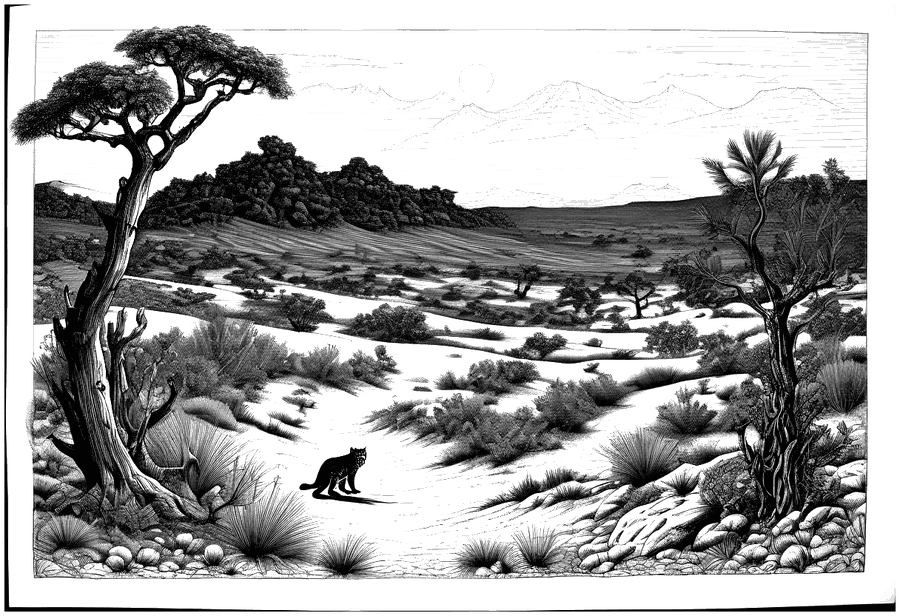
- Feasts
- At Groving (18 Hofjor) every family plants a tree on the desert edge, and the Bretborn plant first, at dawn. On the first dark of the Lamp after Groving the highlands keep the Listening: families sit up in the groves and count each high leopard's cough as a blessing. The Leopard Bretborn sing their verses of the Memory through Ashnight, and the Qashari neighbours bring them tea.
- Daily life
- The highlands are a narrow green upland in Haruwayha between the desert and the coast, terraced with figs, barley and cedar. The Bretborn live in long dry-stone houses under the trees and eat barley bread, goat's cheese, wild greens and honey, and drink husk-tea. Most Bretborn adults serve as Wardens or grove-keepers. At night the high leopards cough in the dark.
- Customs
- A Bretborn child is given its memory-name at seven and plants its own tree the same day. The tree is tended for life, and the owner is buried beneath it. A high leopard that walks through a wedding is the goddess's blessing, and the couple must not move until it has gone. The faith forbids loans, so neighbours give instead and keep careful count.
- Folklore
- The Leopard Bretborn say Ithrel e aun wimiad lomen, 'A human is a short song', kindly, of their Qashari neighbours. Children dare each other to shout into the Mirqah Cavern, which is 'totally empty'. Lamp-Keepers teach that a rubbing of the Elder script brought into a grove will wither the tree above it.
- History
- The Leopard Bretborn stayed on Qabahrah when their kin crossed the sea, and founded the faith of Asheena the High Leopard in these hills. The Long Grove, forty miles of acacia and tamarisk, has been planted one family tree at a time since then, and Takabukha keeps the stump of the first as a shrine. In 693 three dry years killed half the belt, and the Green Edge replanted it in eleven.
- People
- Saihia of the Fallen Bell, of 611 years, is the oldest Bretborn alive and knew a woman born in Bretbury. Synawy ith Wor, a grove-singer at Jafinah, teaches the Memory to Qashari children against the elders' wishes. Reiman ith For, a Warden of the Hunters of the Barren, has come back from the Tubari border with a seized salt-cart and wants to tip it into the sea in front of the Emir.
- This year
- The Najrah Cyclops has been seen nearer Fuluwai since Rocadones, and two shepherds' boys are missing. The cold breath from the Mirqah Cavern has killed a row of figs on the terraces below it. The two Strays walking north have unsettled every Lamp-Keeper, and Pia ith Veth has gone to watch the Gates of Bretbury herself.
- The war
- The Leopard Bretborn ride with the Wardens on Kahpia's side in the Jowshia–Kahpian War, and the Hunters of the Barren raid across the Jowshian and Tubari borders. With so many Wardens away, the new grove line on the desert edge goes unwatered, and the Green Edge planters want everyone home by Groving.
- Market & law
- A grafted fig sapling costs ten qirat, highland honey five qirat a jar, and the glass-eye salve 3 sh in the towns. Leopard Bretborn give gifts, not loans, and sell no rifles at all. Cutting a fruit tree is a hanging offence, and so is salting land, though the Wardens usually reach the salter before the hangman does.
- Healing
- The leopard-priests are among the best healers in the world, and their glass-eye salve is sold all over Asraha. Like their Mistwood kin, the Bretborn heal quietly with marrow-salt, and their mages suffer marrow-burn. The very old may fall into the Long Grey, and are carried to sit under their own trees until it passes or they do.
Adventure seed. Saihia of the Fallen Bell wants carrying to the Mirqah Cavern before Groving. She says she knows the voice in the cold breath, and will not say whose.
The Hornlands · life & lore
- Feasts
- Hornday (20 Tunarejo) is the great day: every Rhunari carves the year's deeds into the horn, pays or forgives horn-debts, and pushes in contests until dusk. The savanna clans kneel with Tugan's elephants at the Kneeling (1 Thaw) and drum for rain at Mahrang's Drum (1 Isgard). The Hornmoot usually meets on the Pushing Ground at the start of the dry season, but this year it has not been called.
- Daily life
- The Hornlands are the savanna of Sag and Kahpia: grass, thorn and baobab, with thorn-walled kraals of humped cattle. Rhunari eat sorghum porridge with soured milk and blood, about three times what a human eats. The horn-house of each clan holds the sawn horns of its dead. Calves carry water to the herd from dawn, and the kraal smells of dung-smoke and hot dust.
- Customs
- A guest at a kraal is handed a gourd of milk and blood and must finish it. A suitor carries a stone into the family's kraal, and if the family push it back out the answer is no. At about twelve a calf's horn is first carved with its lineage. The dead are buried sitting up, facing the grazing, and their horns go to the horn-house.
- Folklore
- Herd-mothers say Zongo toowuuruǂa magham nguu, 'The old cow knows the well', and lead the dry-season moves by it. The clans say Tugan walks the Hornlands at night and that a flattened thornbush is his footprint. A dream of a crooked horn means someone near you is lying, so a Rhunari asks everything twice.
- History
- In 412 the first Hornmoot united the savanna clans after a three-day pushing contest that killed nobody. In 563 the Dry Years killed half the herds, and the clans still keep a horn-debt to the Kahpian shahs who opened the royal wells. In 762 the Bloody Murrain sent many clans into Kahpian service to eat. In 810 the Hornmoot forbade firearms to every Rhunari for ever.
- People
- Moot-Mother Gruva Stands-Unmoved has called no Hornmoot this year and will not say why. Riwawa Counts-the-Herd keeps the horn-house of the largest clan near Vatanzful and knows every debt carved in it. Mizoowa Sleeps-Standing is the best horn-mender in the Hornlands, binding cracked horns with copper wire and resin, and she has more work this year than in the last ten.
- This year
- The talk of every kraal is Rhunari charging Rhunari in the north, and whose horn will be shaved for it. The great elephant migration near Chudeshk has flattened eleven villages' millet stubble, and the clans are walking their cattle wide of it. The Grey Walls in Shahpabad are owed six months' pay and say so loudly.
- The war
- Kahpia's war with Jowshia takes the young bulls south with the Grey Walls, and the Shah pays late while Jowshia is said to pay on time. Families in the Hornlands have sons in the woolly clans' fight in the north as well. At Hornday this year many mothers will carve both sons' deeds on the same horn and pray to Tugan for neither.
- Market & law
- Rhunari sell cattle, hides, mercenary service and their word. A cow costs twenty siglos, and a Grey Wall soldier 3 sh a day. Horn-scrip, a debt carved on a sliver of horn, passes as coin because no Rhunari has ever defaulted on one. A liar's horn is notched, a thief repays three times over in cattle, and a shaved horn means exile.
- Healing
- A broken horn never heals, and the shame is worse than the wound; horn-menders bind cracks with copper wire and resin. Shamans set Rhunari bones with ropes and three helpers. Marsh ague comes with the rains and is dosed with Kahpian bark at 1 sh. Tick-fever takes cattle in the wet months, and the herd-mothers burn the grass to stop it.
Adventure seed. Riwawa Counts-the-Herd has found a horn in her horn-house carved with a deed that has not happened yet. It names a Grey Wall captain and the field before Erencszasz.
The Woolly Steppe · life & lore
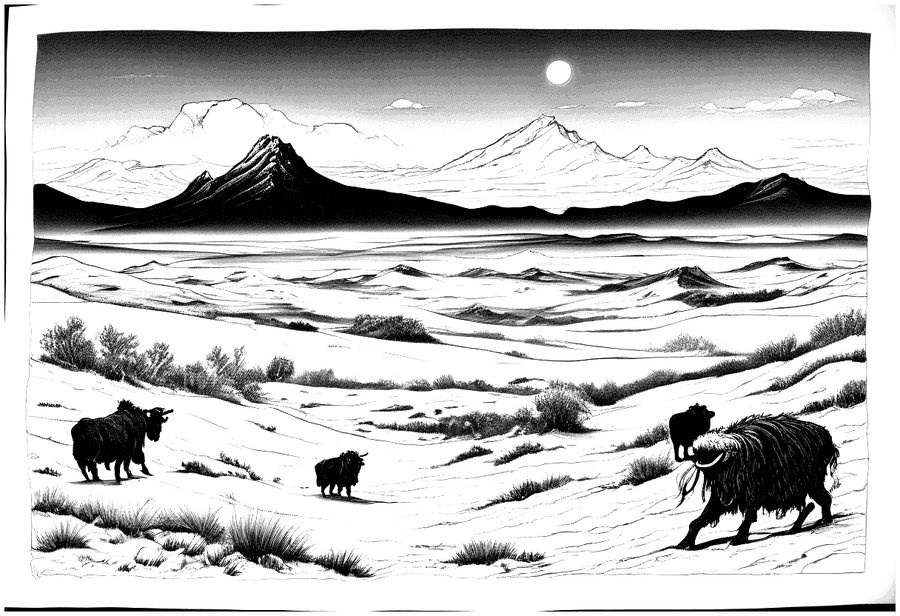
- Feasts
- From Thaw into Mieles the woolly clans come down to the Satorbapios Springs for the Soaking, their great holiday. In Hofjor they keep First Moult, when the clans comb out their winter coats and felt the combings into the year's new tent-walls. Hornday (20 Tunarejo) is kept with pushing contests on the frozen grass. Some clans camp beside the Vengrians at the Sitting of Snow.
- Daily life
- The Woolly Steppe is the cold desert of Hajhia and Balsozhia, all wind, gravel and short grass. The red-brown, shaggy woolly Rhunari live in felt tents and eat millet, mutton and horse-fat. They move camp on sledges that slide on frozen ground in winter and on grass in summer. A camp smells of wet wool and dung-smoke, and its tents are felted from its own people's hair.
- Customs
- A woolly suitor brings a felt rug made from his own combings, and if the family use it the answer is yes. A birth is announced with a single long horn-call. Their dead are buried sitting up and facing the herd, but in winter the ground is too hard, so the dead sit under stone cairns until Thaw, wrapped in their own felt.
- Folklore
- The woolly clans repeat Gongaragho ngawaghaya, 'Do not run from the fire', with a grimace this year, as the Queen's riders burn the grass ahead of the invaders. They say the savanna is where the exiles went. A tent that will not stand on the first try means the clan should not move camp that day.
- History
- In 588 a brawl at the Satorbapios Springs ended in the Pool Peace with the Emperor: separate pools, shared steam. In the Year of Two Winters (817) the woolly herds froze by the thousand, and the clans first sold their service to the Hajhian kings for winter fodder. In 833 they swore to Queen Dorottya, and their horns carry the oath.
- People
- Khaghumu Never-Kneels has vowed to stand at Vasvár until her horn breaks. Khohome Drags-the-Sledge, an elder of ninety, keeps the clans' horn-house tally on the steppe while the fighters are away. Khubumo Breaks-the-Ice, a young bull, carries a Hoarfolk horn-gun against the Hornmoot's law and was turned away from the pools at the Springs this spring.
- This year
- Two Grey Wall companies in Balsozhian pay stand against the woolly clans, so Rhunari will charge Rhunari for the first time in a century. At the Springs the clans found the pools full of wounded Balsozhian riders. Ash from Foleleyme has greyed the eastern pastures, and the clans' sheep have the cough.
- The war
- The woolly clans are sworn to Queen Dorottya and camp on the Lake Shore at Erencszasz, while Balsozhian quartermasters in the occupied north take one sheep in five. Balsozhian riders now call any woolly Rhunari a spy. The clans' herds are driven south at night to save them from requisition, and the old and the calves go with them.
- Market & law
- The woolly clans sell furs to the Norse at Gogur, felt, wool and mercenary service, and take steppe groats and weighed dinars. A felt tent costs 2 cr, and a woolly felt rug 5 sh. Horn-scrip passes between clans as coin. A shaved horn means exile, and a woolly Rhunari caught with a firearm is turned away from the pools and the clan fires.
- Healing
- Hide-rot in wet winters is cured by soaking at the Satorbapios Springs, and spring-salt is rubbed into wounds at 1 d a twist. Winter-black takes the tips of ears and tails. Horn-menders bind cracked horns with copper wire. The clans' shamans set bones with ropes and three helpers, and in the war they need more helpers than they have.
Adventure seed. Khohome Drags-the-Sledge needs the clans' horn-tally carried to Khaghumu at Vasvár before the cannon arrive. The road crosses country the Balsozhians hold.
The Kettle Coast · life & lore
- Feasts
- Kettlemoot (12 Haymonth) is days away: every balloon goes up and the year's best idea is shouted and voted on. Pibbet's Day (9 Ondaria) marks the first flight over Myrnamon in 791, and children go up in tethered kettles. At the end of the monsoon, on Oil-Night, coast families carry oil into the trees for the Green Sleeper, and nobody admits to doing it.
- Daily life
- The Kettle Coast runs through the Kaporesian jungle and wetlands, along the southern Valsiarian shore and across the isles of Tebek. Kettlekin live in shanties stacked six high on stilts over the mangroves. They eat six small meals a day: fried jungle grubs, fish stewed on boiler-tops and sugarcane, with sweet tea from tins. The coast smells of coal smoke, mangrove mud and hot brass.
- Customs
- A new shanty is 'launched' by boiling a kettle on its roof until it whistles. A guest is handed something broken to mend before being fed. Two Kettlekin marry by fixing a machine together, and litters of three are announced with three whistle-blasts. The dead are burned in a boiler at the loudest party of the year.
- Folklore
- Every yard-gang says Zak tak dun vel, 'Six hands make a ship', and counts its crew in sixes. There are a hundred stories about Pibbet Brasswhistle, all different and all true. A green light in the trees means the Sleeper has turned over, and nobody walks inland from Lefka at night.
- History
- The Kettlekin came out of the Kaporesian jungle with scrap and curiosity. In 791 Pibbet rose over Myrnamon on stolen oars, and in 806 the Great Pop blew the roof off the first gas-shed. In 821 Kettlekin crews defected to Tebek with three stolen sky-ships, and in 826 the Hawon envelope-yards burned for three days on leaked gas.
- People
- Zuppa Tinmouth is shanty-reeve of the stilt-town outside Myrnamon and settles disputes by asking who fixed the thing last. Potto Stiltwright builds the stilts and wants the lowest shanties raised another six feet, above the rot. Dattit Patchvalve, envelope-wife of the Hawon yards on Tebek, can sew a gas-bag in a day and wants to be made a captain.
- This year
- The Rot Communion's gardeners have been seen on the upriver tracks, and villages on the Tartonzan burn anyone with mould on their skin. The Teracleanian Dearth has made rice four times dearer. The Boiler Purists say the gas-works are waking Foleleyme, and if they win at Kettlemoot half the sky-fleet may be grounded.
- The war
- Kettlekin crew every sky-ship on every side. Kaporesian Cells run Open Forge hand-gonnes north in hemp bales, so Ortonzanian frigates stop and search every boat. Balsozhian press-gangs take Kettlekin mechanics from the river towns, and the Kushi Admiralty wants Tebek's isles. Kettle-rockets now sell at 10 cr, double last year.
- Market & law
- Kettlekin price everything in brass cogs counted in sixes: six cogs make a boiler, about a shilling. Kaporesian obols and Tebek black doubloons are taken too. Their one law is 'who fixes it owns it'. A thief in a workshop is fined in labour, and a Kettlekin who seals another's valve or hoards a design is thrown out of the workshop moot.
- Healing
- Scalds, lost fingers and boiler-deafness are the wounds of the trade, and every shanty keeps goose-fat and lint. The old get the Rattle, a coal-smoke cough. Marsh ague is dosed with Utturi bark at 1 sh. Anyone showing the Bloom is burned early with fire, and the Thetletown hospital at Myrnamon will not take the infected at any price.
Adventure seed. Potto Stiltwright says the grey-green rot is climbing the lowest shanties' stilts. A healer of the Mercy offers a cure, if someone carries it past the gardeners.
The Glassborn Waste · life & lore
- Feasts
- The Choir rings without stopping, except on the Ash Days, when all three thousand Glassborn fall silent for five days, and the caravans on the edge fast with them. The caravan towns keep the Hearing on 4 Reaping, the anniversary of the first chiming in 622, when no bell may be struck. On the Unspoken Night in Haymonth the edge camps sing without words.
- Daily life
- The Waste is the deep Asrahan desert, sand fused to glass in great swirls in year 0, with no well and no town in it. The Glassborn stand in the sun for days, scour their glass with sand and mend their bronze with metal dug from the dunes. At the centre the towers of Qasr al-Ajras ring like struck bells. At night the glass cracks and pings as it cools.
- Customs
- Two Glassborn with the same ground tone are kin and stand together. When one breaks beyond mending, the Choir rings its fragment back to it until the glass falls silent, then buries the pieces in the fused sand. A Glassborn who hears a stranger repeat a question stops listening to that stranger for ever. Qashari who must cross a corner of the Waste pour a skin of water on the glass first.
- Folklore
- The Choir's proverb is C·C'·C'ˈ | C~D♭~A♭~D♭, 'The glass does not forget', and the caravan-men believe it of every word said near the Waste. Children are told never to answer a chime at night, because it is asking for your name. Drovers say Bretbury lies under the glass, and that a mirage which walks towards you has a mouth.
- History
- The Glassborn stopped when Bretbury burned and stood in the sand for six centuries. In 622 caravans heard chiming at night. In 688 the first Stray reached Qaqah and stood at the Caravan Gate for a year before it rang a word. In 703 the Caliph Rashad sent three hundred riders towards the Gates of Bretbury, and their saddles were found in a line on the glass.
- People
- D-Sixth, a Glassborn with a D ground tone and a motif of C·A, has stood at the Waste's edge facing Zalfamaq for forty years and rung the same chord at every sunrise. Ruqqah al-Bashani, a salt-cutter's widow of Zalfamaq, brings it water each morning out of courtesy and writes down every chord. Nudhaarah al-Rufakhahi, a Successor's Eye, watches the Glassborn from a camp on the edge and reports to Qaqah.
- This year
- Two Strays have crossed the sea and walked north through Orcosia, and the guides say the ring of sentinels at the Gates is one short. Caravan-men say the Choir is ringing higher, which means faster. A caravan of thirty camels vanished between Zalfamaq and Jizayd in Mieles, and its bells were heard for three nights afterwards.
- The war
- The Glassborn serve no side and ignore both Qabahran wars. The Asraha–Mashian War has pushed caravans closer to the Waste, and sentinels have killed six Mashan scouts at the Gates this year. Every faction wants a Glassborn to read the Elder script for it, and none has found one willing.
- Market & law
- The Glassborn take no money. One may answer a single question about the Elder script for a true memory, a song never sung before, or a promise. Choir-glass from broken Glassborn sells for 10 cr in Meedihar and rings when touched, and the Successor-Caliph takes a hand from anyone caught buying it. Crossing the line of the Last Cairn without the Successor's seal is death.
- Healing
- Glass-eye blinds anyone who stands near the Choir at noon without a veil and Qashari kohl. Thirst and sun-stroke kill more than the Glassborn do. A sentinel's wound turns cold and grey, and edge healers pack it with hot sand. Glassborn mend their own cracks by focusing sunlight through their glass to fuse sand into the break.
Adventure seed. In Rocadones D-Sixth rang a new sunrise chord, its first in forty years. Ruqqah al-Bashani will pay 2 mithqal to anyone who stands before it and answers.
The holds at home
The Hoarfolk holds not described elsewhere. Gravdalla Deep and Thousand-Step Hold are under places of note.
Silverhold · life & lore
- Feasts
- Silverhold keeps Wormwake Eve (6 Rostovund) and Surfacing (21 Rocadones) like every hold. Its own feast is Ewe-Day on 9 Hofjor, for the ewe that fell down the sinkhole in 711 and found the silver: a live ewe is lowered into the first gallery on a rope, fed salt and hauled up again to cheering. This year the Old Anvils in the hold refused to hold the rope.
- Daily life
- The hold lies directly under Babadszalkado, so the town's cellars are warm all winter and its wells taste faintly of coal smoke. Hoarfolk eat stone-bread, cave-fish and steppe mutton bought at the town's back gate, and drink grey lichen ale. Vengrian miners work the upper galleries alongside them. The stamp-mill crushes ore day and night, and the whole town has stopped hearing it.
- Customs
- Silverhold is young, and its record wall has room for a hundred delvings, so the hold-line cut its founders' names very large to fill it. Marriages are cut in stone as everywhere, with a silver ring pressed into the mortar of the date. The slow halls are only three galleries deep, and older holds sneer that Silverhold's dead are 'still halfway up'.
- Folklore
- The Open Forge has taken the old saying Kharn bagokh thaz grumrok zâl khoz, 'A gun without thunder-salt is cold iron', as its motto and painted it over the foundry door. Babadszalkado children say a coin dropped down a sinkhole comes back as two. Miners leave a pinch of salt at the sinkhole lip for the ewe, which they say still walks the lowest gallery.
- History
- Silver was struck in 711 by a shepherd chasing a ewe down a sinkhole, and Hoarfolk from Saski Hold founded Silverhold beneath it within a year. In 761 the hold cut a foundry gallery so wide that the town square above sank a foot, and the hold paid for a new church floor. It has never been allowed to forget it. Silverhold cast its first cannon in 790.
- People
- Silver Brôzdis, the hold's assay-mistress, strikes its ingot-marks. She is an Old Anvil in Hold-master Duvra's own hold and has twice refused to stamp Balsozhian silver. Silver Thakdur, a gun-captain, rode the first cannon barge down the Witfordge in Thaw, and his family have stopped answering letters. Pély Dorasz, Babadszalkado's silver-reeve, collects the Queen's tenth and has not been paid himself since Rocadones.
- This year
- The Moot of Anvils votes on expelling the Open Forge in Reaping, and Silverhold is the hold being voted on. Duvra has shut the lower gates to visitors from Old Anvil holds. Since Gravdalla sealed its lower gates, Gravdalla has been buying its marrow-salt from Silverhold, and nobody further up the Hoarspine likes owing Silverhold anything.
- The war
- Silverhold sits under a Hajhian town and sold siege guns to the Hajhian queen's enemy, which makes it the most hated hold in the world this summer. Queen's commissary officers sit at the hold gate and weigh every ingot that comes up, because the Queen needs the silver more than she needs revenge. Townsfolk spit down the vent-shafts.
- Market & law
- Silverhold sells silver, ingot-marks, wheel-lock pistols at 60 cr and, since 833, cannon at 1,500 cr to anyone with a barge. Its ingot-marks should pass for a crown, but Merlish changers now take them at nine shillings. Breaking a hold contract gets the breaker cut into the shame-wall, and Duvra's name has been cut into four other holds' shame-walls this year.
- Healing
- Grey lung and stamp-mill deafness are the usual ailments, and the hold's knitters pack ears with warm wax and ewe's wool. Gunners back from the barges have powder-burn on their forearms, dressed with goose-fat. The knitters will no longer treat humans since the town began spitting, so the town barber sets miners' bones for 6 d and sets them badly.
Adventure seed. Silver Brôzdis has found Balsozhian dinars restruck as Silverhold ingot-marks. She will pay 20 marks to learn who holds the die before the Moot meets in Reaping.
Lenhalas Under · life & lore
- Feasts
- Lenhalas Under keeps Wormwake Eve (6 Rostovund) by sealing a tunnel and checking every old damp-trap. Its own day is Lamp-Day on 14 Thaw, for the black damp of 739: every marrow-lamp in the hold is lit at once at noon and the ninety names are read aloud. Since the monster's tracks were found, the hold also keeps the town's Shutting at the dark of the Lamp.
- Daily life
- The hold lies more than ten thousand feet up in bare tundra, under the human iron town of Lenhalas (about 5,500 people), on ground no realm has claimed. Hoarfolk breakfast on stone-bread, cave-fish and moss porridge, and the town eats mutton and barley. Ore goes down to the furnaces in bucket-ropes. With the night shift stopped, the hold is quiet after dusk, and the quiet frightens people more than the hammering did.
- Customs
- Hold-warden Hordith Dhûrrdunul strikes the mine-mouth with a hammer every morning, and no shift goes in until it rings. Every Lenhalas baby, human or Hoarfolk, gets an iron nail in its swaddling. Marriages are cut on the record wall. The ninety dead of 739 still lie where the damp killed them, behind a wall cut with ninety lamp-niches.
- Folklore
- Smiths here say Skith modarr kharn, 'Iron remembers the forge', and mean that a bad smelt will betray you in battle years later. The Hoarfolk say the Tiszaujfa Monster is the mountain breaking a liar. A marrow-lamp that dims for no reason has smelt the damp or the monster, and either way you should leave.
- History
- In 739 black damp killed ninety miners here, and within ten years every hold had replaced open flame with marrow-lamps. Lenhalas Under was the last to give up tallow, out of grief. In 808 the iron-master Dory Mos opened a seam in the Tiszaujfa hills, found a cave of child-sized bones, sealed it and told nobody. The tracks were first seen the year the seam closed.
- People
- Lenhal Gorrdis, the hold's chief knitter, treated the hill farmer who lost an arm in Rostovund and has kept the bandages, which she will show to nobody. Lenhal Brakdur keeps the shift-bell and wants the night shift restarted with a gunner at every adit. Lozh Tos, the Vengrian hunter after the 500-crown bounty, drinks in the town and asks the Hoarfolk for maps they will not give him.
- This year
- The night shift has stopped since the tracks were found in the spoil, and two children have gone from the hill farms since Mieles. The iron-miners offer 500 crowns for the monster's head. The hold has added 50 ingot-marks of its own, provided the head is brought to the record wall to be measured.
- The war
- Lenhalas stands on unclaimed ground past Hajhia's border, but its iron goes to Queen Dorottya, and Hajhian quartermasters wait at the furnace door. The stopped night shift costs her army a third of its supply. Balsozhian agents have been seen in the town, and the hold suspects them of spreading monster stories. Lenhalas Under is an Old Anvil hold and sells iron, not guns, which it says is a different thing.
- Market & law
- Iron bars sell at 2 crowns, double the price before the night shift stopped. Salt is 10 d a pound and more in winter. Wages are paid in ingot-marks and hacksilver. Anyone the hold's watch has to fetch back from the hill road after dark is fined a day's pay for the trouble.
- Healing
- The knitters cauterise torn wounds with hot iron, and the town barber charges 6 d for anything less. Grey lung and furnace-eye, a red weeping eye from the smelt-glare, are the trade's ailments: furnace-eye is washed with cold tea and the sufferer moved to the day shift. Lowlanders get sky-sickness at this height and are given climber's leaf or sent back down.
Adventure seed. Lenhal Brakdur says the shift-bell rang by itself on the Lampless night, from inside the walled gallery of 739. He wants someone in there before Hordith hears.
Saski Hold · life & lore
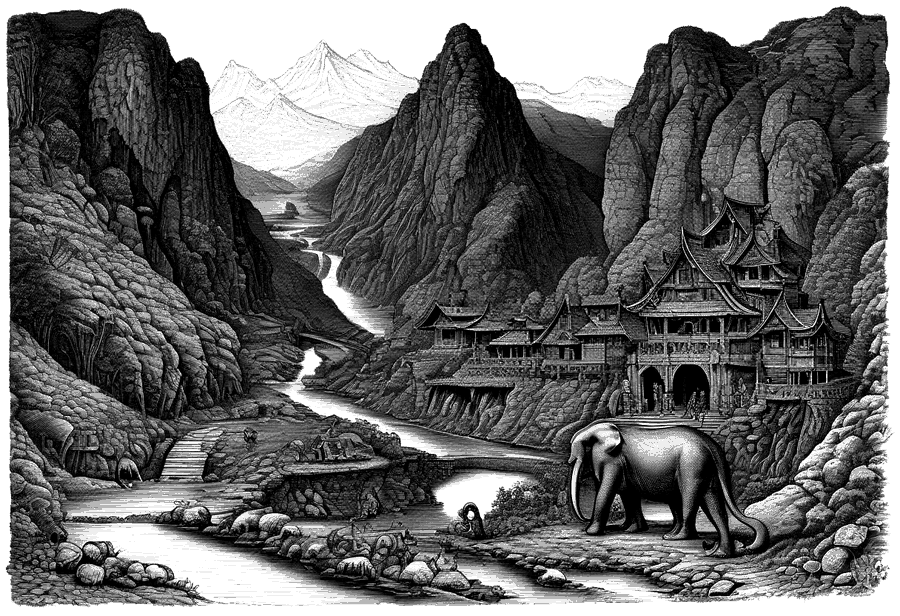
- Feasts
- Saski Hold keeps Wormwake Eve and Surfacing, and also keeps the Soumi Silent Days. On the 10th, 20th and 30th of every month no hammer strikes, under the Quiet Clause agreed with the princes of Valsiaria. On the Long Silence (20 Thaw) the stamp-mills stop for the day and Hoarfolk play staring contests at sunset against Soumi judges, and usually lose.
- Daily life
- The hold is cut under the silver town of Saski, seven thousand feet up in beech forest. Hoarfolk and Soumi miners share the upper galleries and a canteen serving stone-bread, cave-fish, Soumi rye and elk sausage. Elephant teams haul the silver down to the Market of Marks in Valsiari. On Silent Days the hammers are wrapped in felt, and everyone talks in the miners' hand-signs.
- Customs
- Soumi families who have worked the seam for three generations are taken in as 'surface kin', and their names are cut on the record wall in a column of their own. Marriages are cut in stone. Soumi miners who die in the galleries are carried up and buried under the beeches in silence, and the Hoarfolk bearers stop hammering for the day.
- Folklore
- Saski's saying is Ûrgald torg, 'The stone does not lie', and the hold claims it for the purity of the elephant mark. Soumi children believe the Hoarfolk can hear a lie through rock, so they tell their lies outdoors. A miner who speaks in a gallery on a Silent Day will hear the mountain answer, and should not answer back.
- History
- The Saski seam was opened by the Hoarfolk of Saski Hold together with the Soumi crown, and the very pure elephant mark has been struck from it ever since. The Quiet Clause dates from 590, when a prince fined the hold for hammering on a holy day and the hold paid in silence, which impressed everybody. In 712 Saski miners went north and founded Silverhold.
- People
- Saski Dravdis, the hold's mint-warden at the Market of Marks, has never let a light coin out of her hands. Saski Thorruk, the hammer-master, asked the hold-line to suspend the Quiet Clause for the war orders and was out-stared at the hearing. Ruusa Kelvonen, a Soumi elephant-driver, hauls the silver-carts and wants the hold to pension her elephants.
- This year
- The Ulgan Fault has cracked two galleries since Thaw, and the Soumi miners are refusing to go below. Manttamite crusaders marched through Saski drumming on a Silent Day, and the hold answered by striking every hammer at once; both sides call it a victory. Saski is an Old Anvil hold and will vote in Reaping to expel the Open Forge of its own daughter-hold.
- The war
- Valsiaria refuses to fight, so Saski silver is the most neutral money on the continent, and both alliances want elephant marks to pay mercenaries. Balsozhian recruiters have been fined in the Market of Marks for speaking. Kaporesian Cells float Open Forge hand-gonnes north on timber rafts past the hold, and Saski's wardens seize them and tip the powder in the river.
- Market & law
- The elephant mark (1½ sh) is coined from Saski silver, and the hold takes no interest, following Valsiarian law: it shares profits instead. Salt costs 10 d a pound. Shouting in the hold on a Silent Day costs 2 marks, paid in silence. Clipping a mark is punished by exile, which the Hoarfolk carry out by sending the clipper up.
- Healing
- Grey lung retires miners at sixty to the beech terraces, where Soumi druids feed them honey and leave them alone. This year's quakes have kept the knitters busy setting crushed legs by marrow-lamp. Carters bring marsh ague up from the south, and the herb-wives in Saski sell Utturi bark for it at 1 sh a dose.
Adventure seed. A quake crack has opened into a gallery that is not on Saski's record wall. The hold-line wants it explored on a Silent Day, by someone who can keep silent.
Sunhold · life & lore
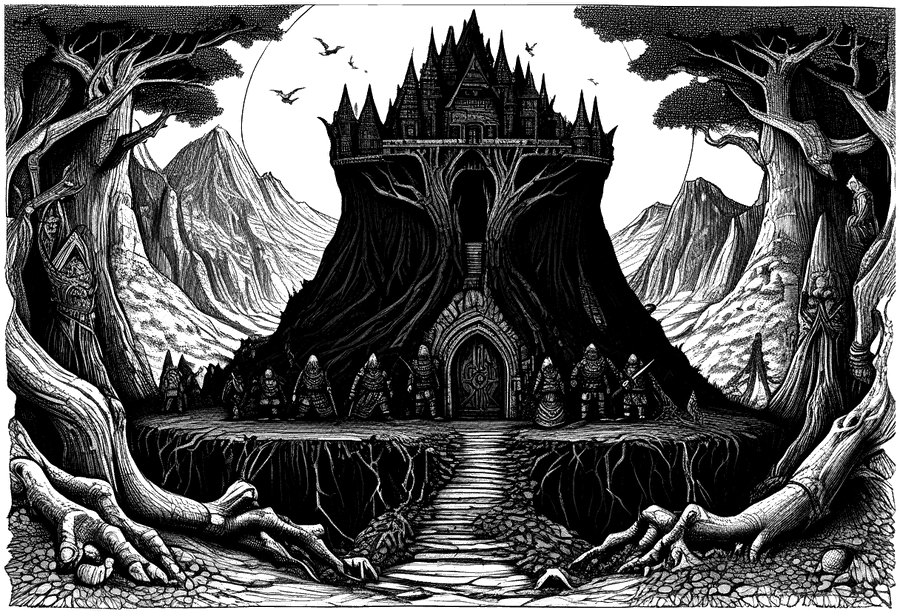
- Feasts
- Sunhold keeps Wormwake Eve on 6 Rostovund, and this year sealed two tunnels instead of one, both facing Ember Deep. On the longest day it keeps Sun-Sealing and walls up any gallery that has run too close to the Crown's summit. At Groving (18 Hofjor) the Hoarfolk plant saplings with the highlanders of Takabukha below, which they find baffling but polite.
- Daily life
- The hold opens on the slopes above Takabukha, and its deepest galleries run east under the roots of the Sunward Crown. Hoarfolk eat stone-bread, Kavarri goat's cheese and figs, which the children love and the elders call 'surface sweets'. Since the Lit, cold iron hangs on every door, everyone sleeps in shifts so someone is always awake, and miners no longer sing at work.
- Customs
- Sunhold has cut the names of Ember Deep's lost into its shame-wall, a mourning and an insult at once. Children now recite twice that deep digging feeds the dragons' dreams. Marriages are cut in stone. Kahpian law holds any oath sworn on the hold's open terrace binding for life, because the terrace is in sight of the Crown.
- Folklore
- Miners say Kârd torg drakost gor skalk dath, 'The stone sings when you strike it', but since the Lit nobody strikes stone just to listen. Sunhold believes the Lit can hear through rock. The herders below say the hold's vents glow when Ankhorra turns over, and Sunhold blames Ember Deep.
- History
- Sunhold was cut into the Crown's roots long before the calendar, and its record wall lists sixty delvings. In 700 Ankhorra was seen over Shahpabad and the Long Sleep began; the wall records the day as 'the sky emptied'. Until last winter Sunhold and Ember Deep kept a joint ingot-mark trade, and it ended mid-shipment, with half the bars still on the road.
- People
- Stîrdis of Sunhold, the trade-mistress, sells steel to Shahpabad and to Jowshia in the same week. Sunhal Bramdur, the gate-captain, has doubled the guard and hung cold-iron chains across the Ember road. Derith Zokgrokul, a Sunhold engineer, sits at the lowest wall with a slate and copies down the Last Shift's tapping.
- This year
- Sunhold has sold more steel this year than ever before. Its traders are buying Kahpian dye-root by the cartload, and nobody knows why miners want magenta, though the knitters say it shows up glowing veins. The Wyrmwatch say Ankhorra moved on the summit during the Comet of Thaw, and the hold has added a second watch on Sun-Sealing.
- The war
- Haruwayha and Kahpia fight Jowshia and Al Tubar, and Sunhold sells steel to both, which the hold calls neutrality. Envoys from both camps have climbed with promises for the dragon, and Sunhold has turned every one back at the gate. Every Sunhold blade sells for a third more than last year, and the mule-trains are taxed for the war at the foot of the road.
- Market & law
- Sunhold steel sells for 3 siglos a pound at the foot of the Crown, and a Sunhold sword costs 50 siglos in Shahpabad. Ingot-marks are taken everywhere in the foothills. Breaking Ember Deep's seals means Hoarfolk banishment and Kahpian law both, and Sunhold pays 50 cr for proof of Delve-Master Kord's death. Marrow-bound blades are forbidden in the hold, and are sold out of it all the same.
- Healing
- Grey lung sends miners to the surface terraces at sixty. Marrow-burned miners who escape Ember Deep are wrapped in cold-iron chain, and the healers sit with them in shifts, talking, so they do not forget their names. Sun-blindness on the snow is treated with kohl and dark cloth, and glass-eye salve comes up from Baljedah at 3 sh a pot.
Adventure seed. Sunhal Bramdur has found a fresh tunnel mouth below Sunhold's lowest gate, cut from the far side. The tool-marks are Ember Deep's, and they are less than a month old.
Ember Deep · life & lore
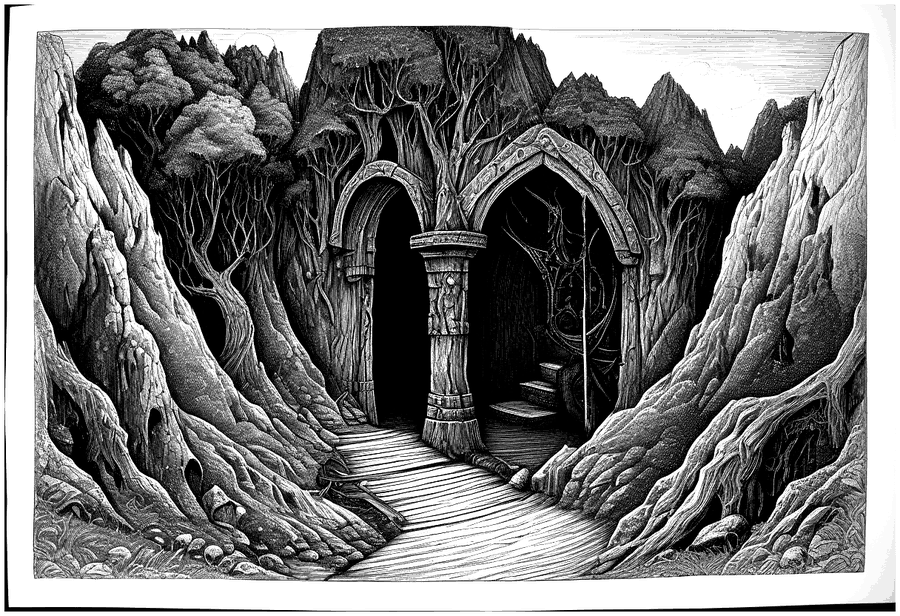
- Feasts
- Ember Deep kept no feast this year that anyone saw. Its Wormwake Eve tunnel was never sealed, so Sunhold sealed two of its own instead. On the 6th of every month the Last Shift taps the old Wormwake prayer, Ûrkhakhê, 'Do not wake', through the rock. The Lit keep no calendar, since they do not sleep.
- Daily life
- Nobody outside knows how the hold lives now. Traders at the gate hear hammering day and night and see a light in the vents, and the marrow-wraith they call the Lamp shows there every night. A camp of Sunhold watchers and Kavarri goatherds sits below the gate, more than ten thousand feet up in cold desert, living on goat's cheese and hot salt broth.
- Customs
- The Lit keep no Hoarfolk rites and no longer remember their names. Sunhold has cut those names into its shame-wall instead. Skand Mokzâlul leaves food at the gate at every shift-change and finds it taken. Hoarfolk passing the gate turn their faces from it and say nothing, as they would at a burial.
- Folklore
- The saying in every Sunward gallery is 'Dig for the marrow, find the Worm.' The Last Shift's most famous message, 'We have found the bottom, and it is looking up', is now repeated by Shahpabad broadsheet-sellers and Sunhold grandmothers alike. Kavarri goatherds say the Lit are the Sun-Coil's dreams wearing Hoarfolk skin.
- History
- Ember Deep was cut as a marrow-hold, and its Marrow-Delvers sold to Bretborn riflemen and Kettlekin gas-works. In 829 they broke into the Cold Garden, a seam where marrow-salt grew like ice on the walls, and the first miners to breathe its dust worked three shifts without rest and were praised for it. Last winter, under Delve-Master Kord, the hold sealed itself from the inside.
- People
- Delve-Master Kord leads the Lit, if he still lives. Ember Nurdis, a shift-foreman of the Last Shift, signs every tapped message with her name and a shift-count, which has reached 1,100 without a gap. Ember Khaldur, a Wraith-Caller, walked out of a vent in Mieles, sold three marrow-bound blades in Takabukha and glows faintly in the dark.
- This year
- Hammering goes on through the rock, and a light shows in the vents at night. The Last Shift taps for rescue and names the galleries where they are hiding. The Wraith-Callers sell marrow-bound blades through Sunhold smugglers, and the camp at the gate has doubled since the Comet of Thaw, mostly with people who want to buy one.
- The war
- Marrow-salt is in demand from Bretborn riflemen and Kettlekin gas-works, and since Ember Deep went dark the 2 cr rifle-pinch costs 3 cr in Meedihar. Kahpian and Jowshian envoys have both offered to buy the hold's seams from whoever can open it. The Haruwayhan garrison of Al Haf refuses to post men at the gate, and the Grey Walls say they would rather fight the Lit than fight unpaid.
- Market & law
- Before the sealing Ember Deep sold marrow-salt at 5 cr a pinch, licensed or not. A vein-crystal cut from one of the Lit fetches a fortune in Meedihar, and marrow-salt shot costs 1 cr a ball. Hold law sends up to the surface anyone who digs too deep; the Lit went down instead. Breaking the seals means banishment and Kahpian law both.
- Healing
- Marrow-burn comes out with every escaped miner: glowing veins and burns from inside. The cure is rest and cold iron against the skin. Those who stay too long by the vents begin to glow and stop sleeping. The camp's only healer wraps them in chain and makes them say their names aloud each hour.
Adventure seed. Ember Nurdis's last message jumped from shift 1,100 to 1,103. Derith Zokgrokul wants to know what happened in the missing three shifts, and who is tapping now.