Rules of play
Coin and banking, guns and sky-ships, weapons, monsters, the hazards of the road, honour and shadow, thieves, and talking your way out.
On this page
Coin, jewels & banking
Most of the Flokburgh Continent reckons money by the Shifton Standard, set by the Merlish counting-houses and accepted by every money-changer between Fagervik and Myrnamon. Qabahran coin and paper are taken in the bigger ports at the rates below. Fifty coins weigh one pound.
Regional coin
| Coin | Metal | Issued by | Worth in crowns | Notes |
|---|---|---|---|---|
| Gold crown | Gold | Merland | 1 | The standard. Stamped with a ship. |
| Horse-dinar | Gold (debased) | Balsozhia | 0.7 | Once worth 1.2 crowns. The Emperor has thinned the gold to pay for the war, and changers weigh every one. |
| Sun-real | Gold | Orcosia | 1.1 | Struck in the temple mint at Orcos. Refusing one is an insult to Rocadones. |
| Elephant mark | Silver | Valsiaria | 0.15 | Saski silver, very pure. Worth a shilling and a half. |
| Steppe groat | Silver | Hajhia | 0.08 | Babadszalkado silver. Wartime refugees now carry it everywhere. |
| Hacksilver | Silver by weight | Raugaria, Kovavikia | 1 per ounce | The Fagervik priesthood mistrusts stamped coin. Raugarians cut silver rings and weigh the pieces. |
| Obol | Bronze | Kaporesia | 0.005 | Half a penny. Also placed on the eyes of the dead. |
| Mithqal | Gold | Asrahan Caliphate | 1.3 | The heaviest gold coin in the world, struck with the seal of the Successor. |
| Company note | Paper | Mashan Trade Company | 9 | Printed at the Sea Exchange in Meedihar with a face value of 10 crowns. Worth the full 10 only in Company ports. |
| Siglos | Silver | Kahpia, Sag, Jowshia | 0.12 | Stamped with an elephant. Jowshian siglos are struck light, so Kahpians refuse them. |
| String of cash | Bronze | Kushi, Ritata | 1.5 | A thousand pierced bronze coins strung on a cord. Sailors pay by cutting the string. |
| Ingot-mark | Silver bar | The Hoarfolk holds | 1 | A finger of silver stamped with a hold-rune. Never debased in four hundred years, and accepted everywhere. |
| Cog | Brass | Kettlekin | 0.02 | Toothed brass coins counted in sixes. Six cogs make a "boiler", worth about a shilling. |
| Black doubloon | Gold (recast loot) | Free Captaincy of Tebek | 0.8 | Melted prize-gold, stamped with a lantern. Full weight, but changers pay less for the smell of the gallows. |
| Horn-scrip | Carved horn | Rhunari | — | A debt carved on a sliver of horn. No Rhunari has ever defaulted on one, so merchants trade them like coin. |
Money-changers take 5% of the value, or 10% outside cities and in wartime. A coin that has been clipped is called a weeping crown.
Money-changer's reckoner
Jewels & precious things
Gems are the traveller's wealth: light, hidden easily, and good in any market. Ilbarescia and Igyoszavas mine gemstones, the Hoarspine yields rock crystal, and pearls come from the Kaporesian reefs. Appraisers grade stones in six tiers.
| Tier | Grade | Typical value | Examples |
|---|---|---|---|
| 1 | Trinket | 5 cr | Agate, jet, river-garnet |
| 2 | Ornamental | 25 cr | Amber, moonstone, Hoarspine crystal |
| 3 | Fine | 100 cr | Pearl, amethyst, topaz |
| 4 | Precious | 500 cr | Ilbarescian emerald, black pearl |
| 5 | Jewel | 1,000 cr | Flawless ruby, star sapphire |
| 6 | Crown jewel | 5,000+ cr | Elder Crown gems, which glow faintly in the dark |
Banks & lending
The counting-houses of Shifton
The great banks are Merlish: Calloway & Daughters, the Lantern Bank of Torkburgh and the Guild of the Scales in Macham. They take deposits (1% a season for keeping), lend at 12–20% a year, and write letters of credit that can be cashed at branch houses in Shifton, Macham, Torkburgh, Shifract, Orcos and Valsiari. A letter is useless without its countersign, a password agreed at the branch where it was written.
Other ways of keeping wealth
Temple treasuries. The Sun Treasury of Orcos keeps gold in exchange for a tithe of a tenth. Silent partnerships. Valsiarians forbid interest, so the lender takes a share of profit instead. Horse-wealth. A Vengrian measures wealth in horses, about 12 crowns each for a riding horse. Hacksilver hoards. Raugarians bury silver, and old hoards are one of the most common treasures in the west.
The Sea Exchange of Meedihar
Across the sea, the Mashan Trade Company is a realm run like a counting-house. Its Sea Exchange in Meedihar prints paper notes, sells shares in ships (50 crowns buys a share in a Kushi convoy and a tenth of what it brings home) and writes sea-loans that are repaid only if the ship returns. Calloway & Daughters keeps an agent in Meedihar, so a Merlish letter of credit can be cashed there, at a price, after a wait.
What things cost
| Item or service | Price | Item or service | Price |
|---|---|---|---|
| Meal at an inn | 4 d | Night at an inn (common room) | 5 d |
| Private room and stabling | 2 sh | Provisions for a day | 5 d |
| Lantern and oil | 6 sh | Rope, 50 feet | 1 sh |
| Riding horse | 12 cr | Warhorse | 80 cr |
| Passage on a coastal ship | 1 sh / day | Mercenary (per day) | 2 sh |
| Healing at a temple | 5 sh per wound | Bribe for a gate guard | 5 sh–2 cr |
| Potion of healing | 25 cr | Lockpicks (thief's roll) | 3 cr |
Powder, sail & marrow
Kidaneland is two centuries into an age of invention. Swords still decide most fights, but guns decide sieges, banks decide wars, and the sky has been crossed by people three feet tall.
- 612Thunder-salt. Hoarfolk alchemists at Gravdalla Deep mix saltpetre, charcoal and marrow-dust and blow the roof off a gallery. Within fifty years every Hoarfolk hold has cannon.
- 680sThe hand-gonne. Hoarfolk matchlocks reach human armies through the Powder Moot's licensed sales.
- 760Paper money. The Mashan Trade Company prints its first notes at the Sea Exchange.
- 791Flight. Pibbet Brasswhistle rises over Myrnamon in a kettle-balloon.
- 799The Lamp of the Chain is lit, opening the island road to Qabahrah to year-round sailing.
- 803The sparklock. Mistwood Bretborn light a firearm with marrow-salt instead of flint.
- 805–812The Sky-Docks of Kamiechia are built. The first sky-lane opens, Kamiechia to Shifton.
- 821Sky-piracy. Kettlekin crews defect to the new Free Captaincy of Tebek with three stolen sky-ships.
- 833 · nowCannon against walls. The Open Forge sells siege guns to Balsozhia. For the first time, human guns will batter a human capital.
Who has what
| Power | Firearms | At sea | In the air | Magic |
|---|---|---|---|---|
| Hoarfolk | Cannon, hand-gonnes, the best powder | None | None; they call it "falling slowly" | Rune-forging, marrow-lamps |
| Bretborn | Sparklock rifles, the finest guns made | Small, fast coastal ships | None, by choice | The most learned casters alive |
| Kettlekin | Kettle-rockets, scrap pistols | Pirate sloops | Every sky-ship in the world | Pressure-charms |
| Kushi | Fire-lances, bought hand-gonnes | The largest war-fleet in the world | Twelve chartered sky-ships | Shrine-priests |
| Merland, Ortonzania | Licensed cannon, wheel-lock pistols | Galleons; Ortonzania's navy is the strongest in the north | Two Company-built mail ships | Church miracles |
| Mashan Trade Company | Bought arquebuses | Merchant dhows and convoys | Four sky-ships, with Kettlekin crews | Little |
| Balsozhia, Hajhia | Almost none until this year; the horse-lords despise guns | A few northern cogs | None | Shamans |
| Raugaria | Few; the Hunt prefers the longbow | Longships | None | Hunt-priests |
| Asrahan Caliphate | Few; desert cavalry and archers | Dhows | None, and suspicious of them | Well-keepers; Elder relics |
| Kahpia | Bought cannon mounted on elephants | River barges | None | Elephant-priests |
| Free Captaincy of Tebek | Whatever it has stolen | Pirate sloops and brigs | Seven sky-pirate ships | Kettlekin charms |
Firearms
A firearm takes a round to aim before its first shot. Each shot is a test of SKILL (roll 2 dice; succeed on a total equal to or less than your SKILL). A hit does the damage shown, and armour counts for half its rating against shot (round down). Firearms are loud: every enemy within earshot hears the first shot.
| Weapon | Tier | Made by | Price | Damage | Reload | Rules |
|---|---|---|---|---|---|---|
| Hand-gonne (matchlock) | 2 | Hoarfolk | 20 cr | 4 | 2 rounds | Misfires on a double 1. In rain it will not fire at all. |
| Arquebus | 2 | Licensed human foundries | 30 cr | 4 | 2 rounds | Misfires on a double 1 or 2. |
| Wheel-lock pistol | 3 | Macham, Hoarfolk | 60 cr | 3 | 3 rounds | Can be fired the round it is drawn; works in rain on a 1–4 on one die. |
| Sparklock rifle | 4 | Mistwood Bretborn | 800 cr, if they sell | 5 | 2 rounds | Never misfires. Uses one pinch of marrow-salt (2 cr) per shot. |
| Fire-lance | 2 | Kushi | 8 cr | 3 | Single use | A powder tube on a spear: one blast, then a spear. |
| Kettle-rocket | 2 | Kettlekin | 5 cr | 2d6 ÷ 2 | Single use | Roll 1 die: on a 1 it goes somewhere else. Sets fire to rigging and balloons. |
| Cannon | — | Hoarfolk; Macham under licence | 1,500 cr | 10 | 5 rounds | Siege and ship weapon. Breaks walls, gates and sky-ship envelopes. |
Rhunari cannot fire pistols or hand-gonnes; their fingers are too broad for the locks. Some woolly clans carry Hoarfolk "horn-guns", heavy arquebuses with a horn-shaped butt, and they despise themselves for it.
Ships
| Ship | Sailed by | Miles a day | Crew | Notes |
|---|---|---|---|---|
| Longship | Raugaria, Kovavikia | 80 | 40 | Oars and sail; beaches anywhere |
| Cog | Northern traders | 70 | 12 | Slow, cheap, everywhere |
| Galleon | Merland, Ortonzania | 90 | 200 | Twenty to forty cannon; the queen of the northern seas |
| War-junk | Kushi | 95 | 150 | Battened sails, watertight compartments, fire-lance crews |
| Dhow | Qashari, the Company | 100 | 25 | Fast with the monsoon; the merchant ship of the south |
| Galley | Kaporesia | 60 | 120 | Rowers, a ram, and a habit of hugging the coast |
| Pirate sloop | Tebek | 110 | 30 | The fastest thing on water |
Sky-ships
A sky-ship is a hull slung beneath one or more envelopes of oiled silk. The oldest lift with hot air from a coal boiler; the newest are filled with marrow-gas from the vents of Foleleyme, which lifts five times as much and burns like the sun if it catches. Every sky-ship in the world was built, or is crewed, by Kettlekin.
| Sky-ship | Lift | Miles a day | Crew / passengers | Price | Notes |
|---|---|---|---|---|---|
| Kettle-skiff | Hot air | 120 | 2 / 2 | 400 cr | One envelope, a basket and a boiler. Lands anywhere, often unintentionally. |
| Lantern-brig | Marrow-gas | 200 | 12 / 20 | 6,000 cr | Three envelopes; the workhorse of the sky-lanes |
| Sky-junk | Marrow-gas | 180 | 30 / 60 | 20,000 cr | Kushi's lacquered warships, with fire-lances and rocket racks |
| Pirate kite | Hot air and gas | 220 | 8 / 4 | stolen | Stripped-down Tebek raiders that drop on ships from the clouds |
Sky-lanes
Six regular routes, flown by chartered Lanternwrights: Kamiechia–Shifton, Shifton–Myrnamon, Myrnamon–Lantern Cove (by the pirates), Lantern Cove–Meedihar (also by the pirates), Meedihar–Kamiechia, and Kamiechia–Balsozha, which opened last year and which Merland would dearly like closed. A passage costs 1 crown per hundred miles.
Sky hazards
Storms: test your LUCK or be blown 1d6 × 20 miles off course. Fire: a rocket or cannon hit on a gas envelope, if you fail a LUCK test, brings the ship down in flames. Boarding: sky-pirates drop on ropes; fight with −1 Attack Strength until you are on a deck. Dragons: no sky-ship has met one awake. Every crew expects to.
Road engines
A few steam engines now run on roads, and they are the newest thing in the world. They are rare, slow and temperamental, and they need a Kettlekin mechanic riding with them. Only the strongest power and the richest houses have any. Most people have never seen one, and horses hate them.
| Engine | Who has them | Miles a day | Crew | Price | Notes |
|---|---|---|---|---|---|
| Road-kettle (steam carriage) | The Prince of Kushi, the Board of Nine, Calloway & Daughters and two other Shifton banks | 60 | Driver-mechanic and up to 4 passengers | 3,000 cr | About a dozen exist. 12 mph on a good road, none at all off one. Breaks down on a 1 on one die each day. A status symbol first and transport second. |
| Iron Tortoise (land-ironclad) | Kushi only: three, guarding the Kamiechia ridge | 25 | 8 | not sold | Riveted iron shell, one light cannon, armour rating 6. Built by the Lanternwrights with plate the Hoarfolk deny selling. Cannot cross soft ground or most bridges. |
| The Kettle-Fort (prototype) | Merland: one, in the Macham Foundry Ward | 0 | 20 | — | Three chimneys, four cannon and an unpaid foundry bill. It has never left the shed. The Moot argues every month about whether to finish it before Balsozhia's siege guns arrive. |
Marrow: how magic works
Magic is the marrow of the Worm, a cold power that seeps up through the land. It pools in ruins, old bones, sacred forests and deep seams, crystallises underground as marrow-salt and escapes from volcanic vents as marrow-gas. Anyone can learn to draw on it, at the cost of their own strength. Most never do.
| Tradition | Practised by | What it does | Cost and limit |
|---|---|---|---|
| Temple miracle | Priests of every faith | Healing, blessing, warding, curses | STAMINA, plus the god's favour: a priest with more SHADOW than HONOUR finds their prayers unanswered |
| Lanthe sorcery | Bretborn mages, a few human scholars | Illusion, fire, binding, far-speech | STAMINA; the most powerful spells need marrow-salt |
| Rune-forging | Hoarfolk smiths | Weapons and armour of tier 4, marrow-lamps, locks that cannot be picked | Months of work and a pound of marrow-salt per rune |
| Shamanic trance | Vengrian, Halmi and Tallian shamans | Speaking with spirits and ancestors, weather, finding the lost | Hours of trance; the shaman cannot act while it lasts |
| Pressure-charms | Kettlekin | Making machines work beyond their design, briefly | 1 STAMINA, and the machine may explode on a double |
| Hedge-craft | Village wise-folk everywhere | Small luck, small cures, small curses | 1 STAMINA; nothing large |
The price nobody pays yet. Kjelheim priests and the oldest Hoarfolk say the marrow is the Worm's own dreaming, and every pinch of salt burned in a sparklock or a gas-envelope feeds the dragons' dreams. Since the sky-ships began drawing gas from Foleleyme, Foleleyme has begun to smoke. Nobody in Shifton or Kamiechia wants to hear it.
Weapons & armour
The gamebooks use three scores, rolled at the start: SKILL (1 die + 6), STAMINA (2 dice + 12) and LUCK (1 die + 6). In combat each side rolls 2 dice and adds SKILL to find its Attack Strength; the higher total wounds the other. Weapons are graded in tiers, and each tier adds to Attack Strength and to the damage of a hit.
| Tier | Name | Attack | Damage | Price | Examples |
|---|---|---|---|---|---|
| 0 | Improvised | −2 | 1 | — | Chair leg, torch, broken bottle, bare fists |
| 1 | Common | −1 | 2 | 5 sh–2 cr | Dagger, club, hunting spear, sling, quarterstaff |
| 2 | Soldier's | 0 | 2 | 5–15 cr | Sword, war axe, mace, shortbow, crossbow |
| 3 | Fine | +1 | 3 | 40–120 cr | Raugarian longbow, Orcosian sun-falchion, Merlish arbalest |
| 4 | Named | +2 | 3 | 500+ cr | Hoarspine-steel blades, rune-cut axes of Gogur |
| 5 | Relic | +3 | 4 | priceless | Elder Crown weapons: each has its own name, history and will |
For guns, from the Hoarfolk hand-gonne to the Bretborn sparklock, see powder, sail & marrow.
Armour
Armour has a rating. When you are hit, roll one die; if the roll is equal to or less than your armour rating, you lose 1 STAMINA less (never less than 1 in total).
| Armour | Rating | Price | Cost of wearing it |
|---|---|---|---|
| Padded jack or furs | 1 | 2 cr | None |
| Leather or brigandine | 2 | 10 cr | None |
| Mail hauberk | 3 | 60 cr | −1 to sneak and swim rolls |
| Plate harness | 4 | 400 cr | −2 to sneak, swim and climb; cannot be worn in jungle heat for long |
| Steam harness (Boilerguard of Kushi only) | 5 | not sold | −3 to sneak, swim and climb; +2 damage with heavy weapons; runs one hour per sack of coal; on a double 1 in combat the boiler bursts (lose 4 STAMINA) |
| Shield (add to any) | +1 | 3 cr | Needs one hand |
Regional weapons
| Weapon | Tier | From | Special |
|---|---|---|---|
| Steppe horse-bow | 2–3 | Balsozhia, Hajhia | Can be fired from horseback without penalty |
| Raugarian longbow | 3 | Raugaria, Kovavikia | Shoots first at range: one free hit before melee begins |
| Orcosian sun-falchion | 3 | Orcosia | +1 damage against undead when blessed by a Fuempild priest |
| Elephant goad-lance | 2 | Valsiaria | Long reach: +1 Attack Strength in the first round |
| Merlish arbalest | 3 | Merland | Pierces mail: ignore armour rating 3 or lower; a round to reload |
| Kaporesian trident | 2 | Kaporesia | Can disarm: on a double, the foe drops its weapon |
| Qabahran watered steel | 4 | Forged in Kahpia, sold in Meedihar | The only tier-4 blade you can simply buy (600 cr at the Sea Exchange). Never rusts. |
| Asrahan camel-lance | 2 | Asraha, Al Tubar | +1 Attack Strength when charging on camelback; horses facing camels fight at −1 |
| Kushi longbow | 3 | Kushi, Ritata | Can be shot kneeling in a boat without penalty |
The knightly orders at home
The Sunlancers · life & lore
- Feast days
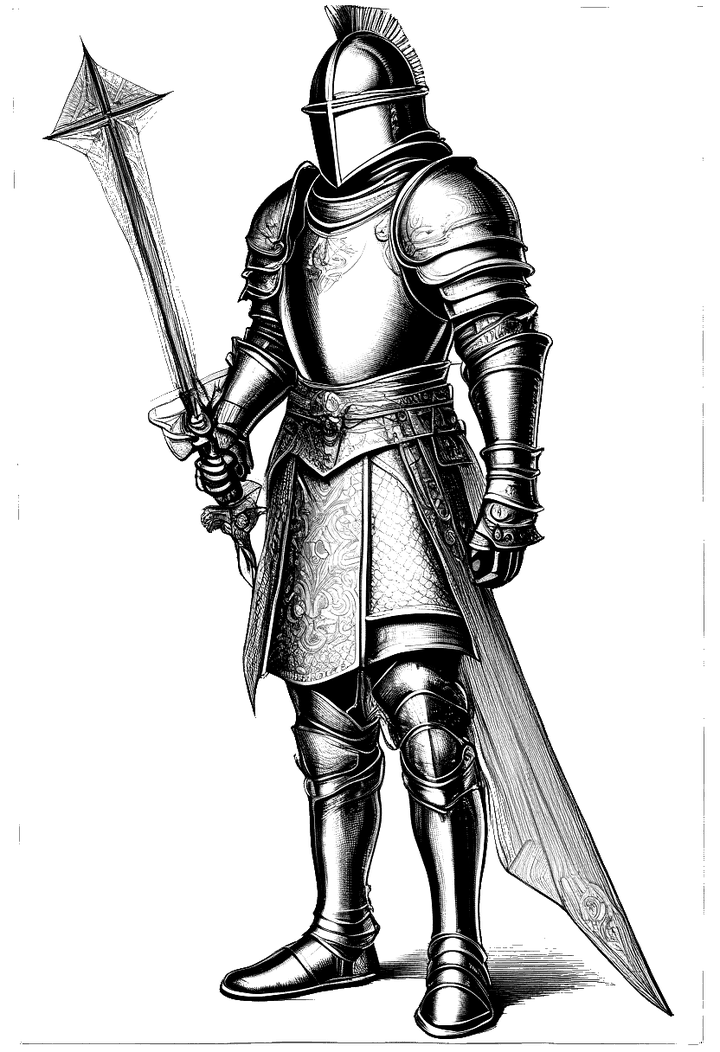
- Lionsday (21 Rocadones) is the order's great day. The knights stand in full plate on Lion Hill from dawn to dusk of the longest day and charge past the Lion-Pontiff at noon. On Burnishing Day (3 Mieles) every knight polishes his plate with white Orcosian sand until he can read a letter in it. The Ash Days fast is kept in armour.
- Daily life
- A Sunlancer rises before dawn, hears the Lion's prayer and burnishes his plate with sand and chalk for an hour. Mornings are lance-drill on Lion Hill, and at noon the temple bell stops everything. The order eats bean stew, flatbread with honey and watered red wine. After sunset a knight does nothing martial at all; nights are for confession, letters and sleep.
- Oaths & rites
- A squire spends the night before his knighting in an unlit chapel, unarmed, to learn what the Lion cannot see, and swears at noon never to strike in darkness. A knight who breaks the vow has the Lion on his shield painted over with soot and walks barefoot through Orcos at noon. The dead are buried at noon facing east, with a burnished helm, and the rest of the plate goes back to the order.
- What they say
- Orcosians say 'A Sunlancer's war ends at sunset', and every enemy of Orcosia plans accordingly. The order's spurs are engraved Luedeo detoso sue zila, 'A good name is gold.' Children believe a Sunlancer's breastplate shows a liar's face in red, and the knights do not discourage it.
- History
- The order began during the Grey Sweat, in 346, as the Lion's Lanterns: riders who carried the sick out of plague villages at noon, when the Lion could see them, and buried the dead. In 512, after the Ilbarescian schism, the Sun Treasury mint was moved inside Lion Hill and the Sunlancers were given its guard. They have kept it ever since and have never lost a coin.
- Members
- Lancer Ardejo of Sabueda the Burnished, master of horse, belongs to the Lion's Mouth and wants the order to ride for Hajhia this summer. Lancer Quilmo of Tazales, the oldest knight, has guarded the mint for fifty years and never drawn his sword after dark. Lancer Vienor of Llobada the Bright feeds the Hajhian refugees camped below Lion Hill from the order's own stores, and the treasurer has noticed.
- This year
- The Sunlancers drill daily on Lion Hill, and boys follow them hoping to be taken. When two Glassborn Strays walked through the Lion Gate in Rocadones and the bronze lions made no sound, the order stood guard on the Gate for three days. The Comet of Thaw, a light in the night sky, has the order's chaplains divided over whether it may be looked at.
- The war
- Orcosia is 'still deciding', so the order waits in Orcos while the Sun Temple draws up its levy rolls. Balsozhian envoys point out that horse-archers raid at dusk, when a Sunlancer may not strike, and Hajhian envoys reply that the Wings would be glad of them by day. Hajhian and Balsozhian agents bid for remounts, so even the order's grooms are being offered bribes.
- Money & law
- A Sunlancer is paid 3 sh a day by the Sun Treasury, with fodder for two horses. A burnished harness costs about 400 cr, a sun-falchion 40 to 120 cr, and a white destrier 90 sun-reals this year. Selling an order horse is theft from Rocadones. A knight's faults are confessed at noon with a fine to the Sun Treasury, and striking in darkness means expulsion.
- Healing
- Sun Temple healers charge 5 sh a wound and dress cuts with honey and sun-dried linen. The commonest complaint is the Lion's Kiss, heat-stroke inside burnished plate on Lionsday, treated with river water and shade. Any cure that borrows from the dead counts as necromancy in Orcosia, so the order's surgeons refuse grave-moss even when it would work.
Adventure seed. A Sunlancer was found dead at dawn on the Library road, his sword bloodied: he fought in the dark. Lancer Quilmo wants to know whom, before the Pontiff hears.
The Queen's Wings · life & lore
- Feast days
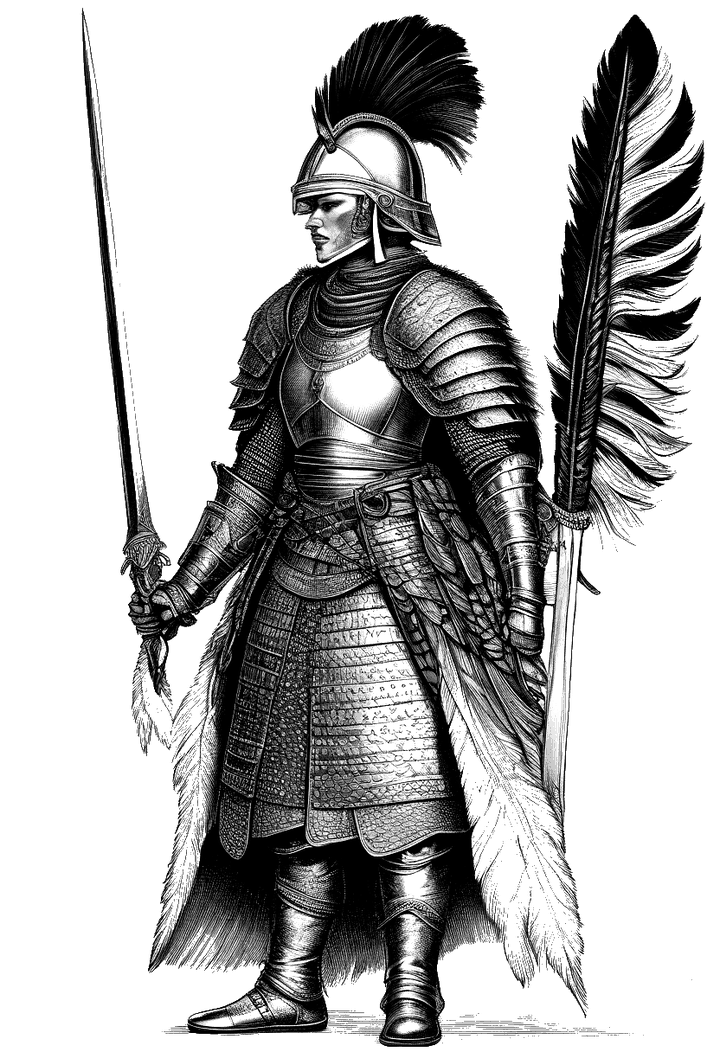
- Queen's Ride (1 Mieles), the anniversary of Dorottya's crowning, was kept this year with a parade of the Wings through Erencszasz. The order keeps the Sitting of Snow (15 Longnight) with the clans. Its own day is Feather-Fall (20 Ondaria), when the steppe eagles moult and the frames are restrung with new feathers.
- Daily life
- The Queen has sworn not to sleep under a roof, so neither do the Wings. They sleep in sheepskin beside their horses, with the feather-frames stacked round them like a fence. Breakfast is mare's-milk curd and millet, eaten standing. Each Wing rides with three horses and straps on the frame only for the charge, because it catches every wind.
- Oaths & rites
- A candidate climbs to a steppe-eagle eyrie for moulted feathers, harming no bird; a frame takes a hundred and twenty. The vow is sworn under open sky with the Queen holding the candidate's bridle. A disgraced Wing has the feathers pulled from the frame one by one before the company. The dead are laid on the steppe, their frames burned so the feathers fly, and their horses given to the poorest neighbour.
- What they say
- The order's cry is Rezlert csodorasz ún nyokzon szénykind, 'Many horses run on one road.' Balsozhian horse-archers tell each other, 'When the feathers rattle, shoot the horse.' Steppe villagers believe a feather dropped from a Wing's frame and kept under the pillow brings a son.
- History
- King Lajos Erenc raised the Wings in 788 from his eyrie-wardens, the riders who guarded the royal eagle-cliffs, and the frames were first worn to frighten horses at a Sitting of Snow. In 833 Queen Dorottya opened the order to women, and a third of the Wings are now women. Since then they have ridden wherever she rides.
- Members
- Zhóka Teneszár, a Wing from Kevecsa, was the first woman to carry the Queen's own standard and has not put it down since Thaw. Mively Csánd is the oldest lancer in the order; he rode for King Bence and disapproves of everything, including winning. Hela Vorcsány makes and mends the frames, and is short of eagle feathers.
- This year
- The Wings have taken every sound remount between Erencszasz and the Tiszaujfa hills. Real eagle feathers are running out, and some new frames carry goose-feathers dyed brown, which the old Wings call a disgrace. The Queen's riders burn the grass ahead of the invaders, and the Wings ride rearguard while they do it.
- The war
- The Wings ride wherever Dorottya rides: screening the Tent Sea, scouting the Cannon Road and drilling outside Vasvár. The charge is made for lancers, and the Balsozhian horse-archers will not stand for it. The Open Forge cannon coming down the Witfordge are the first enemy the Wings cannot frighten. Calloway gold pays their wages.
- Money & law
- A Wing is paid in steppe groats and sews them into the sleeves; a lance-horse costs 24 cr this year, double the peacetime price. A finished frame is worth about 3 cr in feathers alone. Any Wing found with feathers from a shot eagle is plucked and dismissed, and horse-thieves who steal from the order are dragged, as everywhere in Hajhia.
- Healing
- Lance splinters, falls and trampled feet are the usual wounds, and the frame-straps raise wing-gall, raw welts across the shoulders, treated with sheep's fat. Camp flux runs through the Tent Sea, and the Thetletown field hospitals boil every pot. The clan shamans ride in trance for the badly wounded and ask the Sky-Mother to wait.
Adventure seed. Mively Csánd says a Balsozhian officer is riding in a captured Wing frame, and that its feathers are from the Queen's own frame. He wants it back before Feather-Fall.
The Boilerguard · life & lore
- Feast days
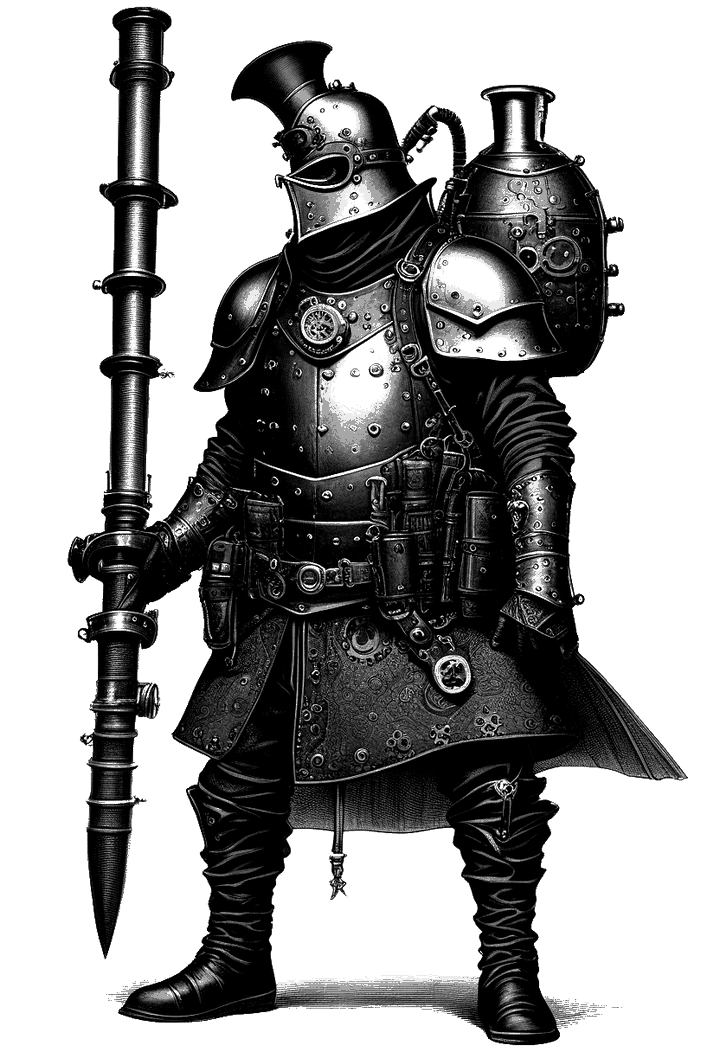
- At Sail-Dipping in Rocadones the thirty harnesses are walked down the Shrine Road to the harbour shrine on the coast and dip their vent-pipes to it. On Hearth-Sweeping, the last Ash Day, every boiler is scoured, and at New Fire it is relit from the Ridge Palace hearth. The order's own day is Firing Day (9 Uxbridmanch), when all thirty fire together on the tower-tops and every chimney in the city answers.
- Daily life
- Each knight has a Kettlekin stoker who follows with sacks of coal. Mornings are drill in harness on the tower-tops for one hour, then the long hiss of venting. Afternoons are spent in cotton, oiling pistons and practising with the hammer, unaided, which few can lift. The knights eat rice, pickled fish and a great deal of radish, and smell permanently of coal and hot oil.
- Oaths & rites
- A candidate must stand a full hour in harness on top of the First Tower without venting or stumbling, then swears Ami ri damima zu homibuka, 'I will guard the islands', on the shore. A disgraced knight has his boiler drained and walks down the tower-stair in cotton. The dead are burned and their ashes taken out to sea, and their names are stamped into the harness plate beside every earlier wearer.
- What they say
- Kamiechia dockhands have borrowed the Kettlekin proverb Ske ketti fe, tsak, 'If the kettle is silent, run', and say it of any Boilerguard whose hiss stops. Children say every name stamped in a harness wears it still. Tsuruma grandmothers call the Boilerguard 'a hearth that walks' and leave rice at a knight's feet for luck.
- History
- The first harness was made in 819, and its boiler burst on the Ridge Palace stairs and killed the man inside. The order of thirty was founded in 824, once the Lanternwrights had learnt to fit a valve that vents before it bursts. The Hoarfolk deny they sold the plate. Kushi shipwrights swear it arrived in crates marked 'stove-iron'.
- Members
- Hodoechia ke Masori, the oldest of the thirty, has worn harness for ten years and is deaf in both ears. Tamashima ke Yori, the youngest, stood her admission hour and a half and is the only knight to have lifted the hammer unaided. Kuppo Ventwhistle, the order's Kettlekin boiler-master, can tell which harness is coming up the stair by its hiss.
- This year
- In Mieles a harness vented inside the Ridge Palace and scalded a minister of the Toll Office, and the Toll Office wants the order kept out of the palace. Merland's envoy has offered for a single harness and been told, again, that none is for sale at any price. The Iron Tortoises are seen on the ridge road at night, and the knights resent sharing the honours.
- The war
- Kushi is allied to the Compact but not at war, so the Boilerguard hold the tower-tops of Kamiechia and guard the Sky-Docks. The Admiralty wants them for its strike on Tebek's isles, but a harness on a war-junk would go straight to the bottom if it went overboard. Kettlekin crews are offered double pay to fly for the Compact, and the order's stokers are being tempted.
- Money & law
- A Boilerguard is paid 3 strings of cash a month, with coal. A sack of coal runs a harness for one hour and costs 60 cash, and each knight burns about five a week in drill. Selling a harness is forbidden at any price, and touching one without leave earns a flogging. Stealing one would be punished like building a sky-ship without a charter: by death.
- Healing
- Steam scalds are the order's wound: the knight is put straight into cold seawater, then dressed by Tsuruma surgeons with crushed aloe and rice-paste, or by the Kettlekin with goose-fat and lint. Boiler-deafness comes with the years. A burst boiler takes a knight close to death, and the pistons crush the fingers of the careless.
Adventure seed. Kuppo Ventwhistle has found a second maker's mark under the paint on harness Seventeen, cut in Hoarspeech. Merland's envoy would pay a fortune to read it first.
Monster tiers
Foes are graded in five tiers, so a gamebook can pace danger: tier I in the first sections, tier IV or V at the end.
| Tier | Name | SKILL | STAMINA | Typical foes |
|---|---|---|---|---|
| I | Nuisances | 4–6 | 3–6 | Giant rats, cutpurses, wild dogs, drunk soldiers |
| II | Dangers | 6–8 | 6–10 | Wolves, brigands, swamp leeches, militia, wolverines |
| III | Terrors | 8–10 | 10–14 | Ghouls, crypt guardians, Balsozhian champions, giant spiders |
| IV | Legends | 10–12 | 14–20 | The Tiszaujfa Monster, frost-wyrms of the Hoarspine, the Hatbury sea monster |
| V | Elder | 12+ | 20+ | Guardians of Elder Crown cities, the necromancer of Winedihul, the Worm's dreams made flesh |
Creatures of Kidaneland, by region
| Creature | Tier | SKILL / STAMINA | Where | Notes |
|---|---|---|---|---|
| Kovavikian wolverine | II | 7 / 6 | Kovavikian taiga, near Hofjor | A huge migration is under way this year. They hunt in packs of 2–4. |
| Tetmik Spider (brigand) | II | 7 / 7 | Balsozhian cold desert, near Csorke | Desert brigands who wear black silk masks and strike at night. |
| Montaso Shark (bandit) | II | 8 / 8 | Hajhian steppe, near Lanellevici | Mounted bandits now taking pay from both armies. |
| Tulpio Tiger (brigand) | II | 7 / 8 | Valsiarian forest, at Kanpaa | Forest outlaws who poach elephants for ivory. |
| Marsh horror | III | 8 / 11 | Raugarian wetlands | Drags its prey under; test your LUCK or be pulled down. |
| Crypt-warden | III | 9 / 12 | The Winedihul Crypt, Ortonzania | A skeleton in Elder armour (armour rating 3). |
| Zircsifalva Lake monster | III | 9 / 14 | Zircsifalva Lake, near Raluna | About 11 feet long. Fishermen will not cast their nets. |
| The Tiszaujfa Monster | IV | 11 / 18 | Tiszaujfa hills, Hajhia, near Lenhalas | Said to eat children whole. Iron miners have seen its tracks. |
| Hatbury sea monster | IV | 10 / 20 | The waters off Laomera | Sailors claim it is 14 feet long; others say much more. It attacks the ship, not you. |
| Hoarspine frost-wyrm | IV | 12 / 18 | High passes and ice caves | Its breath freezes: lose 3 STAMINA unless you test your LUCK successfully. |
| Elder Crown guardian | V | 12 / 24 | Ruined cities: near Aroksparombek, Sugarvines and Lefka | Bronze and glass. Only tier-4 or tier-5 weapons can harm it. |
| Northern-isle ice bear | II | 8 / 10 | Blikstur, Vopeid and Hrafjor | Hunts seal-hunters as readily as seals. |
| Glass scorpion | II | 7 / 6 | The Asrahan desert | Its sting brings visions: test your LUCK or lose 1 SKILL until you rest. |
| Magenta war-elephant | III | 9 / 18 | Kahpia, Sag, Jowshia | Each round it wins, you lose 3 STAMINA. |
| Mirage-lure | III | 9 / 10 | The Glass Waste, near Zalfamaq, Jizayd and Soraidah | You fight it only if you follow it. Otherwise test your LUCK or lose a day and 2 STAMINA. |
| The Najrah Cyclops | IV | 11 / 20 | The Najrah hills, Haruwayha, near Fuluwai | Said to prefer eating children. |
| Noskirk sea monster | IV | 11 / 24 | The southwestern isles, off Lantern Cove | Sailors say it is 39 feet long. It attacks the ship. |
| Sand-drowned guardian | V | 13 / 26 | The buried gates of Bretbury | An Elder Crown guardian half sunk in the sand. Only tier-4 or tier-5 weapons can harm it. |
| Sky-pirate boarder | II | 7 / 7 | Anywhere under the sky-lanes | Drops on a rope from a pirate kite; fights at +1 in the first round. |
| Grey Wall champion | III | 9 / 16 | Kahpia, Balsozhia, Hajhia | A Rhunari mercenary in horn-plate. Charges for +2 Attack Strength in the first round. |
| Marrow-wraith | III | 9 / 12 | Deep mines and the Foleleyme gas-works | A ghost of crystallised magic. Ordinary weapons do 1 damage; marrow-salt thrown at it does 4. |
| Glassborn sentinel | V | 12 / 22 | The Gates of Bretbury; the Glassborn Waste | Armour rating 4. It will not pursue beyond the Waste. |
| A great dragon | V+ | 13–16 / 32–50 | Seven lairs | See the seven dragons. |
How the world works
Travel
| Way of travel | Miles per day |
|---|---|
| On foot, good road | 20 |
| On foot, forest, marsh or jungle | 8–10 |
| Horseback, road | 35 |
| Courier with spare horses | 70 |
| Steppe riders (Vengrian) | 50 |
| Coastal ship, fair wind | 90 |
| Hoarspine pass | 6 |
| Camel caravan, desert | 25 |
| On foot, desert | 12 |
The famous courier route, the Ride to Shifract, runs from Balsozha through Orcos and the southern rainforest to Shifract in about two months. Riders change horses in Orcos.
Crossing to Qabahrah. From the southeast coast of the Flokburgh Continent it is 553 miles of open sea to Mutsu. Then come short hops along the Chain (Mutsu to Moro 157 miles, Moro to Ichi 35, Ichi to Shimisa 43) and a final 1,093 miles to the Qabahran coast. That is about 1,900 miles of sailing, three weeks with fair winds. Nobody sails the 2,700 miles of open ocean directly.
Climate & seasons
The year has twelve months of thirty days, named for the gods and the seasons. Winter in the north is long and hard: the taiga freezes from the month of Isgard to the month of Thaw. The south has a wet season and a dry season instead of winter, and the monsoon closes the jungle tracks of Kaporesia for two months.
Glaciers on the Hoarspine are advancing. Kjelheimers say it is the Worm's breath, Merlish scholars say it is the weather, and both agree the passes are getting worse.
Hazards
| Hazard | Rule |
|---|---|
| Falling | Lose 1 STAMINA for every 10 feet fallen, to a maximum of 12. Water halves it if it is deep enough. |
| Drowning | You can hold your breath for rounds equal to your SKILL. After that, lose 2 STAMINA a round. Mail armour: test your SKILL each round or sink. |
| Cold | Each night in the open in the taiga or on the Hoarspine without furs and fire, lose 2 STAMINA. On glaciers, lose 1 SKILL until you are warm again. |
| Heat | Each day in jungle or desert in armour rated 3 or more, lose 2 STAMINA. Drink twice the water. |
| Thirst | In hot desert, a day without water costs 4 STAMINA. In the Glass Waste, test your LUCK each day or a mirage leads you astray (lose a day). |
| Darkness | Fighting in the dark: −2 Attack Strength. A lantern burns for 6 hours on a flask of oil; a torch for 1 hour. |
| Hunger | Eating a meal restores 4 STAMINA. A day without food costs 3 STAMINA. |
| Carrying | You can carry ten items plus your weapon and armour. Coins: 50 to an item slot. |
| Rest | A full night's rest in safety restores 2 STAMINA, or 4 with a meal and a bed. |
Magic
Magic is the marrow of the Worm, a cold power that seeps up through the land and pools in ruins, sacred forests and old bones. A spellcaster draws on it at the cost of their own STAMINA: 1 for a small spell (light, a lock opened, a voice thrown), 2–3 for a battle spell, and 6 or more for great workings. Magic is stronger near Elder Crown ruins (half cost) and weaker on the open sea (double cost). Cold iron blocks spells cast directly on the person carrying it, and running water breaks a ward or a curse that tries to cross it. Necromancy, raising the dead from the Worm's marrow, is a crime everywhere except, rumour says, in Winedihul.
Honour & shadow
Kidaneland keeps two separate tallies of the soul. HONOUR rises for deeds of courage, mercy and kept faith. SHADOW rises for cruelty, theft and treachery. A hero can have both: the gamebooks are interested in characters who are good at some things and bad at others. Both start at 0 and run to 12.
Gaining honour
| Sparing a beaten foe | +1 |
| Keeping an oath at a cost | +2 |
| Freeing prisoners or slaves | +2 |
| Giving away treasure to the needy | +1 |
| Facing a tier IV or V foe to save others | +3 |
Gaining shadow
| Stealing from someone who does not deserve it | +1 |
| Killing a helpless foe | +2 |
| Breaking an oath | +2 |
| Using necromancy or torture | +3 |
| Betraying a companion | +3 |
What the scores do
| Score | Effect |
|---|---|
| HONOUR 6+ | Temples heal you at half price. Knights and priests will listen. +1 when persuading the honourable. |
| HONOUR 10+ | Common folk recognise you; songs are sung. Some sections open only to a hero of renown. |
| SHADOW 4+ | Thieves' guilds will deal with you. +1 when intimidating. |
| SHADOW 8+ | Temples refuse you healing. Guards look twice. The dead begin to whisper to you at night. |
| SHADOW 12 | The Worm's marrow claims you. Your adventure ends, or you become the villain of someone else's. |
Faith changes the rules. A cleric or devout hero applies their god's own list as well (see gods & faiths). A follower of Hofjor gains honour for freeing caged animals and shadow for hiding behind walls. A follower of Varvikyryla gains shadow for losing their temper. The same deed can be holy to one character and sinful to another.
Thieves & guilds
Wherever money moves, someone takes a share. In Kidaneland money moves most in Merland, and so does theft.
| Guild or gang | Territory | Trade |
|---|---|---|
| The Quiet Hands | Shifton, Macham and Torkburgh | Forged letters of credit, burglary of counting-houses, blackmail of burgesses. Members knock twice, pause, then once. |
| The Gatemules | Ortonzanian ports | Smuggling past customs. Named for Gabingdon, to whom they pray before every run. |
| Tetmik Spiders | Balsozhian cold desert | Caravan robbery. They now raid army supply trains. |
| Montaso Sharks | Hajhian steppe | Horse theft and ransom. |
| Tulpio Tigers | Valsiarian forest | Ivory poaching and kidnapping. |
| The free captains | Off Balsozha, Bybros and Bingle | Piracy. Kaporesia taxes them; Merland hangs them. |
| The Sand Ledger | Meedihar and Saizayd | Forged Company notes, and insurance fraud: they sink empty ships and claim full cargoes. |
| Northern raiders | Off Malocsermat and Felderoy, in the Northern Isles | Raid Kovavikian and Balsozhian whalers. |
| Southern free captains | Off Wansan and Dareh, in the southwestern isles | Prey on Kushi convoys. They are said to pay the Toll of the Chain in forged Company notes. |
| The Free Balloonists | The sky-lanes, from Lantern Cove | Kettlekin sky-pirates who drop on ships from cloud cover. They take cargo and crew, but never sink a balloon: it is bad luck. |
Thief's rolls
A thief's work is a test of SKILL: roll 2 dice, and succeed if the total is equal to or less than your SKILL after modifiers.
| Action | Modifier | If you fail |
|---|---|---|
| Pick a lock | +1 with lockpicks; −2 for a Merlish bank lock | Try again after 10 minutes, or the picks break on a double six |
| Pick a pocket | −1 in a crowd of soldiers; +1 at a fair or circus | The mark notices: fight, flee or talk |
| Move silently | −1 in mail, −2 in plate | Whoever is listening hears you |
| Find a trap | +1 if you search slowly (costs a meal's worth of time) | You trigger it |
| Disarm a trap | −1 for Elder Crown traps | Roll again: a double sets it off |
| Climb a wall | +2 with a rope and grapple; −2 in rain | You fall (see falling, how the world works) |
Selling stolen goods to a fence brings a third of their value, or half if the thief is a guild member. Guild membership costs 10 crowns and a tithe of a tenth, and requires SHADOW 4 or more.
Thieves' cant
- a lantern
- a watchman
- to whisper a door
- to pick a lock
- silent coin
- a bribe
- a weeping crown
- a clipped coin
- to go to Gabingdon
- to flee through the town gates
- a burgess's dream
- a forged letter of credit
- the Worm's dinner
- a body dumped in a well or river
- talking to the camel
- lying to the authorities
Persuade & intimidate
Not every problem should be solved with a sword. When the gamebook offers a chance to talk, roll 2 dice and add the modifiers below. Succeed if the total is equal to or less than your SKILL (to persuade or deceive) or your SKILL plus SHADOW halved (to intimidate).
What each people respects
Try a roll